



Contents: Selector lever lock ↓ Selector lever positions ↓ Indication ↓ Kick-down device (hereinafter…↓ Operating Instructions for Automatic…↓ Switching modes ↓ Start of movement ↓ Stop ↓ Starting the engine by towing ↓ Transportation of a damaged vehicle ↓ Emergency mode ↓
Gear shifting in the automatic transmission gearbox can occur according to one of two schemes: sport or economical. The selection of the shift scheme is performed automatically, depending on the intensity of pressing the gas pedal.
The sports scheme is selected by quickly pressing the gas pedal (the pedal should not be pressed until the forced downshift system - "kick-down" - is activated. During "sport" switching, the engine power reserve is fully used due to a later switch to the next gear during acceleration.
When the gas pedal is pressed slowly or normally, the economy mode is selected. Economy of the engine is achieved by earlier switching to a higher gear when accelerating and later switching to a lower gear when decelerating.
Selector lever lock
The selector lever is locked in the "P" and "N" positions when the ignition is on. To move the lever out of this position, press the brake pedal and the locking button located on the lever. This device prevents unintentional movement of the car.
The purpose of the locking retarder is to prevent the lever from locking when rapidly passing through the "N" position (for example, from "R" to "D"). This allows you to "rock" a skidding car. The locking retarder is only activated if the lever is held in the "N" position for more than 1 second without pressing the brake pedal.
At speeds exceeding 5 km/h, the lock in the "N" position is automatically disengaged.
Selector lever positions
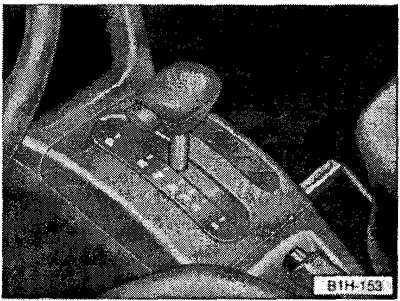
R - parking: The transmission, and along with it the drive wheels, are locked.
The lever can be set to this position only when the car is completely stopped. Before switching on and off the "P" position, press the lock button on the lever. With the ignition on, additionally press the brake pedal.
R - reverse: Reverse gear can only be engaged after the vehicle has come to a complete stop. Before setting the lever to position "R" from positions "P" or "N", press the brake pedal and the lock button on the lever. In position "R" with the ignition on, the reversing lights come on.
N - neutral position To move the lever out of the "N" position at a speed below 5 km/h, as well as when the vehicle is stationary and the ignition is on, press the brake pedal and the lock button on the lever.
D - automatic mode (movement under normal conditions): All four forward gears are automatically shifted depending on speed and engine load. Under certain circumstances, it may be preferable to temporarily set the lever to one of the positions described below.
3 - automatic mode, which automatically switches between 1st, 2nd and 3rd gears; 4th gear will not engage. Recommended for use in hilly terrain to enhance engine braking on long, gentle descents, and in other conditions where frequent shifting from 3rd to 4th gear occurs in the "D" position.
2 - automatic mode in which 1st and 2nd gears are automatically switched; 3rd and 4th gears are not engaged. Recommended for use in mountainous terrain to enhance engine braking on steep descents, as well as in other conditions when in position "D" or "3" there is frequent switching from 2nd to 3rd gear (for example, on a slippery or very dirty road).
1 - forced engagement of 1st gear; 2, 3 and 4 gears are not engaged. Recommended for very steep climbs and descents, as well as for starting off on a very slippery road, "rocking" a skidding car and other difficult conditions when further gear shifting is impractical. To set it to this position, you need to press the lock button on the lever. The constant speed device is not used in this position.
Indication
When the car is moving, the lever can be moved to positions 3, 2 and 1. The automatic device will not allow the engine to exceed maximum speed.
Kick-down device (hereinafter referred to as "kick-down")
Kick-down is used to engage a lower gear when the gas pedal is fully pressed, which ensures maximum acceleration of the car. When the gas pedal is pressed all the way, depending on the speed and engine speed, a shift to a lower gear occurs. Engaging the next (higher) the transmission occurs only after the maximum engine speed has been reached.
Operating Instructions for Automatic Transmission
Starting the engine. The engine can only be started with the lever in position "N" or "P", see also chapter "Starting the engine".
Switching modes
Before selecting the transmission operating mode, with the vehicle stationary and the engine running, always press the brake pedal.
Do not press the accelerator pedal while selecting the mode.
If the selector lever is accidentally moved to the "N" position while driving, release the accelerator and wait until the engine speed drops to idle before moving the lever to the forward position.
Caution: When the engine is running and the selector lever is set to the drive position, it is necessary to stop the car and hold it in place using the brake pedal, because even when the engine is idling, the transmitted torque is sufficient to move the car on a level surface. If the selector lever is moved to the drive position with the car stopped, under no circumstances should you press the gas pedal at this moment - in this case, the car will immediately start moving, even with the handbrake applied.
Before starting repair or adjustment work with the engine running, set the selector lever to the "P" position and apply the parking (hand) brake.
Start of movement
Select the mode, i.e. set the selector lever to one of the driving positions (R, D, 3, 2 or 1). Wait for the transmission mechanisms to engage (you will feel a slight push). After this, you can press the gas pedal - the car will immediately start moving.
Stop
When the vehicle is temporarily stopped (for example, when the traffic light is red) it is not necessary to set the lever to neutral - it is enough to stop the car with the brake pedal. The engine should be idling.
Parking
On a level road, it is enough to set the selector lever to the "P" position, thereby locking the transmission. On a road with a slope, first apply the handbrake, and then lock the transmission - this way the transmission parking dog does not receive too much load and is easier to release.
Starting the engine by towing
In cars with automatic transmission, this method of starting the engine is not possible.
If the battery is discharged, start the engine using jumper cables and an external battery (for example, another car battery - see chapter "starting the engine from an external battery".
Transportation of a damaged vehicle
If the vehicle needs to be towed, follow the instructions in the appropriate chapter.
Emergency mode
If the electronic control devices fail, the automatic transmission operates in emergency mode:
- In emergency mode, the gears may still shift automatically, but stronger jolts will be felt. In this case, contact a repair service.
- If - the gears stop shifting automatically, they can be shifted manually, and in the selector lever positions "D", "3" and "2" only 3rd gear will be engaged. In the lever positions "1" and "R", 1st gear and reverse gear work respectively, as in normal mode. In this mode, the torque converter experiences increased load (primarily due to the lack of 2nd gear) and may overheat, so contact repair service immediately.
Visitor comments