



Contents: 1 - coolant temperature/level ↓ 2 - engine oil pressure ↓ 3 - high beam headlights ↓ 4 - direction indicators ↓ 5 - brake system ↓ 6 - battery discharge ↓ 7 - Engine preheating device (for…↓ Trailer direction indicators ↓ Air cushion system ↓ Anti-lock braking system (ABS) ↓
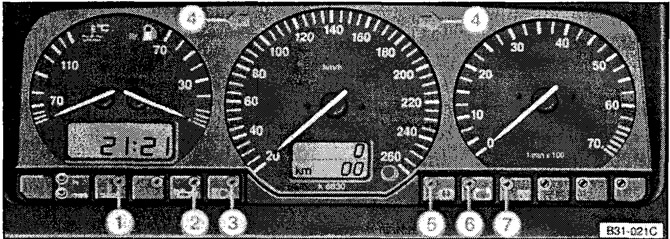
The location of the control lamps on the instrument panel depends on the model of the car and the engine. To determine the purpose of the lamps, they are always marked with the symbols shown below.
- 1 - Coolant temperature/level
- 2 - Engine oil pressure
- 3 - High beam headlights
- 4 - Direction indicators
- 5 - Brake system
- 6 - Battery discharge
- 7 - Engine preheating device
1 - coolant temperature/level
When the ignition is turned on, the indicator light flashes for a few seconds to check its functionality, then should go out.
If the light does not go out or starts to flash while driving, this means the engine is overheating or the coolant level is too low - you need to stop, turn off the engine and check the coolant level. Add fluid if necessary or eliminate the cause of overheating.
Caution: Be careful when opening the expansion tank cap! When the engine is hot, the cooling system is under pressure, and if you quickly remove the cap, the liquid may boil and splash out along with steam. Allow the engine to cool before unscrewing the cap.
Warning: Watch the radiator fan! It may turn on unexpectedly even when the ignition is off!
If the coolant level is within normal limits, engine overheating may be caused by a faulty fan. Check the fan fuse and replace if necessary.
If the warning light does not go out despite the coolant level being normal and the radiator fan being in good working order, seek professional help. Do not continue driving with an overheated engine.
If the radiator fan fails, you can continue driving until the overheating indicator lamp goes out, provided that the coolant level is normal. In this mode, you can drive to the repair site using the cooling effect of the oncoming air flow - to do this, you need to avoid driving at low speed and with a high load on the engine.
2 - engine oil pressure
When the ignition is turned on, the indicator light flashes. Immediately after the engine starts, the light should go out.
If the lamp does not go out or flashes while driving - at speeds above 2000 rpm - a signal (buzzer) sounds. In this case, stop immediately, turn off the engine, check the oil level and, if necessary, add it.
If the light blinks despite the oil level being normal, stop the engine immediately. With such a malfunction, the engine should not run even at idle speed - you must contact the repair service.
If the engine speed drops below idle speed while driving, the indicator light may also flash. In this case, increase the speed by engaging a lower gear.
Note: The control lamp does not react to the oil level in any way! The oil level should be checked regularly, ideally every week.
3 - high beam headlights
The indicator light comes on when the high beam headlights are turned on in any way.
4 - direction indicators
Depending on the direction indicators turned on (right or left), the right or left indicator light is flashing. If one of the turn signal lights is not lit, the indicator light will flash twice as fast (this does not apply to the operation of a vehicle with a trailer).
5 - brake system
The indicator light comes on when the handbrake is applied or when the brake fluid level is low (the ignition must be on).
Caution: If the light does not go out after releasing the handbrake, or lights up while driving, the brake fluid level is too low. Immediately top up the brake fluid and contact the nearest repair service to have the brake system checked. When driving, be prepared for a sudden decrease in brake efficiency and an increase in brake pedal travel.
6 - battery discharge
The indicator light comes on when the ignition is turned on. It should go out immediately after the engine starts.
If the light comes on while driving, stop, turn off the engine and check the drive belts.
If the belt is loose or broken, you cannot continue driving, because the cooling pump is also driven by the belt. Be sure to tighten or replace the belt.
If the belt is in good condition, then with a faulty charging system you can drive to a repair shop.
Note: On cars with air conditioning, the cooling pump has a separate drive, so if the alternator belt breaks, you can drive to the nearest repair shop. Remember that when the alternator is not working, the battery is constantly discharged, so be sure to turn off all unnecessary electrical devices.
7 - Engine preheating device (for diesel engines only)
When the engine is cold, the control lamp lights up when the ignition is turned on. If the lamp does not light up, there is a malfunction in the preheating system - contact the repair service.
After the light goes out, start the engine immediately.
Since preheating is automatically activated in 55 kW diesel engines after the driver's door is closed, it may happen that after the ignition is turned on the preheating indicator light does not light because the engine will already be warm by this time - in this case the engine can be started immediately.
Note: If a fault occurs in the engine management system on the 66 kW diesel engine while driving, this is indicated by a flashing control lamp - in this case, contact a repair service immediately.
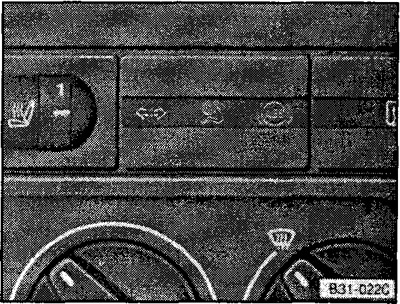
A separate display contains additional control lights, which are marked with the corresponding symbols:
Trailer direction indicators
The indicator light flashes when the trailer direction indicators are on.
Air cushion system
The indicator light comes on when the ignition is turned on for 3 seconds. If it does not go out after that, or flashes while driving, there is a malfunction in the airbag system. To check this system, contact the repair service.
Anti-lock braking system (ABS)
The control lamp lights up when the ignition is turned on for a few seconds. After the automatic self-test of the system, it goes out.
If the light does not go out or lights up while driving, there is a malfunction in the anti-lock braking system. In this case, it is still possible to stop the car, but the anti-lock function of the system will no longer work. Contact the repair service as soon as possible.
Visitor comments