



Caution: Cylinder #1 is on the right side of the engine when viewed from the direction of travel.
1. Remove the right mudguard, V-belt, crankshaft pulley and timing belt cover
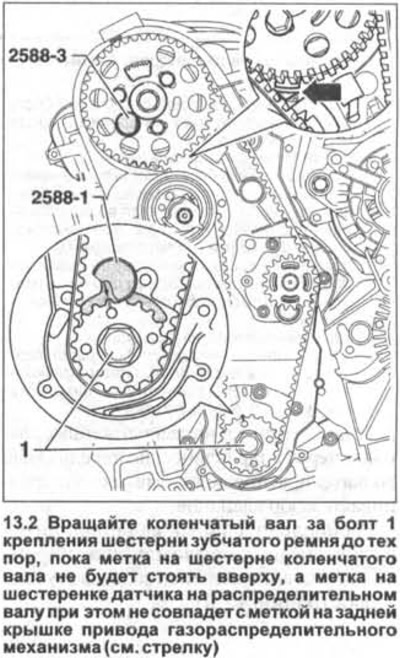
2. Rotate the crankshaft by bolt 1 of the toothed belt gear until the mark on the crankshaft gear is at the top, and the mark on the sensor gear on the camshaft coincides with the mark on the rear cover of the timing drive (see arrow in illustration).
The engine crankshaft can be turned in several ways.
- method 1. Raise the front of the car by jacking it up from the side. Engage 5th gear, tighten the night brake lever. Turn the raised front wheel. This will also cause the engine crankshaft to rotate. An assistant is needed to turn the wheel.
- method 2. Place the car on a level surface. Engage 5th gear. Push the car forward or backward.
- method 3. Set the transmission to neutral and apply the parking brake. Turn the crankshaft clockwise using the central bolt securing the belt pulley to the crankshaft.
Caution! Do not turn the engine using the pinion mounting bolt on the camshaft. This will overstress the timing belt.
3. Fix the hub of the camshaft drive gear using the ILAZET-2588-3 locking roller. To do this, insert the roller into the longitudinal hole on the gear on the left side and simultaneously into the hole on the cylinder head(see illustration 13.2).
The article is posted on the portal (vwmanual)
Note! Instead of the HAZET roller, you can use a 6 mm diameter punch.
4. Fix the toothed belt gear on the crankshaft using the special device HAZET-2588-1, putting it on the teeth of the gear from the end side so that the projection of the device enters the sealing flange (see illustration 13.2).
Attention! The marks on the crankshaft gear and on the thrust device must be located opposite each other. In this case, the projection of the device must enter the hole of the sealing flange. If the specified thrust device is not available, then mark the TDC of the piston of cylinder No.1 on the sealing flange.
Visitor comments