



Rear wheel brake mechanism is drum type
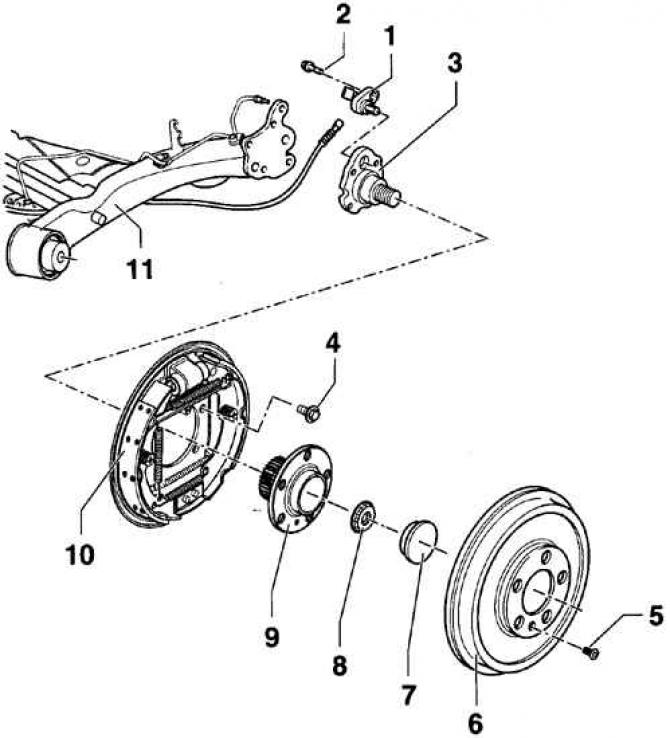
- 1 - ABS sensor;
- 2 - Allen screw, 8 Nm;
- 3 - hub journal;
- 4 - bolt, 60 Nm;
- 5 - Phillips head screw;
- 6 - brake drum;
- 7 - protective cap. When removing the brake drum, it is not necessary to remove the protective cap;
- 8 - self-locking twelve-sided nut, 175 Nm. A new nut must be used during installation;
- 9 - rear wheel hub with bearing;
- 10 - brake shield with brake pads;
- 11 - rear beam
Rear brake shoes of a drum brake of a front-wheel drive vehicle
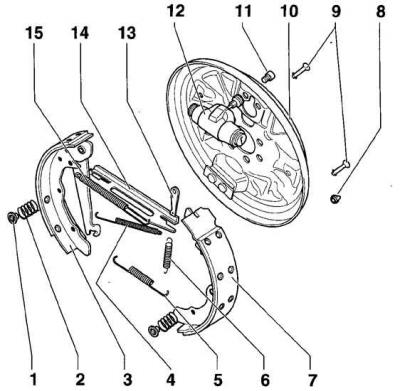
- 1 - spring plate. To remove the spring, press on the plate and turn it 90°;
- 2 - spring;
- 3 - brake shoe with handbrake drive lever;
- 4 - upper return spring;
- 5 - lower return spring;
- 6 - spring;
- 7 - brake shoe. The minimum thickness of the brake shoe lining is 2.5 mm;
- 8 - cap. After removing the cap from the brake shield, you can check the condition of the brake pads;
- 9 - expansion pin;
- 10 - brake shield;
- 11 - Allen bolt, 8 Nm;
- 12 - wheel brake cylinder;
- 13 - wedge. When removing the brake drum, the wedge must be moved upwards;
- 14 - spacer bar. When installing the spacer bar, it must be lubricated with G000650 grease;
- 15 - pressure spring
The rear drum brake has an automatic brake shoe clearance adjustment device. The expansion bar automatically changes its length and thus ensures a constant clearance between the brake drum and the brake shoes. For this purpose, a wedge with a spring, which is an extension of the expansion bar, is placed between the front shoe and the expansion bar. After pressing the brake pedal once, the required clearance is set. If the shoe travel increases due to wear, the wedge moves down under the influence of the expansion bar and the spring. Thus, the length of the expansion bar changes and the clearance of the brake shoes is automatically maintained.
Execution order
Warning: Always replace all pads on one axle, even if only one pad has reached the wear limit.
1. The thickness of the rear brake shoe linings of a drum brake can be checked without removing the brake drums. Remove the rubber cap that is installed above the handbrake cable entry on the brake shield.
2. Using a portable lamp, check the thickness of the brake shoe linings.
3. Raise the rear of the vehicle and support it on stands.
4. Remove the rear wheels and release the handbrake.
5. Remove the brake drum mounting screw.
6. Rotate the brake drum so that one of the wheel bolt holes is positioned at an angle of 45° from the vertical plane, towards the front of the vehicle.
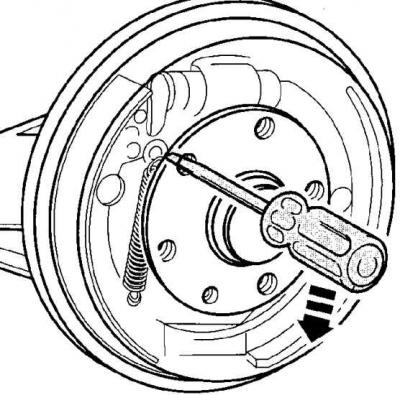
7. Release the brake pads by inserting a screwdriver through the hole and moving the wedge up.
8. Remove the brake drum. Use a universal puller if necessary.
Warning: When the brake drum is removed, do not press the brake pedal, as the pistons may come out of the wheel cylinder.
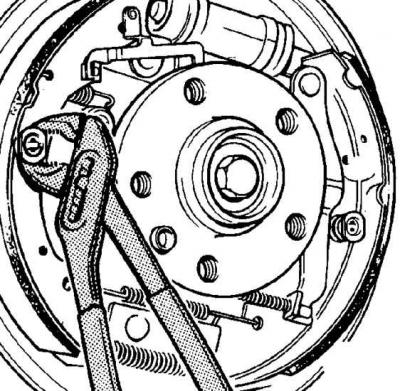
9. Press the spring cups with pliers, turn them 90° and remove them together with the springs. While turning the Czechs from the back of the brake shield, hold the pin in place.
10. Remove the cup and spring from the second brake shoe in the same manner.
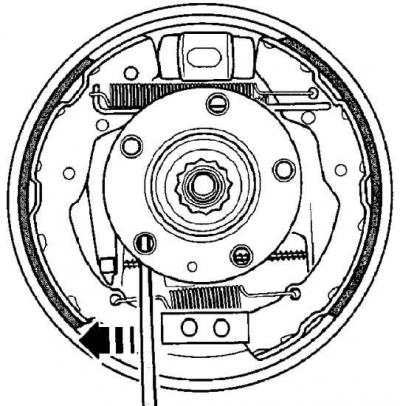
11. Using a screwdriver, remove the brake shoe from the lower support.
12. Remove the lower return spring.
13. Disconnect the handbrake cable from the brake shoe lever.
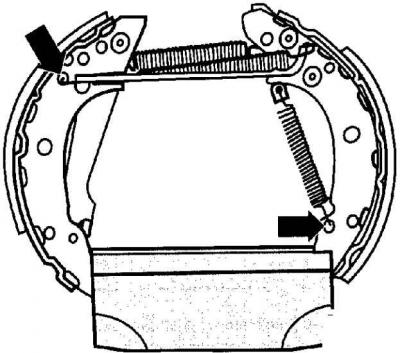
14. Remove the brake shoes and secure them in a vice. Remove the upper return spring and the wedge tension spring.
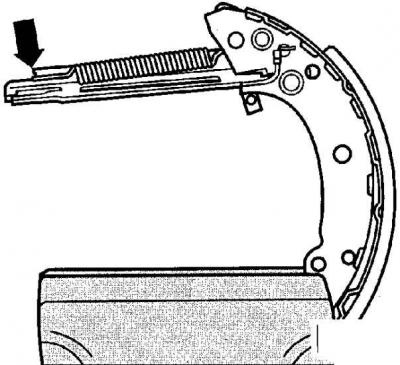
15. Disconnect the clamping spring of the expansion bar and remove the expansion bar together with the wedge (the arrow indicates the place of disconnection).
Visitor comments