



Contents: Execution order ↓ Security Control Check ↓
Execution order
Warning: Do not press the brake pedal when the brake pads are removed.
1. Clean any dust or dirt from the caliper and any rust from the edge of the brake disc. If the pads are still serviceable, clean them using a wire brush and rag.
2. Check the brake disc for cracks, especially around the wheel bolt holes, as well as for wear and mechanical damage, and replace it if necessary.
3. Measure the thickness of the brake disc.
4. Check the condition of the caliper piston dust cap and replace it if necessary.
Warning: If the brake pads are heavily worn, check the ease of movement of the caliper piston. To do this, insert a wooden block between the brake pads in the caliper and ask an assistant to press the brake pedal. When you press the brake pedal, the piston should move smoothly, compressing the brake pads. Otherwise, repair the caliper in a stationary environment.
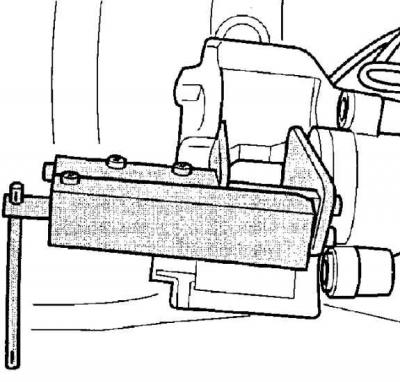
5. If new brake pads are to be installed, use a special tool to press the piston into the caliper.
6. To press the piston into the caliper, you can use a wooden rod or a hammer handle. Make sure that the piston is not warped and that the piston and dust boot surfaces are not damaged.
7. When the piston is pushed in, the brake fluid is forced out of the brake cylinder into the expansion tank, so constantly monitor the fluid level in the tank, and if necessary, pump out a small amount of it from the tank.
8. Install the brake pads into the caliper.
9. Since May 1998, the brake pad design has been changed. The back side of the inner brake pad is painted white. The outer brake pad is painted black and has a three-arm retaining clip.
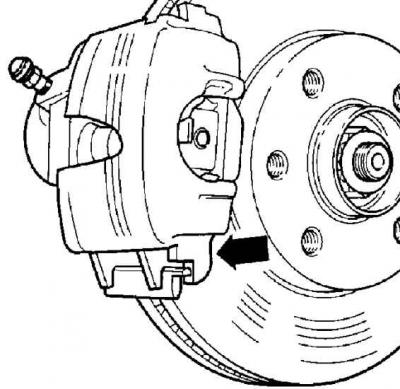
10. Install the caliper on the steering knuckle. First, install the lower part of the caliper (arrow) with the grooves on the steering knuckle guide.
11. Secure the caliper with guide bolts to the steering knuckle and tighten them to 28 Nm.
12. Install the guide bolt covers.
View the original on this portal VWmanual
13. Install the front wheels, then lower the vehicle and tighten the wheel bolts to 120 Nm.
14. Check the brake fluid level in the reservoir and top it up if necessary.
15. Press the brake pedal several times to press the brake pads against the brake disc.
Warning: Be careful to allow new brake pads to run in. To do this, at a speed of about 80 km/h, slow down several times to a speed of 40 km/h by lightly pressing the pedal. In between, allow the brake pads to cool slightly.
Warning: After installing new brake pads, avoid sudden braking during the first 200 km of vehicle travel.
Security Control Check
1. Check that the brake hoses are tightly tightened.
2. Check if the brake hose is secured in the holder.
3. Check that the bleed screws are securely tightened.
4. Check if the brake fluid level is sufficient.
5. Check with the engine running. Press the brake pedal with a force of 20–30 kg/m for about 10 seconds, but the pedal should not fall through.
6. Check the tightness of all listed connections.
Visitor comments