



Contents: ABS. Anti-lock braking system ↓ EBV. Electronic brake force…↓ EDS. Electronic differential lock ↓ ASR. Reduction of torque transmitted…↓ MSR. System preventing the locking…↓ Execution order ↓
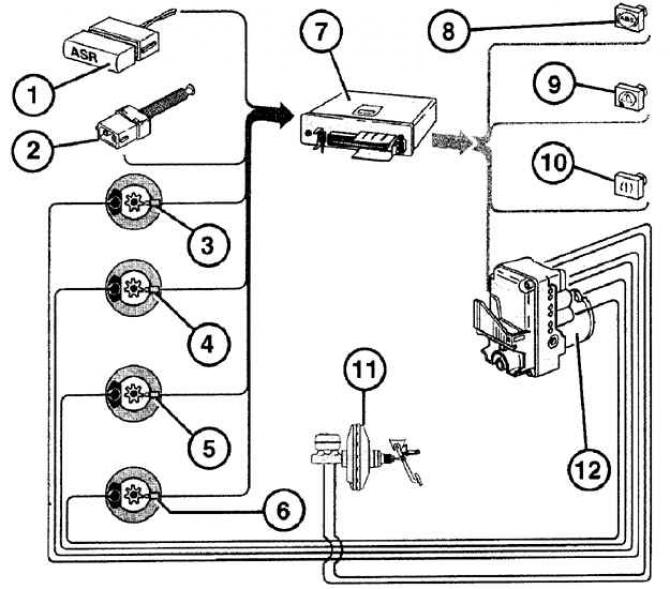
- 1 - ASR switch;
- 2 - brake light switch;
- 3 - rear left wheel speed sensor;
- 4 - rear right wheel speed sensor;
- 5 - Right front wheel speed sensor;
- 6 - Left front wheel speed sensor;
- 7 - ABS/EBV/EDS/ASR/MSR control unit;
- 8 - ABS/EDS control lamp;
- 9 - ASR/ESP control lamp;
- 10 - brake fluid level indicator lamp;
- 11 - master brake cylinder, brake booster and brake pedal;
- 12 - hydraulic block
ABS. Anti-lock braking system
Braking efficiency is greatest when the tire's grip on the road surface is at its maximum. During braking, the tire slides along the surface and the wheel's circumferential speed becomes less than the vehicle's speed.
Slip is minimal (0%) when the wheel rolls freely and maximal (100%) when the wheel is locked. Maximum braking efficiency is achieved when slip is 15%. This value also helps maintain vehicle stability and control.
The role of the anti-lock braking system is to limit the pressure generated in the hydraulic brake system so that the amount of slip is kept near the optimum value (15%). The action of this system must be immediate and separate for each wheel. The system must respond immediately to each change in the surface (coefficient of adhesion) and the load on the vehicle.
The anti-lock braking system performs the functions of power supply, brake drive and vacuum booster, as well as wheel anti-lock control. The hydraulic unit is installed instead of the serially installed vacuum booster with a built-in master brake cylinder. ABS can only be installed at the factory during vehicle production and cannot be installed additionally. The anti-lock braking system prevents the wheels from locking during abrupt braking. Due to this, the braking distance is reduced, especially with low traction with the road surface in rain and snow. The force of adhesion between the wheels and the road in this case is greater when the wheels continue to rotate during braking. In addition, even with full braking, the car remains controllable. The speed of rotation of the wheel is measured by revolution sensors, one on each wheel. Based on the signals from the wheel speed sensors, the electronic control unit calculates the average speed, approximately corresponding to the speed of the vehicle. By comparing the rotation speed of each individual wheel with the average calculated speed, the electronic unit determines the slip state of the individual wheel and thus determines which wheel is in a pre-lock state.
When one of the four speed sensors transmits a signal about the blocking of the corresponding wheel, the electronic control unit immediately sends a closing signal to the corresponding inlet solenoid valve, which immediately shuts off the supply of brake fluid through the brake pipe to the brake of this wheel - the braking force remains constant. If the slip still continues, then the outlet valve opens and the pressure in the hydraulic system of this brake decreases - the wheel is not braked (excess brake fluid returns to the reservoir). As soon as the wheel starts to rotate again, the inlet valve opens and the outlet valve closes immediately. The pressure in the circuit increases and the wheel is braked again.
This cycle of braking and free wheel rotation occurs very quickly (several times per second) and continues until the car stops or until the brake pedal is released.
This process is repeated during sharp braking separately for each wheel until the brake pedal is released or when the vehicle speed decreases to 2-3 km/h. The driver determines the operation of the ABS by the pulsation of the brake pedal.
The emergency shutdown system ensures that the ABS system is switched off in the event of any malfunction or low voltage in the vehicle's electrical network (below 10V).
The electronic control unit also performs an auto-diagnostic function, warning the driver by lighting a control lamp about the registration of a malfunction of the electrical circuits or elements of the anti-lock system. If the ABS system is faulty, the brakes are nevertheless in good condition and function as if this system is not in the car.
EBV. Electronic brake force distribution on the rear wheels
The electronic brake force distributor performs the functions of a mechanical pressure regulator, but works more precisely and has a wider adjustment range. When the car is moving in a straight line, the supply of brake fluid to the rear brakes is fully open. To ensure stable cornering with braking, the supply of brake fluid to the rear brakes is limited. Based on the signals from the wheel speed sensors of the ABS system, the EBV control unit determines when the car is moving in a turn. When the car turns, the braking force transmitted to the rear wheels is reduced, reducing the likelihood of skidding.
View the original article on the resource: VWMANUAL.ru
EDS. Electronic differential lock
As a supplement to the ABS elements, EDS reduces the transmission of engine torque under adverse driving conditions, especially on climbs and during acceleration of the vehicle, eliminating slippage of one of the drive wheels. Thanks to the mechanical differential lock, the transmission of torque is improved, since the side with a higher friction coefficient can transmit more torque.
The electronic control unit receives information from the ABS sensors about the rotation speed of the drive wheels and constantly compares them. If there is a difference in the speed of more than approximately 110 rpm, the EDS is switched on automatically and reduces the torque transmission to the slipping wheel until it has approximately the same speed as the non-slipping wheels. Thanks to this control, it is achieved that increased torque is transmitted to the wheel with better grip conditions. The EDS is automatically switched off at vehicle speeds above 40 km/h, as well as when cornering and when the brakes overheat.
ASR. Reduction of torque transmitted to the drive wheels
Reducing the torque when both drive wheels slip is accomplished by reducing engine power. In this case, engine power is limited so that only the torque required to move the vehicle is transmitted.
The ASR system should always be switched on. Only in certain exceptional cases, when wheel slip is desired, is it preferable to switch the system off.
MSR. System preventing the locking of the drive wheels
The MSR system is installed on vehicles with TDI diesel engines and prevents the drive wheels from locking on a slippery road if the driver suddenly releases the accelerator pedal. In this case, the ABS sensor sends a signal to the engine control unit and it briefly increases the engine speed, as a result of which the wheels begin to rotate without locking and the car remains normally controlled.
If there is a malfunction, the electronic control system is automatically switched off, and the control lamps on the instrument cluster light up. In this case, the brake system operates in normal mode.
If the ABS and EBV warning lights come on while driving, be aware that the rear wheels may lock up under heavy braking.
If one or more indicator lights come on while driving, this indicates that the system is switched off. In this case, you must perform the following actions.
Execution order
1. Stop the car, turn off and start the engine.
2. Check the battery voltage. If it is below 10.5V, charge the battery.
Warning: If the ABS warning light comes on at the start of a ride and then goes out, this indicates that the voltage was within the acceptable limit for ABS operation, but then increased as a result of the alternator operation.
3. Check the condition of the battery terminals.
4. Raise the vehicle, remove the wheels and check the wheel speed sensor wiring for proper operation.
5. If the fault is not corrected, further inspection must be carried out at a service station.
Visitor comments