



Contents: Execution order ↓ Security Control Check ↓
Execution order
Warning: Always replace all pads on one axle of the vehicle, even if one pad has reached the wear limit. If the pads are to be reinstalled, they must be marked before removal.
1. Clean the brake drum, brake shoes and brake shield.
Warning: When brake pads are in operation, brake dust is generated which contains asbestos which is harmful to health, so do not use compressed air or inhale the dust when cleaning brake pads.
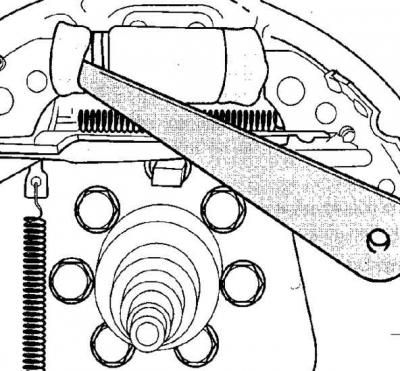
2. Remove the seal from the wheel cylinder and if it is wet, it must be repaired or replaced. When removing the seal, do not remove the piston from the wheel cylinder.
The article is posted on this website www.vwmanual.ru
3. Measure the inside diameter of the brake drum. If the drum wear has reached the limit, replace both rear brake drums.
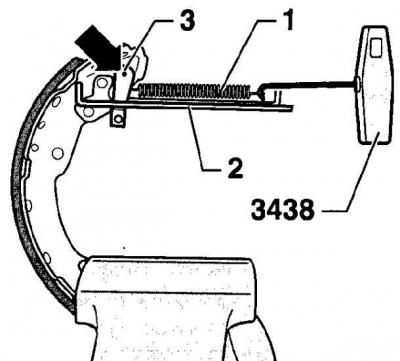
4. Secure the brake shoe in a vice, install the tension spring (1) on the expansion bar (2) and the front brake shoe and place the expansion bar on the brake shoe (3 – wedge, 3438 – device for installing the tension spring).
5. Install the brake shoe with the handbrake lever into the expansion bar.
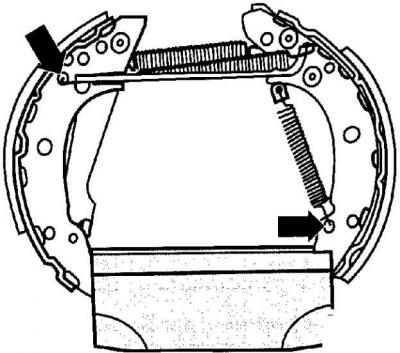
6. Install the upper return spring.
7. Install the wedge tension spring.
8. Connect the handbrake cable to the handbrake lever on the brake shoe.
9. Install the top of the brake shoes into the grooves on the pistons of the working brake cylinder.
10. Install the lower return spring onto the brake shoes, then install the lower part of the shoes onto the shoe support.
11. Install the retaining pins, pressure springs and cups.
12. Press down on the cup while holding the retaining pins on the back of the brake shield and rotate the cup 90° until it locks firmly into place.
13. Move the wedge up to create maximum brake shoe clearance.
14. Install the brake drum onto the hub and secure it with the screw.
15. Press the brake pedal once to set the required brake pad clearance.
16. Adjust the handbrake cables.
17. Install the wheels and lower the vehicle.
18. Repeat these operations on the second rear wheel.
Security Control Check
1. Check that the brake hoses are tightly tightened.
2. Check if the brake hose is secured in the holder.
3. Check that the bleed screws are securely tightened.
4. Check if the brake fluid level is sufficient.
5. Check with the engine running. Press the brake pedal with a force of 20–30 kg/m for about 10 seconds, but the pedal should not fall through.
6. Check the tightness of all listed connections.
Visitor comments