
English Русский
Български
Беларускі
Український
Српски
Hrvatski
Română
Polski
Slovenský
Magyar
  |  Articles  |  Sitemap  |  Contacts  |    |
Car maintenance Ford Car maintenance Hyundai Car maintenance Chevrolet Car maintenance BMW Car maintenance Audi Car maintenance Opel Car maintenance AvtoVAZ
VWmanual.ru


Main   Passat   Golf   Polo   Touareg   Tiguan   Sharan   Transporter   Others  
Passat B2 (1981-1988) Passat B3 (1988-1993) Passat B4 (1988-1996) Passat B5 (1996-2005) Passat B6 (2005-2010)

Removal and installation front disc brake pads VW II (VW Passat B3)

  • Main
  • Passat
  • Passat B3
  • Chassis
  • Brake system
  • Removal and installation front disc brake pads VW II
            0


Contents: Removal ↓ Installation ↓

Removal


Loosen the wheel bolts, lift the car from the front, and remove the wheels.

Caution: If the brake pads are to be re-installed, their location must be marked before removal. Swapping the pads, for example, swapping the outer pad with the inner pad or moving the pad from the right wheel to the left wheel and vice versa, is not allowed. Changing the location of the pads may result in uneven braking action. It is recommended to use only genuine VW/AUDI brake pads. The front brake pads must be replaced as a set, even if only one pad has reached the wear limit.

Caution: If the brake pads are to be re-installed, their location must be marked before removal.…


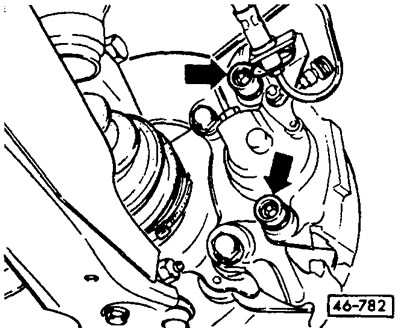
Use a SW13 ring spanner to loosen the mounting bolts.

Note: The bolts are self-locking, so a relatively high torque must be applied to release them. Pay attention to the different lengths of the bolts and put them back in their original places when installing.

Note: The bolts are self-locking, so a relatively high torque must be applied to release them. Pay…


Remove the brake hose holder from the wheel hub bearing housing.


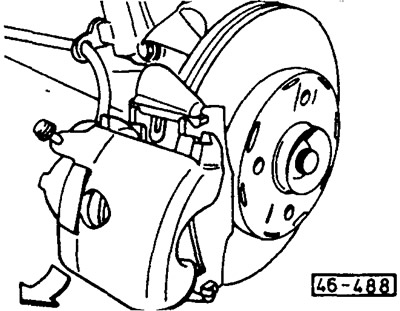
Move the caliper away from the brake shield at the bottom (arrow) and remove it.

Hang the caliper on a wire to the body.

Note: The support should not just hang down; the brake hose must not be stretched or twisted.


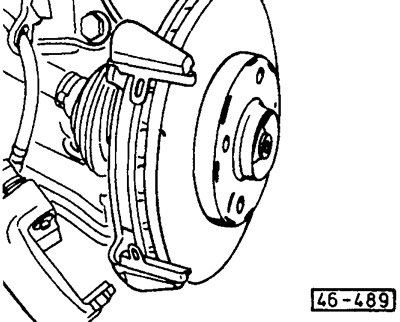
Pull the brake pads out of the brake shield guides.

Remove the brake pad retaining springs.

Installation


Caution: When the brake pads are removed, do not depress the brake pedal, otherwise the piston will be pushed out of the caliper body.


Clean the guide surfaces or lining areas of the pads with a suitable soft metal brush or wipe with a cloth soaked in alcohol. Do not use solutions containing mineral oils or tools with sharp edges.

Before installing the pads, examine the brake discs with your fingers to check for nicks. Discs with nicks can be ground down (workshop work), depending on whether they are thick enough.

Measure the thickness of the brake discs, see below.

Check the dust caps for cracks. Replace damaged caps immediately, as penetrating dirt will quickly damage the caliper seal. In this case, the caliper must be removed and disassembled (workshop work).

The brake cylinder piston is pushed back into the cylinder using a return device. A hardwood rod can also be used for this purpose (with a hammer handle), however, special attention must be paid to the piston not being skewed and to the piston surfaces and dust cap not being damaged. To facilitate installation, first insert the inner brake pad and attach the caliper. Instead of the outer brake pad, insert the tire iron and press the caliper outwards, while alternately attaching the tire iron from above and below. This will press the piston of the wheel brake cylinder into the caliper. Rest the tire iron on the brake disc in the area of the brake shield.


Note: To avoid damaging the brake disc, be sure to place a wooden lining underneath.


Attention: When installing the piston into the cylinder, the brake fluid from the brake cylinder is squeezed into the expansion tank. Monitor the fluid level in the tank and, if necessary, suck out excess fluid with a siphon. To suck out, use a bottle that was used to remove air from the hydraulic system, or a plastic bottle that has previously only come into contact with brake fluid. Do not use bottles intended for drinking liquids! Brake fluid is poisonous and should never be sucked out by mouth through a hose. After replacing the brake linings, the brake fluid level in the expansion tank should also not exceed the "Max" mark, since the fluid expands when heated. Brake fluid flowing out of the tank gets under the master brake cylinder, destroys the varnish coating and leads to corrosion.


Note: If the brake linings are heavily worn, check the ease of movement of the piston. To do this, insert a wooden block into the caliper and ask an assistant to slowly press the brake pedal. The brake cylinder piston should be easily pressed out and back in. During the check, another caliper should be installed in its place. Make sure that the piston is not pressed out completely. If the piston is difficult to move, the caliper must be repaired (workshop work).

Note: If the brake linings are heavily worn, check the ease of movement of the piston. To do this,…


The brake pad retaining springs must be replaced. New retaining springs are usually supplied with the brake pads. Insert the retaining springs so that the shorter part faces inward.

Insert the lower retaining spring into the brake shield. Attach the upper spring and insert the inner brake pad into the brake shield from the side above the retaining springs. The inner brake pad has a reduced working surface.
Insert the lower retaining spring into the brake shield. Attach the upper spring and insert the…


Insert the outer brake lining into the brake shield.

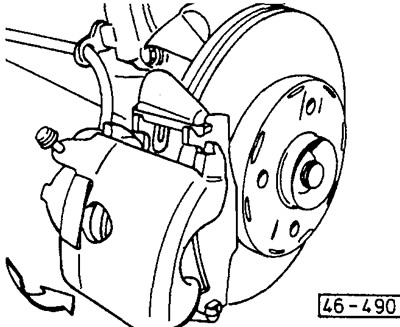
Place the brake shield on top of the caliper and push it down from below.

Caution: Press the caliper against the brake shield so far that the mounting bolts can be inserted. If the caliper is over-tightened during this operation, the springs holding the brake pads may become deformed. This may cause noise when braking.


Treat the mounting bolts with a product to prevent them from loosening, insert them and tighten them to 25 Nm. The longer bolt is usually inserted from above.

Attach the brake hose holder to the wheel hub bearing housing.

Tighten the wheel. Lower the car and tighten the wheel bolts crosswise to 110 Nm.

Caution: Press the brake pedal firmly several times until you feel a strong resistance. This will center the brake pads and position them according to the operating conditions.


Check the brake fluid level in the expansion tank and, if necessary, top up the tank to the "MAX" mark.

New brake pads should be carefully worked in by repeatedly braking the car from a speed of 80 km/h to 40 km/h by lightly pressing the brake pedal. Allow the brakes to cool between braking operations.

Caution: On a section of the road up to 200 km long, braking to a complete stop must not be undertaken.

This article is available at russian, bulgarian, belarusian, ukrainian, serbian, croatian, romanian, polish, slovak, hungarian
The text has been checked: Medvedeva Elena

Share information:

Previous articles
Front Brake Caliper VW II (vehicle models up to 9/93)
General information about the braking system
Next articles
Girling Front Brake Caliper
Removal and installation Girling front disc brake pads
Front brake caliper Ate/Teves (cars with engines of 150, 174 hp from 10/93)
Removal and installation front disc brake pads Ate/Teves
Girling Rear Brake Caliper
Removal and installation rear disc brake pads


Similar articles from other manuals for VW cars:
Front Disc Brake Pads — Removal and Installation Golf 5 (2003-2008)
Removal and installation front brake pads on POLO vehicles Polo 4 (2001-2009)
Adjusting brake pads on two wheels Touareg 1 (2002-2006)
Removal and installation front brake pads FN 3 Tiguan 1 (2007-2015)
Checking the thickness of the front brake pads Sharan 1 (1995-2000)
Front disc brake pads (14-inch wheels) Transporter T4 (1990-2003)
Checking the thickness of disc brake pads Caddy 3 (2003-2010)
Link to this page in different formats


Visitor comments


No comments yet


How much will 48 + 25 =


Passat B6 
  • General information
  • User manual
  • Maintenance
  • Petrol engine 1.6L
  • Engine repair
  • Cooling and lubrication system
  • Fuel injection system
  • Petrol engine 2.0L
  • Engine repair
  • Lubrication system
  • Cooling system
  • Fuel and exhaust systems
  • Diesel engine 2.0L
  • Engine repair
  • Cooling and lubrication system
  • Fuel and exhaust systems
  • Transmission
  • Clutch
  • Mechanical gearbox
  • Automatic gearbox
  • Drive shafts
  • Chassis
  • Wheels and tires
  • Car suspension
  • Steering
  • Brake system
  • Body
  • Exterior (external elements)
  • Electrical equipment
  • Power devices
  • Lighting and appliances
  • Electrical circuits
Passat B5 
  • General information
  • User manual
  • Weekly checks
  • Maintenance
  • Power unit
  • Engine repair
  • Cooling system
  • Fuel system (petrol)
  • Fuel system (diesel)
  • Engine management
  • Exhaust system
  • Transmission
  • Clutch
  • Car gearbox
  • Drive shafts
  • Chassis
  • Car suspension
  • Wheels and tires
  • Steering
  • Brake system
  • Body
  • Exterior (external elements)
  • Interior (internal elements)
  • Doors and covers
  • Ventilation and heating
  • Electrical equipment
  • Power devices
  • Lighting and appliances
  • Electrical circuits
Passat B4 
  • General information
  • User manual
  • Maintenance
  • Technical data
  • 8-valve engine
  • Engine repair
  • Cooling and lubrication system
  • Supply system
  • Ignition system
  • Fuel injection «Mono-Jetronic»
  • Control system «Mono-Motronic»
  • Control system «Digifant»
  • Control system «Simos»
  • 16-valve engine
  • Engine repair
  • Cooling and lubrication system
  • Fuel injection «K-Jetronic»
  • Control system «KE-Motronic»
  • Control system «Digifant»
  • Diesel engine
  • Engine repair
  • Cooling and lubrication system
  • Power and control system
  • Turbocharging system
  • Digital control system
  • Transmission
  • Clutch
  • Manual gearbox
  • Hydromechanical gearbox
  • Front wheel drive
  • Chassis
  • Car suspension
  • Steering
  • Brake system
  • Body
  • Body elements
  • Electrical equipment
  • Power devices
  • Lighting and appliances
  • Electrical circuits
Passat B3 
  • General information
  • User manual
  • Driving Tips
  • Maintenance instructions
  • Technical data
  • Power unit
  • Engine repair
  • Ignition system
  • Lubrication system
  • Cooling system
  • Supply system
  • Petrol injection system
  • Diesel engine
  • Exhaust system
  • Transmission
  • Clutch
  • Car gearbox
  • Chassis
  • Suspension
  • Steering
  • Brake system
  • Wheels and tires
  • Body
  • Exterior
  • Interior
  • Heating system
  • Electrical equipment
  • Power devices
  • Lighting system
  • Equipment and devices
  • Wiper system
  • Electrical circuits
Passat B2 
  • General information
  • Introduction to instructions
  • User manual
  • Power unit
  • Engines 4-cylinder FZ
  • Engines 4-cylinder
  • Engines 5-cylinder
  • Transmission
  • Clutch
  • Four-speed gearbox
  • Five-speed gearbox
  • Hydromechanical gearbox
  • Front wheel drive
  • Chassis
  • Front suspension
  • Rear suspension
  • Steering
  • Brake system
  • Body
  • Body elements
  • Electrical equipment
  • Equipment and devices
  • Electrical circuits
VWmanual.ru © 2016-2026 | Mobile version | News and articles | Sitemap: EN BG BY UA RS HR RO PL SK HU | Write message | Site search
Passat B2 • Passat B3 • Passat B4 • Passat B5 • Passat B6 • Golf 1, diesel • Golf 1, petrol • Golf 2, petrol • Golf 2 • Golf 3 • Golf 4 • Golf 5 • Polo 3 • Polo 4 • Touareg 1 • Tiguan 1 • Sharan 1 • Transporter T3 • Transporter T4 • LT 28 • LT 2D • Beetle • Caddy 3 •
Our website uses cookies to ensure functionality and convenience.