
English Русский
Български
Беларускі
Український
Српски
Hrvatski
Română
Polski
Slovenský
Magyar
  |  Articles  |  Sitemap  |  Contacts  |    |
Car maintenance Ford Car maintenance Hyundai Car maintenance Chevrolet Car maintenance BMW Car maintenance Audi Car maintenance Opel Car maintenance AvtoVAZ
VWmanual.ru


Main   Passat   Golf   Polo   Touareg   Tiguan   Sharan   Transporter   Others  
Golf 1 (1974-1984, diesel) Golf 1 (1974-1984, petrol) Golf 2 (1984-1993, petrol) Golf 2 (1984-1993) Golf 3 (1991-1997) Golf 4 (1997-2004) Golf 5 (2003-2008)

Bleeding the brake system (VW Golf 2)

  • Main
  • Golf
  • Golf 2
  • Chassis
  • Brake system
  • Bleeding the brake system
            0


1. Two people are needed to bleed the system. One of them presses the brake pedal, and the other unscrews and screws the air bleeder.

2. Air removal should begin from the farthest wheel and end with the closest one from the brake cylinder. The order of air removal is as follows:

a) rear right wheel.
b) rear left wheel,
c) front right wheel,
d) front left wheel.

3. It is necessary to systematically check the level of brake fluid in the reservoir to prevent air from entering the cylinder, since in this case, air removal will have to be started from the beginning.

4. Unscrew the air bleeder at the beginning of the pedal stroke and screw it in at the end of the fluid flow from the air bleeder to prevent the air bleeder from sucking in air.

5. To remove air from the brakes, you must:

a) Press the brake pedal several times and hold it down.

b) At this point, the second person turns the air bleeder so that the liquid begins to flow out.

c) Without waiting for the liquid to completely stop flowing, screw in the air bleeder. You need to have time to screw in the air bleeder before air can penetrate through the thread of the air bleeder into the cylinder.

d) The brake pedal must be held down and not released until there is a signal that the air bleeder is fully depressed. Only then is it permitted to lift (release) the pedal. If necessary, do the same for the other wheels according to the order given above.

d) Repeat this operation several times until the fluid stops flowing out along with the air bubbles and the brake pedal becomes high and hard. When pressed, the pedal should constantly remain at the same height.


e) If after the first press the pedal falls low, and then its stroke is reduced and it becomes springy, this indicates the presence of air in the system. In this case, it is necessary to repeat the air removal operation.

e) After air removal is complete, it is necessary to add liquid to the tank to the required level.

g) Each air bleeder must have a protective cap. This is very important to prevent corrosion of the air bleeder, which reduces the risk of the air bleeder coming off when unscrewing

Note: The fluid that leaked out during air removal must not be poured into the tank, as it is contaminated and often diluted with water. The manufacturer recommends replacing the fluid in the system every two years (after winter).

To fill the system, use only the liquid recommended by the manufacturer. Brake fluid is poisonous, caustic and hygroscopic.

Another way to avoid air being sucked in through the air bleeder is to attach a small, tightly fitting hose to the air bleeder and immerse the other end in a container of liquid that is raised 300 mm above the air bleeder. This method is not effective in a situation where air is being bled from the entire brake system.


6. Remove the cable with metal protection from the grips (holders), securing it to the body, and slide it out from under the car (photo 8.35).
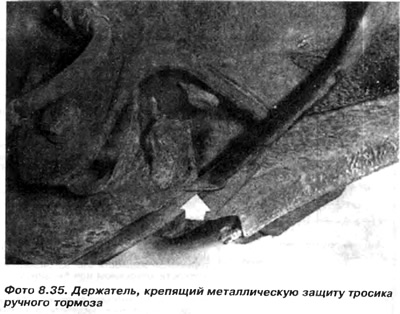
6. Remove the cable with metal protection from the grips (holders), securing it to the body, and…


Installation


7. Installation is carried out in the reverse order of dismantling.


8. The clearance of the handbrake lever is adjusted depending on whether the brakes are disc or drum.

a) Drum brakes - with the handbrake fully released, press hard on the main brake pedal and tighten the handbrake lever two clicks. Tighten the adjusting nut so that the rear wheel resistance during rotation is noticeable. Fully lower the handbrake lever, then check whether the wheel rotates freely. If the wheel rotates freely, lock the adjusting nut with the lock nut. Then tighten the handbrake lever and check whether the wheel is locked. Repeat the same operation for the second cable.

b) Disc brakes — before adjusting the handbrake cables, check the gap between the outer shoe and the clamp. Release the handbrake lever completely, then tighten the cable adjustment nut to the position where the lever on the clamp stops touching the buffer it rests on. The gap between the lever and the buffer should not exceed 1 mm. Then tighten the lock nut and check whether the wheel rotates without friction when the handbrake lever is released, and is locked when it is tightened.

Repeat the same operation for the second cable.

This article is available at russian, bulgarian, belarusian, ukrainian, serbian, croatian, romanian, polish, slovak, hungarian
The text has been checked: Semenova Anna

Share information:

Previous articles
Rear drum brakes
Rear brake disc
Rear wheel brake calipers
Front brake disc
Front wheel brake calipers
Brake force corrector
Next articles
Handbrake lever
Brake system fault table


Similar articles from other manuals for VW cars:
Bleeding the brake system Passat B3 (1988-1993)
Bleeding the brake system Polo 4 (2001-2009)
Bleeding the brake system Touareg 1 (2002-2006)
General information about the brake system Tiguan 1 (2007-2015)
Bleeding the brake hydraulic system Sharan 1 (1995-2000)
Bleeding the brake system Transporter T4 (1990-2003)
Bleeding the brake system Beetle (1960-1986)
Link to this page in different formats


Visitor comments


No comments yet


How much will 49 + 21 =


Golf 5 
  • General information
  • User manual
  • Maintenance
  • Troubleshooting
  • Power unit
  • Engine repair
  • Cooling and ventilation system
  • Fuel system
  • Ignition system
  • Transmission
  • Clutch
  • Mechanical gearbox
  • Automatic gearbox
  • Chassis
  • Brake system
  • Car suspension
  • Steering
  • Body
  • Interior (internal elements)
  • Exterior (external elements)
  • Doors and covers
  • Electrical equipment
  • Power devices
  • Washers and wipers
  • Lighting and appliances
  • Electrical circuits
Golf 4 
  • General information
  • User manual
  • Weekly checks
  • Maintenance
  • Power unit
  • Petrol engines
  • Diesel engines
  • Cooling system
  • Fuel system (petrol)
  • Control system (petrol)
  • Fuel system (diesel)
  • Exhaust system
  • Transmission
  • Clutch
  • Car gearbox
  • Drive shafts
  • Chassis
  • Car suspension
  • Steering
  • Wheels and tires
  • Brake system
  • Body
  • Exterior (external elements)
  • Interior (internal elements)
  • Ventilation and heating
  • Car doors and sunroof
  • Washers and glass cleaners
  • Electrical equipment
  • Power devices
  • Lighting and appliances
  • Electrical circuits
Golf 3 
  • Petrol engine
  • Engine repair
  • Lubrication system
  • Cooling system
  • Ignition system
  • Diesel engine
  • Engine repair
  • Diesel injection system
  • Pre-glow system
  • Transmission
  • Clutch
  • Gearbox and drive shafts
  • Chassis
  • Steering
  • Wheels and suspension
  • Brake system
  • Electrical equipment
  • Lighting and appliances
  • Electrical circuits
Golf 2 
  • General information
  • Introduction to guide
  • User manual
  • Petrol engines 1.3 l
  • Engine repair
  • Lubrication system
  • Cooling system
  • Carburetors
  • Supply system
  • Ignition system
  • Petrol engines 1.6/1.8 l
  • Engine repair
  • Supply system
  • Ignition system
  • Diesel engines
  • Engine repair
  • Lubrication system
  • Cooling system
  • Power and exhaust system
  • Transmission
  • Clutch
  • 4-speed gearbox 084
  • 5-speed gearbox 085
  • 4-speed gearbox 020/4R
  • 5-speed gearbox 020/4T
  • Automatic gearbox
  • Drive shafts
  • Chassis
  • Steering
  • Car suspension
  • Brake system
  • Body
  • Body elements
  • Doors, locks and windows
  • Electrical equipment
  • Equipment and devices
  • Power devices
Golf 2 (petrol) 
  • General information
  • Characteristics
  • Car care
  • Maintenance
  • Power unit
  • Engine repair
  • Engine 1.05/1.30
  • Engine 1.60/1.80
  • Cooling and lubrication system
  • Power and exhaust system
  • Transmission
  • Clutch
  • Car gearbox
  • Drive shafts
  • Chassis
  • Brake system
  • Steering
  • Suspension
  • Body
  • Body and equipment
  • Electrical equipment
  • Lighting and appliances
  • Electrical circuits
Golf 1 (petrol) 
  • General information
  • Characteristics
  • User manual
  • Maintenance
  • Power unit
  • Engine adjustment
  • Engine 1.1/1.3
  • Engine 1.5/1.6/1.8
  • Engine electrical equipment
  • Cooling system
  • Fuel system
  • Transmission
  • Clutch and manual gearbox
  • Automatic gearbox
  • Chassis
  • Steering
  • Front suspension
  • Rear suspension
  • Brake system
  • Electrical equipment
  • Lighting and appliances
  • Electrical circuits
  • Body
  • Body and equipment
  • Optional equipment
Golf 1 (diesel) 
  • General information
  • Specifications
  • Maintenance
  • Power unit
  • Engine repair
  • Exhaust and turbocharger
  • Cooling system
  • Fuel system
  • Fuel injection system
  • Transmission
  • Clutch and drive shafts
  • Car gearbox
  • Chassis
  • Suspension and wheels
  • Steering
  • Brake system
  • Wheels and tires
  • Body
  • Heating and ventilation
  • Exterior (external elements)
  • Interior (internal elements)
  • Doors and windows
  • Electrical equipment
  • Equipment and devices
  • Lighting system
  • Power devices
  • Electrical circuits
VWmanual.ru © 2016-2026 | Mobile version | News and articles | Sitemap: EN BG BY UA RS HR RO PL SK HU | Write message | Site search
Passat B2 • Passat B3 • Passat B4 • Passat B5 • Passat B6 • Golf 1, diesel • Golf 1, petrol • Golf 2, petrol • Golf 2 • Golf 3 • Golf 4 • Golf 5 • Polo 3 • Polo 4 • Touareg 1 • Tiguan 1 • Sharan 1 • Transporter T3 • Transporter T4 • LT 28 • LT 2D • Beetle • Caddy 3 •
Our website uses cookies to ensure functionality and convenience.