



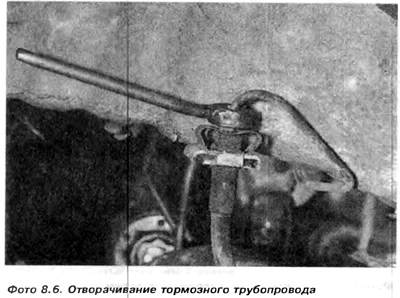
2. To remove the rigid brake line, you must:
a) Seal the tank by inserting a piece of foil under the plug.
b) Clean the connections and unscrew the connection nuts at both ends, preferably using a wrench with a notch equal in width to the diameter of the brake pipe (photo 8.2).
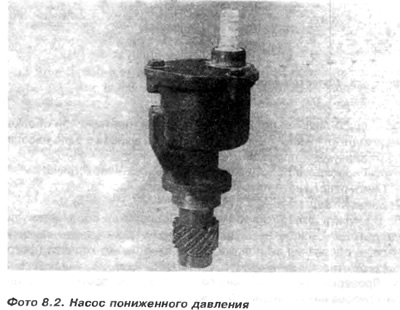
Installation is carried out in the reverse order of dismantling.
3. To remove the elastic pipeline, it is necessary:
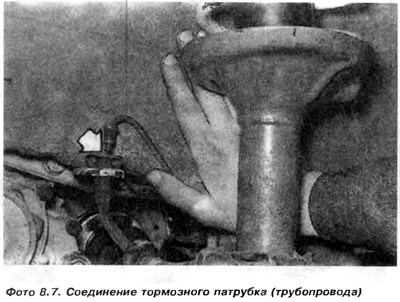
a) Unscrew the connection nut that secures the rigid pipeline to the flexible one, and remove the pipeline from the socket. Put a rubber cap, removed, for example, from the brake caliper air bleeder, on the end of the rigid pipeline (photo 8.7).
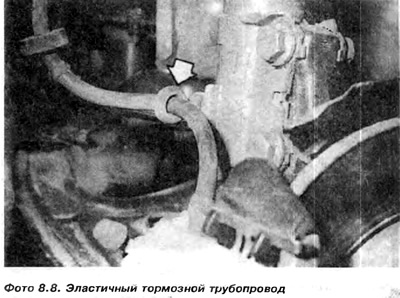
c) Remove the spring guard securing the end of the elastic pipeline to the bracket. Unscrew the other end of the pipeline from the working part. Remove the rubber bracket of the pipeline from the hook of the return mechanism (photo 8.8).
4. If difficulties arise when unscrewing the coupling nut from the flexible pipe socket, it is necessary to cover the coupling with a penetrating agent, and if this does not help, cut off the rigid pipe near the nut, install an Allen key and try again. In this case, the nut will either unscrew or its protruding part will break off from the flexible pipe socket. Therefore, it is necessary to act carefully so as not to damage the nut connections during previous attempts.
It is not recommended to drill out the nut. Any loosening of the thread or scratches on the sealing surface in the socket create a risk of leakage or tearing out the nut of the rigid pipeline from the socket. In this case, it is better to replace the pipeline with a new one.
5. After removing the rigid and elastic pipes, it is necessary to remove air from the brake system.
6. Finally, you should check the tightness of the twisted connections. To do this, you will need the help of another person who will press hard on the brake pedal during the inspection. If there are no leaks, the connection can be considered tight.
Visitor comments