



The second important parameter is the so-called disc runout. The runout of the friction surfaces of the disc is measured using a clock sensor. If any parameter does not correspond to the permissible values, the disc must be replaced.
When the disc is thick enough, but only scratched or its runout slightly exceeds the permissible value, it can be sanded.
To remove the disk you need to:
1. Perform the actions described in paragraphs 10.1-10.5.
2. Loosen the bolts and remove the clamp bracket.
3. Using a screwdriver, remove the hub cap 6 (figure 8.9).
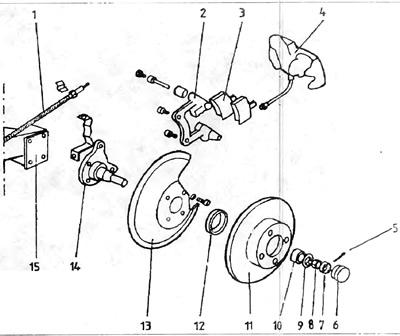
Figure 8.9. Rear disc brake
1 - handbrake cable; 2 - clamp bracket; 3 - brake pads; 4 brake clamp; 5 - check; 6 - hub cap; 7 - crown protection; 8 - hub journal nut; 9 - washer; 10 - bearing; 11 - brake disc; 12 - seal housing; 13 - brake disc casing; 14 - hub axle; 15 - rear axle beam.
4. Remove nut 5, then remove the crown protection.
5. Unscrew the hub nut 8 and remove the safety washer 9 and the outer conical bearing 10.
6. Remove the disc from the hub axle journal.
7. Knock out the inner cone bearing in place with the seal and the ring protecting the seal 12.
8. Knock out the outer bearing tracks from the disk. For disassembly and subsequent assembly of the tracks, use appropriate metal tubes or punches turned to size.
9. If necessary, you can unscrew the brake disc casing 13 together with the wheel hub axle 14 from the rear axle beam 15.
[The original can be viewed on the portal www.vwmanual.ru]
10. If it is necessary to replace the disc of one of the two rear brakes after a short mileage, it is sufficient to replace only the damaged disc. In other cases, it is necessary to replace both discs.
Installation
11. Installation begins with screwing the hub axle and disc casing. Tighten the bolts to a torque of 60 Nm.
12. Check if the bearing seats of the disc are clean. Then drive both tracks with the smaller diameter of the inner holes inward until they stop.
13. Coat the inner bearing with bearing grease and insert it into the race, then lubricate the lip of the hub seal and drive it in flush with the edge of the hub. Put on the seal housing.
14 Squeeze out enough grease into the hub to fill the entire space between the rings of the two tracks to the height of their inner edges. Push the disc onto the hub axle.
15. Lubricate the bearing and place it on the bushing axis, pushing it towards the track. Then install the safety washer, setting its tooth in the groove on the journal, tighten the nut with a torque of 20 Nm. Turn the disk several times to settle the bearings. Loosen the nut by half a turn and then slowly tighten it again. When the normal gap is established between the bearings, and the disk rotates easily, you must stop tightening the nut. Then you must install the crown protection on the nut and a new pin.
16. Fill the cap halfway with grease and lightly tap it into the hub hole.
17. Before installing the clamp bracket, check the guard rings and guide pins for damage. If there is damage, the bracket must be replaced with a new one. The bracket must be tightened with a torque of 65 Nm.
18. Install the brake pads and clamps.
Visitor comments