
English Русский
Български
Беларускі
Український
Српски
Hrvatski
Română
Polski
Slovenský
Magyar
  |  Articles  |  Sitemap  |  Contacts  |    |
Car maintenance Ford Car maintenance Hyundai Car maintenance Chevrolet Car maintenance BMW Car maintenance Audi Car maintenance Opel Car maintenance AvtoVAZ
VWmanual.ru


Main   Passat   Golf   Polo   Touareg   Tiguan   Sharan   Transporter   Others  
Golf 1 (1974-1984, diesel) Golf 1 (1974-1984, petrol) Golf 2 (1984-1993, petrol) Golf 2 (1984-1993) Golf 3 (1991-1997) Golf 4 (1997-2004) Golf 5 (2003-2008)

Servo (VW Golf 2)

  • Main
  • Golf
  • Golf 2
  • Chassis
  • Brake system
  • Servo
            0


Contents: Installation ↓ Low pressure pump ↓
To remove the servo you need to:

1. Remove the brake cylinder as described in paragraph 5 of this section.

2. Disconnect the low pressure flexible hose from the servo and, if necessary, the shut-off valve.

3. Remove the lower instrument panel housing from the driver's side.

4. Remove the safety catch from the kingpin securing the servo pusher 15 and remove the kingpin.

5. Unscrew the 4 nuts securing the servo body to bracket 7. Remove the servo.

Installation


6. Assembly is performed in the reverse order of disassembly. Before installation, both kingpins must be coated with a small amount of grease. Defective nuts securing the servo must be replaced with new ones.

View the original on the website [VWMANUAL.ru]

7. Damage to the servo valve can cause so-called by-pass air to be sucked into the intake manifold. This is indicated by a change in engine idle speed after pressing the brake pedal. If damage is suspected, the valve must be replaced with a new one.

Low pressure pump


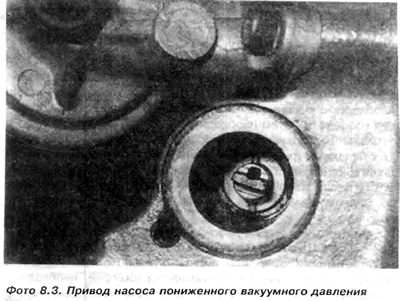
In diesel engines, the reduced pressure in the supply manifold required for the servo to operate does not exist. The reduced pressure is created by a vacuum pump (photo 8.2). The vacuum pump is driven by an intermediate shaft with a vane (photo 8.3).
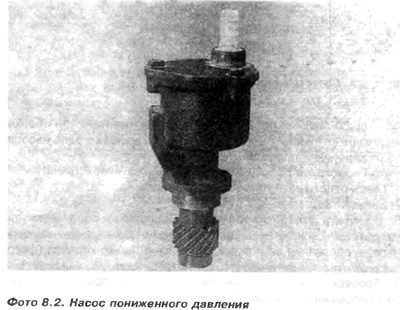
In diesel engines, the reduced pressure in the supply manifold required for the servo to operate…


In diesel engines, the reduced pressure in the supply manifold required for the servo to operate…


The drive fin is offset from the shaft axis, so during assembly it is necessary to accurately position the cutout in the pump shaft in relation to the drive fin.


To check the operation of the vacuum pump, you must:

1. Remove the elastic hose from the pump nipple.

2. Start the engine.

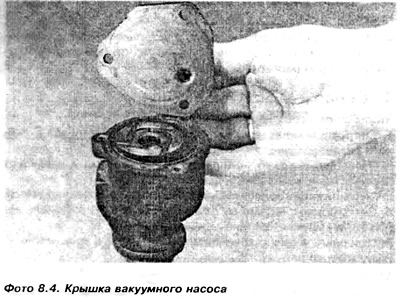
3. Cover the nipple hole. Check whether a vacuum is created. If the pump does not create a vacuum, you can remove the pump cover, marking its position in relation to the body (photo 8.4).
3. Cover the nipple hole. Check whether a vacuum is created. If the pump does not create a vacuum,…


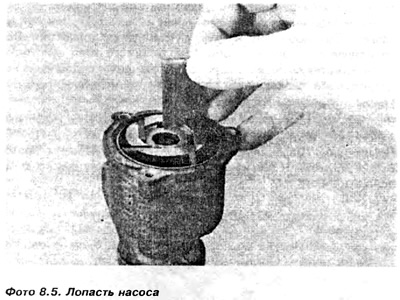
4. The pump condition must be checked at an authorized service station.
4. The pump condition must be checked at an authorized service station.

This article is available at russian, bulgarian, belarusian, ukrainian, serbian, croatian, romanian, polish, slovak, hungarian
The text has been checked: Semenova Anna

Share information:

Previous articles
Brake pedal
Frequency of maintenance of the brake system
The structure of the braking system
Technical data
Next articles
Brake cylinder
Rigid and flexible brake lines
Brake force corrector
Front wheel brake calipers
Front brake disc
Rear wheel brake calipers


Similar articles from other manuals for VW cars:
Removal and installation the clutch servo spring Passat B4 (1988-1996)
Removal and installation the headlight corrector servo drive Touareg 1 (2002-2006)
Removal and installation the clutch pedal servo spring Tiguan 1 (2007-2015)
Servo motor for adjusting the light range Transporter T4 (1990-2003)
Link to this page in different formats


Visitor comments


No comments yet


How much will 39 + 37 =


Golf 5 
  • General information
  • User manual
  • Maintenance
  • Troubleshooting
  • Power unit
  • Engine repair
  • Cooling and ventilation system
  • Fuel system
  • Ignition system
  • Transmission
  • Clutch
  • Mechanical gearbox
  • Automatic gearbox
  • Chassis
  • Brake system
  • Car suspension
  • Steering
  • Body
  • Interior (internal elements)
  • Exterior (external elements)
  • Doors and covers
  • Electrical equipment
  • Power devices
  • Washers and wipers
  • Lighting and appliances
  • Electrical circuits
Golf 4 
  • General information
  • User manual
  • Weekly checks
  • Maintenance
  • Power unit
  • Petrol engines
  • Diesel engines
  • Cooling system
  • Fuel system (petrol)
  • Control system (petrol)
  • Fuel system (diesel)
  • Exhaust system
  • Transmission
  • Clutch
  • Car gearbox
  • Drive shafts
  • Chassis
  • Car suspension
  • Steering
  • Wheels and tires
  • Brake system
  • Body
  • Exterior (external elements)
  • Interior (internal elements)
  • Ventilation and heating
  • Car doors and sunroof
  • Washers and glass cleaners
  • Electrical equipment
  • Power devices
  • Lighting and appliances
  • Electrical circuits
Golf 3 
  • Petrol engine
  • Engine repair
  • Lubrication system
  • Cooling system
  • Ignition system
  • Diesel engine
  • Engine repair
  • Diesel injection system
  • Pre-glow system
  • Transmission
  • Clutch
  • Gearbox and drive shafts
  • Chassis
  • Steering
  • Wheels and suspension
  • Brake system
  • Electrical equipment
  • Lighting and appliances
  • Electrical circuits
Golf 2 
  • General information
  • Introduction to guide
  • User manual
  • Petrol engines 1.3 l
  • Engine repair
  • Lubrication system
  • Cooling system
  • Carburetors
  • Supply system
  • Ignition system
  • Petrol engines 1.6/1.8 l
  • Engine repair
  • Supply system
  • Ignition system
  • Diesel engines
  • Engine repair
  • Lubrication system
  • Cooling system
  • Power and exhaust system
  • Transmission
  • Clutch
  • 4-speed gearbox 084
  • 5-speed gearbox 085
  • 4-speed gearbox 020/4R
  • 5-speed gearbox 020/4T
  • Automatic gearbox
  • Drive shafts
  • Chassis
  • Steering
  • Car suspension
  • Brake system
  • Body
  • Body elements
  • Doors, locks and windows
  • Electrical equipment
  • Equipment and devices
  • Power devices
Golf 2 (petrol) 
  • General information
  • Characteristics
  • Car care
  • Maintenance
  • Power unit
  • Engine repair
  • Engine 1.05/1.30
  • Engine 1.60/1.80
  • Cooling and lubrication system
  • Power and exhaust system
  • Transmission
  • Clutch
  • Car gearbox
  • Drive shafts
  • Chassis
  • Brake system
  • Steering
  • Suspension
  • Body
  • Body and equipment
  • Electrical equipment
  • Lighting and appliances
  • Electrical circuits
Golf 1 (petrol) 
  • General information
  • Characteristics
  • User manual
  • Maintenance
  • Power unit
  • Engine adjustment
  • Engine 1.1/1.3
  • Engine 1.5/1.6/1.8
  • Engine electrical equipment
  • Cooling system
  • Fuel system
  • Transmission
  • Clutch and manual gearbox
  • Automatic gearbox
  • Chassis
  • Steering
  • Front suspension
  • Rear suspension
  • Brake system
  • Electrical equipment
  • Lighting and appliances
  • Electrical circuits
  • Body
  • Body and equipment
  • Optional equipment
Golf 1 (diesel) 
  • General information
  • Specifications
  • Maintenance
  • Power unit
  • Engine repair
  • Exhaust and turbocharger
  • Cooling system
  • Fuel system
  • Fuel injection system
  • Transmission
  • Clutch and drive shafts
  • Car gearbox
  • Chassis
  • Suspension and wheels
  • Steering
  • Brake system
  • Wheels and tires
  • Body
  • Heating and ventilation
  • Exterior (external elements)
  • Interior (internal elements)
  • Doors and windows
  • Electrical equipment
  • Equipment and devices
  • Lighting system
  • Power devices
  • Electrical circuits
VWmanual.ru © 2016-2026 | Mobile version | News and articles | Sitemap: EN BG BY UA RS HR RO PL SK HU | Write message | Site search
Passat B2 • Passat B3 • Passat B4 • Passat B5 • Passat B6 • Golf 1, diesel • Golf 1, petrol • Golf 2, petrol • Golf 2 • Golf 3 • Golf 4 • Golf 5 • Polo 3 • Polo 4 • Touareg 1 • Tiguan 1 • Sharan 1 • Transporter T3 • Transporter T4 • LT 28 • LT 2D • Beetle • Caddy 3 •
Our website uses cookies to ensure functionality and convenience.