



1. Disconnect the battery clamp with the sign
2. Disconnect the electrical wires from the lid of the thermal fluid tank.
3. Remove the air filter housing.
4. Disconnect the elastic injection pipes from the fastening clamps on the supply channel, and then remove the section of the supply channel between the fuel economizer and the throttle body
5. Place a container under the brake cylinder to collect the fluid that will flow out during disassembly.
6. Suck out the brake fluid from the reservoir using a syringe and pour it into a clean container.
7. Loosen the connections and disconnect the brake pipes from the cylinder.
If you have difficulty loosening the connections, you can use a penetrating agent, wait 10 minutes, and then try again. To loosen the brake pipes, you can use a regular open-end wrench, preferably a hex wrench.
8. Loosen the mounting nuts and disconnect the cylinder from the servo.
[The original can be found at: www.VWmanual.ru]
9. Disconnect the brake fluid reservoir from the cylinder. Remove it from the rubber sealing rings 4. Then, lifting with a screwdriver, remove the rings from the cylinder body. If the cylinder is damaged, it can only be disassembled into parts, thoroughly washed with denatured alcohol and the gaskets replaced. If this does not help, the cylinder must be replaced with a new one.
Installation
10. Assembly should begin with lubricating the rubber sealing rings with brake fluid and pressing them into the cylinder body holes. Then press the brake fluid reservoir nipples into the body gaskets.
11. Perform the remaining operations in the reverse order of disassembly. A new gasket 8 must be installed between the servo and the cylinder. After securing the cylinder to the servo and before tightening the brake pipes, pour fluid into the reservoir and wait until the fluid begins to flow out through the pipe sockets. Then screw the pipe connections into the housing. This will facilitate bleeding the brakes later at the end of the entire operation, when bleeding is performed. If there are any fluid stains on the surface of the car, they must be washed off with water.
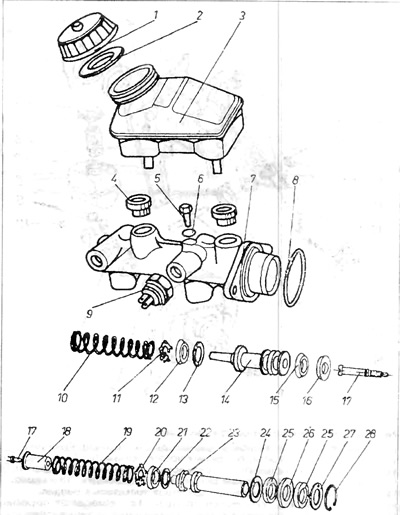
Figure 8.3. Brake cylinder
1 - brake fluid reservoir cap; 2 - plug gasket; 3 - brake fluid reservoir; 4 - tank gasket; 5 limiting bolt; 6 - gasket; 7 - cylinder body; 8 - housing gasket; 9 - brake light switch; 10 - spring; 11 - spring seat; 12 - rubber sealing ring; 13 - washer; 14 piston; 15 - rubber sealing ring; 16 - washer; 17 - bolt; 16 - bushing; 19 - spring; 20 - spring seat; 21 - rubber sealing ring; 22 - washer 23 piston; 24 - washer; 25 rubber sealing ring; 26 - washer; 27 - washer.
Visitor comments