



Instructions: Use only new brake fluid. Take into account the presence of hydrostatic pressure in the brake fluid reservoir!
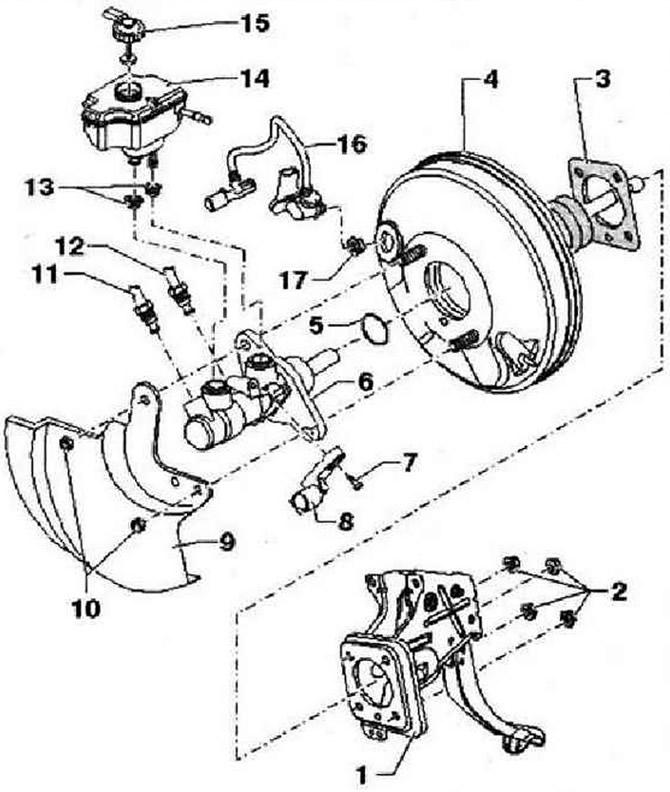
- 1 - Pedal assembly
- 2 - Hexagonal self-locking nut,
- 25 Nm, replace after each removal, first tighten from the bottom left and from the top right
- 3 - Brake booster seal
- 4 - Brake booster, on petrol engines the required vacuum is supplied from the intake manifold, cars with a 2.0 l petrol engine are additionally equipped with a vacuum pump, cars for North America with a hydraulic brake booster are equipped with a vacuum sensor, in cars with diesel engines a vacuum pump is installed to create a vacuum. Checking the functionality: with the engine not running, press the brake pedal several times with force (this will allow the residual vacuum in the amplifier to be released), press the brake pedal with medium force and hold it. Start the engine. If the brake booster is working properly, the brake pedal will start to sink noticeably easier when pressed (the effect of the amplifier becomes clearly noticeable), if a fault occurs, it is replaced entirely (pre-check all vacuum lines)
- 5 - Sealing ring
- 6 - The main brake cylinder cannot be repaired; if a malfunction occurs, it is replaced entirely
- 7 - Screw Tough, 8 Nm
- 8 - Brake light switch "F"
- 9 - Heat shield
- 10 - Hexagon self-locking nut, 25 Nm, replace after each removal
- 11 - Brake line nipple, 14 Nm, master cylinder/floating cylinder circuit to hydraulic unit
- 12 - Brake pipe nipple, 14 Nm, brake master cylinder/pushrod cylinder circuit to hydraulic unit
- 13 - Lubricate the sealing bushings with brake fluid and install the brake fluid reservoir
- 14 - Brake fluid expansion tank
- 15 - Lid
- 16 - Vacuum hose with check valve and additionally in vehicles with hydraulic brake booster with vacuum sensor "G608", insert into brake booster
- 17 - Sealing sleeve, sockets for vacuum hose fitting
Visitor comments