



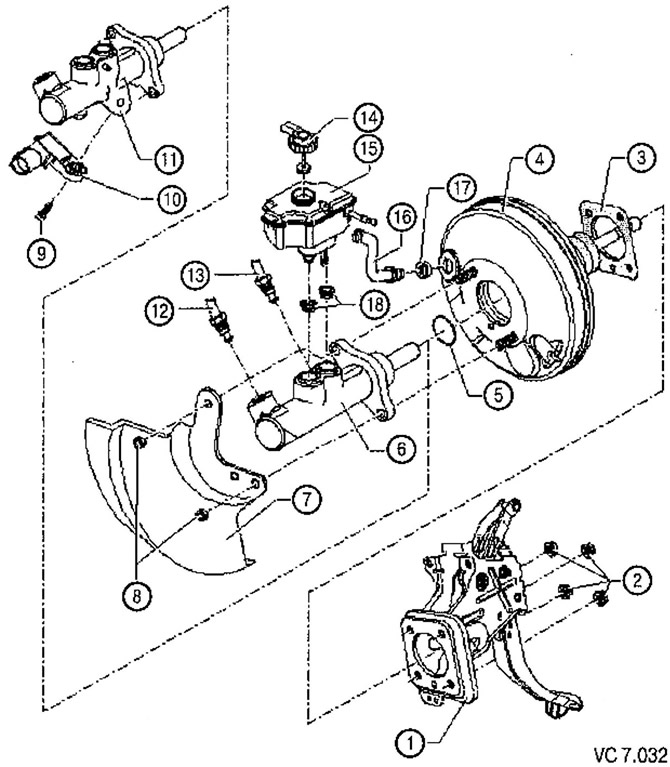
List of parts and assemblies of the master brake cylinder and brake booster with technological notes on repair for Figure VC7.032:
1. Pedal assembly.
2. Hexagon self-locking nut: 25 Nm:
- replace after each removal.
3. Brake booster gasket.
4. Brake booster:
- on gasoline engines, the required vacuum is supplied from the intake manifold;
- in diesel engines a vacuum pump is installed to create a vacuum;
- to check with the engine not running, press the brake pedal firmly several times (this will relieve the residual vacuum in the amplifier), then press the brake pedal with medium force and hold it. Start the engine. If the brake booster is working properly, the brake pedal will become noticeably easier to press when pressed (the amplifier's effect becomes clearly noticeable);
- if a malfunction occurs, it is replaced entirely.
5. Sealing ring.
6. Dual-cavity brake master cylinder without brake light switch:
- cannot be repaired. If any malfunction occurs, it is replaced entirely.
7. Heat shield.
8. Hexagon self-locking nut: 25 Nm:
- replace after each removal.
9. Internal Torx screw, tightening torque: 5 Nm.
10. Brake light switch (F) with brake pedal sensor (F47):
- For vehicles prior to model year 2007, the brake light switch (F) is located on the brake pedal.
11. Dual-cavity brake master cylinder with brake light switch:
- cannot be repaired. In case of malfunction, it is replaced entirely.
12. Brake line: 14 Nm:
- from the main brake cylinder with a floating piston to the hydraulic block.
13. Brake line: 14 Nm.
14. Lid.
15. Brake fluid reservoir.
16. Vacuum hose.
17. Compaction.
18. Seals:
- lubricate with brake fluid and install the brake fluid reservoir.
The original can be seen on the portal: www.VWmanual.ru
Visitor comments