



Contents: Removal ↓ Installation ↓
Removal
Mark the position of the brake pads if they will be used again. They must be installed back in the same places, otherwise there will be uneven distribution of braking forces between the wheels!
Remove the wheels.
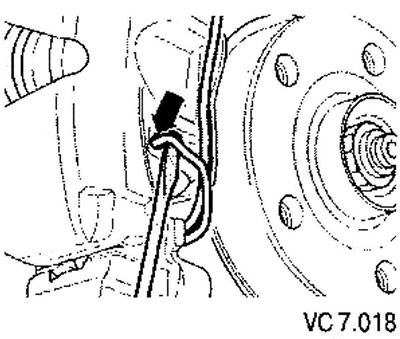
Use a screwdriver to pry the support spring (arrow) out of the brake caliper.
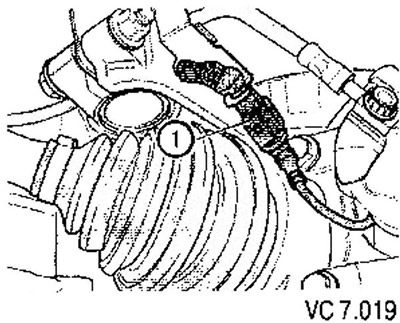
Disconnect the electrical connector (1) of the brake pad wear sensor cable.
Remove the caps (arrows).
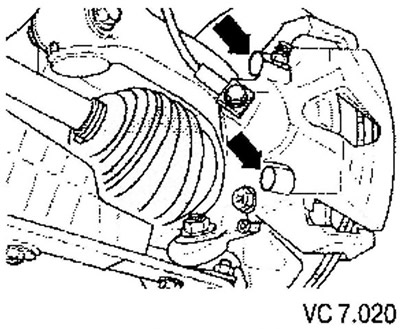
Unscrew and remove both guides (arrows) from the brake caliper.
Remove the brake caliper and tie it with wire so that its weight does not damage the brake hose.
Remove the brake pads from the brake caliper housing and bracket.
Clean the caliper, especially thoroughly in the brake pad seat (there should be no glue or grease residue here).
Use only alcohol to clean the brake caliper.
Installation
Before pressing the piston into the cylinder using a special device, it is necessary to pump out some of the brake fluid from the reservoir. If brake fluid is added as the brake pads wear out, this will prevent leaks and the damage they cause.
Press the piston into the caliper.
Remove the protective film from the outer brake shoe backing plate.
Install the outer brake shoe onto the brake caliper.
Insert the inner brake shoe with the retaining spring into the brake caliper (piston).
When installing, glue the pad only when it is in the proper position in the caliper.
Avoid damaging the adhesive layer.
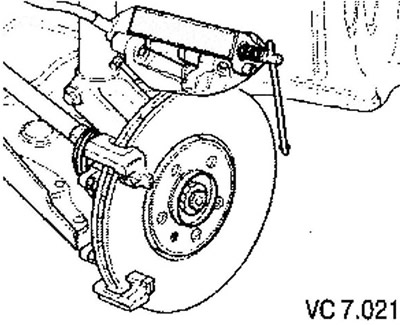
Using two guides, screw the brake caliper to the bracket.
Install both protective caps.
Install the support spring into the brake caliper.
Connect the brake pad wear sensor cable connectors.
Install the wheels.
Tightening torque: Guides to brake caliper: 30 Nm.
Visitor comments