



General information
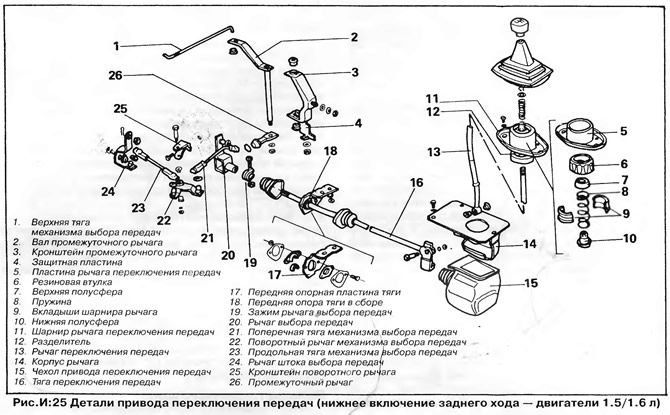
There are two different types of gearshift actuator. On early production cars (before August 1975, gearboxes up to #GC 25084) the reverse lock is located in the gearshift mechanism inside the gearbox, and to engage reverse gear you need to push the gearshift lever to the side (figure I:24). On later production cars (since September 1975), and also on 5-speed gearboxes, the reverse lock is built into the gearshift drive, and to engage reverse gear, you need to press the lever down (figure I:25). This gear shift drive cannot be installed on a vehicle with an earlier gearbox (before No. GC 25084).
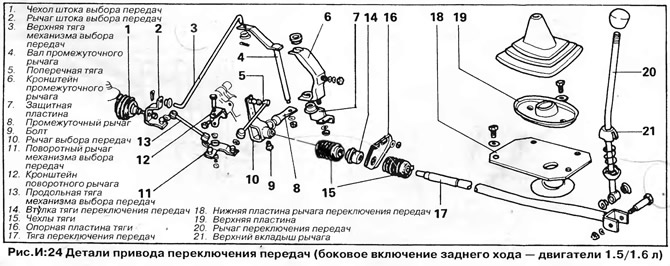
Side-mounted reverse gear drive (adjustment)
Shift into 1st gear and adjust the front shift rod support plate so that the gear selector lever at the end of the rod is vertical. If you now set the shift lever to neutral, the bottom of the lever should be vertical - if not, loosen the two bolts at the base of the lever and move the top plate to adjust its position.
If after this adjustment the gear shifting is still difficult, adjust the gear selector rod mounting screw located on the top of the gearbox housing. Before adjusting, set the rod to the neutral position and disconnect the rods from the rod lever. Press the rod into the gearbox until it stops against the reverse lock. Loosen the screw until the rod pops back out under the action of the spring, then loosen the screw another 1/4 turn and tighten the lock nut. Install the protective cap on the screw.
Drive with lower reverse gear engagement (adjustment)
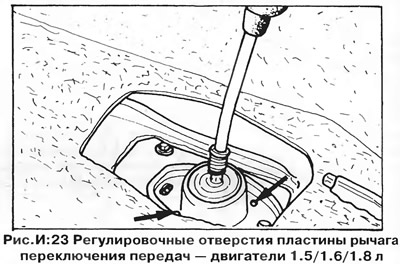
Set the gear shift lever to neutral, loosen the two bolts holding the shift plate and slide the plate until the two adjustment holes in the plate align with the corresponding holes in the shift lever housing (figure I:23). The threaded holes for the bolts should be located in the center of the holes in the plate - if this does not happen, turn the plate 180°. Tighten the bolts.
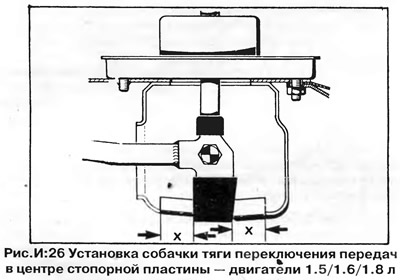
Loosen the gear selector lever clamp so that it can slide freely along the gear shift rod. Remove the gear shift boot from the bottom of the lever housing and slide it forward along the rod (to do this, you may have to loosen the screws that secure the lever housing). On 5-speed gearboxes, the cover has a removable lid that provides access to the mechanism, so there is no need to remove the cover.
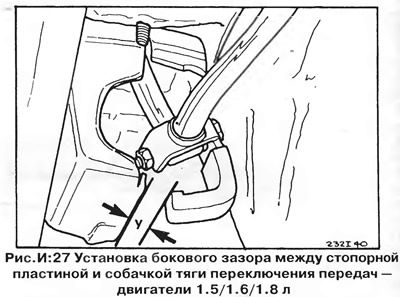
Position the shift rod pawl exactly in the center of the shift rod housing lock plate (figure I:26) — the distances "X" from the pawl to each edge of the plate must be the same. Using a steel strip, set the lateral clearance "U" = 20 mm between the pawl and the plate (for a 5-speed gearbox "U" = 15 mm) — Figure I:27. Holding the gear shift lever in this position, tighten the gear selector lever clamp on the rod.
Engage all gears in turn and make sure that they engage easily and reliably. Check the operation of the 5th gear locks (if available) and reverse.
If after this adjustment the gear shifting is still difficult, adjust the selector shaft mounting screw located on the top of the gearbox housing. Before adjusting, set the shaft to the neutral position and disconnect the rods from the shaft lever. Loosen the lock nut and screw in the screw until the lock ring of the pin located in the center breaks away from the screw. Turn the screw the other way until the lock ring touches it and tighten the lock nut. The lock ring should lift slightly as soon as the selector shaft begins to turn.
Visitor comments