



Contents: Disassembling the gearbox (figure…↓ Primary shaft - disassembly (figure…↓ Secondary shaft - disassembly ↓ Synchronizers - disassembly ↓ Inspection of gearbox parts ↓ Assembling the primary shaft (figure…↓ Secondary shaft assembly (figure…↓ Clutch housing (figure I:45) ↓ Gearbox housing (figure I:36) ↓ Gearbox assembly 084 ↓
Disassembling the gearbox (figure I:36)
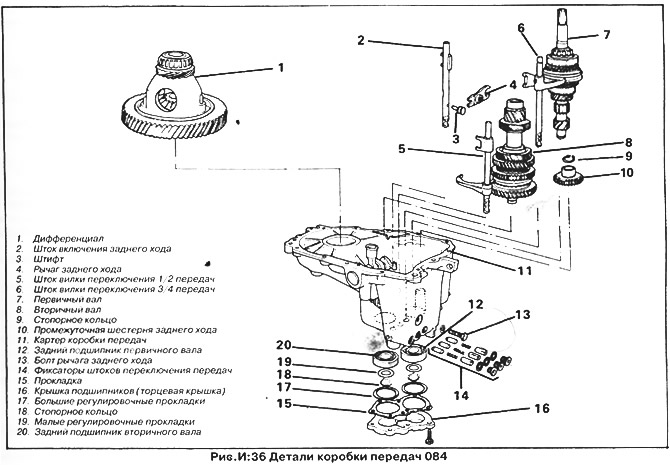
1. Drain the remaining oil from the gearbox and wash it with solvent.
2. Remove the clutch release bearing. Remove the outer sleeve of the clutch release shaft (1, figure I:5), pull the shaft out of the inner sleeve and remove it from the clutch housing.
3. Remove the axle shaft flanges (see the "Axle shaft flange seals" section of this chapter).
4. Remove the clutch housing mounting bolts. Make sure all bolts are removed, especially those inside the housing. Using a mallet, tap lightly around the joint where the clutch housing meets the gearbox until the clutch housing is free of the mounting pins. You may need to gently pry the clutch housing out with a lever
5. Remove the magnetic metal chip catcher from the bottom of the gearbox housing and clean the gearbox from any remaining chips
6. Remove the differential (1, figure I:36).
7. Turn the gearbox over with the rear end cover facing up. Unscrew the seven cover mounting bolts and remove the cover (16, figure I:36).
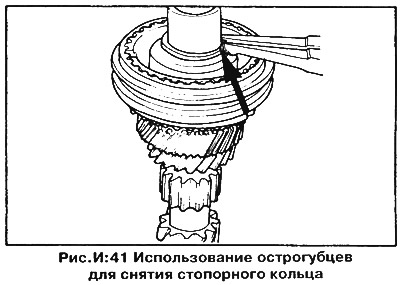
8. Remove the bearing adjusting shims and snap ring from the input shaft using snap ring pliers and a thin screwdriver.
9. Make sure the gearshift rods are in neutral and all gears are disengaged. Use a hex key to remove the rod lock plugs along with the springs, bushings and plungers (14, figure I:36).
10. Remove the reverse gear lever screw located above the locking plugs (13, figure I:36). On later models, the screw is a Phillips head and is usually tight, so use an impact driver to loosen it.
11. Turn the transmission over and pull out the reverse gear rod and lever. Be careful not to damage the dowel pins.
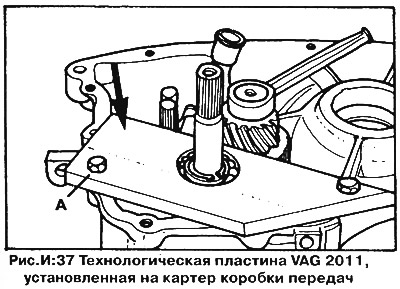
12. To remove the primary shaft and its rear bearing, it is necessary to secure the front end of the shaft using a technological fastening plate (vAG 2011 fixture), which can be purchased or made by yourself. Bolt the plate to the gearbox housing, installing washers to hold the input shaft stationary (figure I:37).
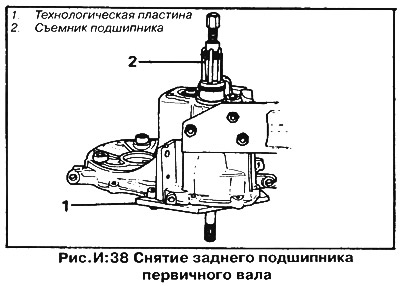
13. Remove the rear primary shaft bearing from the gearbox housing using a puller (figure I:38), unscrew the bolts and remove the technological plate.
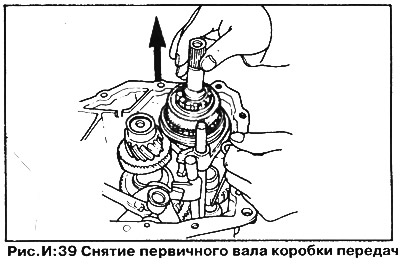
14. Move the gear shift dog to the side and secure it with a wire hook. Move the primary shaft away from the secondary shaft together with the fork and the 3/4 gear shift rod and remove the primary shaft from the crankcase. The reverse gear must be lifted in order to pass the first gear gear of the primary shaft past it (figure I:39).
15. Remove the secondary shaft bearing retaining ring and gaskets (18 and 19, figure I:36).
16. Install the puller on the secondary shaft bearing and press the secondary shaft out of the bearing and out of the gearbox housing towards the clutch together with the rod and 1/2 gear shift fork.
17. Remove the locking crackers and springs from the gearbox housing.
18. Knock out the secondary shaft rear bearing from the gearbox housing using a soft drift.
Primary shaft - disassembly (figure I:44)
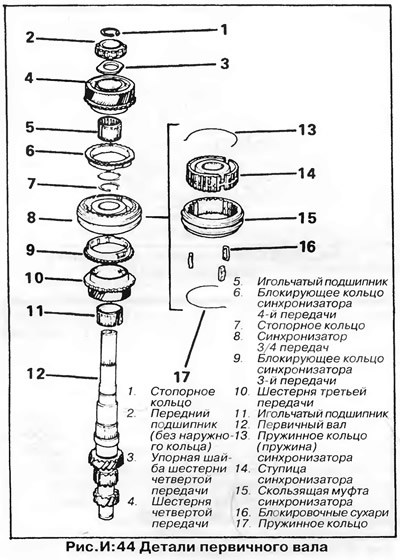
1. Remove the retaining ring from the splined (front) end of the input shaft (1, figure I:44). Remove the front bearing and thrust washer from the 4th gear (2 and 3, figure I:44).
2. Remove the fourth gear pinion together with the synchronizer locking ring and needle bearing (4 and 5, figure I:44).
3. Remove the thrust washer and the 3/4 gear synchronizer retaining ring (7, figure I:44). By hooking the puller onto the 3rd gear pinion, pull the pinion together with the 3/4 gear synchronizer (8, 9 and 10, Figure I:44). Separate the parts from each other, remove the third gear synchronizer ring and needle roller bearing.
4. Clean and inspect the components as described in the section "Inspecting the Transmission Components". Check the synchronizers (13-17, Fig. I:44) as described in the section "Synchronizers".
Secondary shaft - disassembly
1. Remove the secondary shaft gear retaining ring and thrust washer (1, figure I:40).
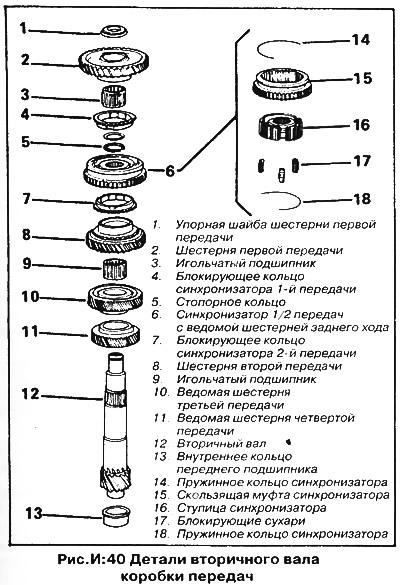
2. Remove the first gear pinion, needle bearing and synchronizer ring (2, 3, and 4, Figure I:40).
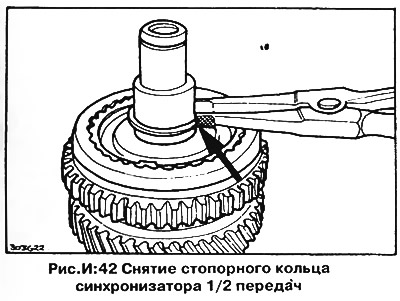
3. Remove the thrust washer and the 1/2 gear synchronizer retaining ring (figure I:42).
The article is published on this resource [www.VWMANUAL.ru]
4. Using a puller, grip the 2nd gear pinion and pull the pinion together with the 1/2 gear synchronizer (6, 7 and 8, figure I:40). Separate the parts, remove the second gear synchronizer locking ring and the second gear pinion needle roller bearing.
5. Clean and inspect the components as described in the "Inspecting the Transmission Components" section. Check the synchronizers as described in the "Synchronizers" section.
Synchronizers - disassembly
1. Mark the relative positions of the hub and the synchronizer sliding sleeve.
2. Remove the spring rings, pull the hub out of the coupling and remove the crackers (14-18, Figure I:40).
3. Check the cleanliness of the internal hub splines and the locking crackers for wear or damage.
4. Place the sliding sleeve on the hub, aligning the marks made earlier (figure I:43).
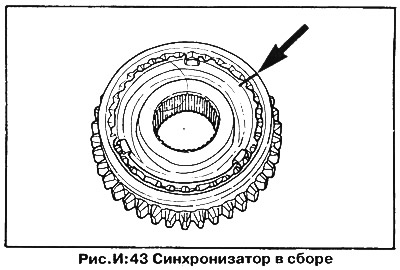
5. The grooves on the inside of the coupling must be aligned with the grooves for the crackers on the hub. The recess on the sliding coupling must face the same direction as the groove on the side surface of the hub. The groove is on the side with the longer splines of the hub.
NOTE: There are no grooves or notches on the secondary shaft synchronizers.
6. Install the crackers and spring rings. The bent ends of the spring rings should be located in the grooves. The spring rings should be directed in opposite directions, and their bent ends should be spread at an angle of 120°.
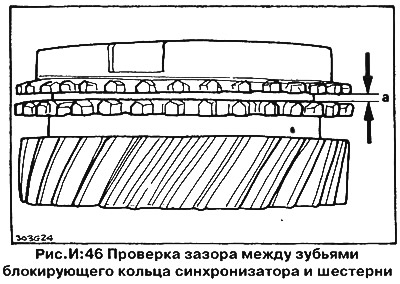
7. Check the locking rings by placing them on the conical surfaces of the corresponding gears and measuring the gap between the teeth of the ring and the gear using feeler gauges (figure I:46). If the gap is less than 0.5 mm, replace the locking rings.
Inspection of gearbox parts
Clean all parts and inspect them for wear and damage as follows:
1. Inspect all gear teeth for wear or chipping, and all bearings (including the surfaces of the thrust washers) for scoring, wear or roughness. If the teeth are damaged, the gear should be replaced (gear block) together with the synchronizer locking rings.
2. Inspect the shaft surfaces for wear or deterioration of the surface hardness. Inspect the synchronizing ring teeth for chipping or breakage, as well as the conical surfaces and synchronizing teeth on each gear. Check the condition of the conical surfaces of the gears and the synchronizer locking rings by installing each ring on the cone of the corresponding gear and turning it, while pressing it against the gear. Also check the clearance shown in Figure I:46 - it should be at least 0.5 mm. If the locking ring turns on the gear easily, this indicates wear of the conical surfaces. Repeat the check with a new synchronizer locking ring to identify the defective part.
3. Check the ease of rotation of the ball bearings; inspect the roller and needle bearings for pits on the roller surface and replace them if necessary.
4. Check the operation of all locks - that is, the condition of the crackers and spring rings of the synchronizers, the locking crackers and the locks of the gearshift rods; replace the retainer springs if necessary.
5. Inspect the ends of the gear shift forks and compare their thickness with the thickness of the new forks.
6. Before assembly, lubricate the working surfaces of all parts (synchronizer hubs, rings, cones, gears, etc.)
Assembling the primary shaft (figure I:44)
1. Install the third gear needle bearing and gear onto the input shaft.
2. Install the third gear synchronizer locking ring onto the 3/4 gear synchronizer by inserting crackers into the grooves of the ring. Press the synchronizer onto the shaft splines using a puller or metal tube. The groove on the side of the hub should face the fourth gear pinion. Secure the synchronizer with a new thrust washer and retaining ring.
3. Install the fourth gear synchronizer locking ring, aligning the grooves with the crackers. Install the fourth gear pinion needle bearing.
4. Install the fourth gear pinion and secure it with a new thrust washer and snap ring, making sure the ring is correctly positioned.
Secondary shaft assembly (figure I:40)
CAUTION: If the driven gears of the third and/or fourth gears require replacement, this work should be entrusted to a VAG representative or a specialist company, since the gears must be heated to 120°C and installed using a special press.
1. Place the second gear needle bearing on the secondary shaft and install the second gear.
2. Install the 2nd gear synchronizer locking ring onto the 1/2 gear synchronizer, aligning its grooves with the crackers.
CAUTION: The ring must be installed on the reverse gear side.
3. Press the synchronizer onto the splines using a puller or a metal tube, with the groove of the sliding sleeve facing the first gear side.
4. Secure the synchronizer with a new retaining ring and install a new thrust washer.
5. Install the first gear locking ring onto the 1/2 gear synchronizer, aligning the grooves of the ring with the crackers.
6. Install the first gear pinion needle bearing, then install the pinion. Install a new thrust washer and secure the pinion with a new snap ring.
Clutch housing (figure I:45)
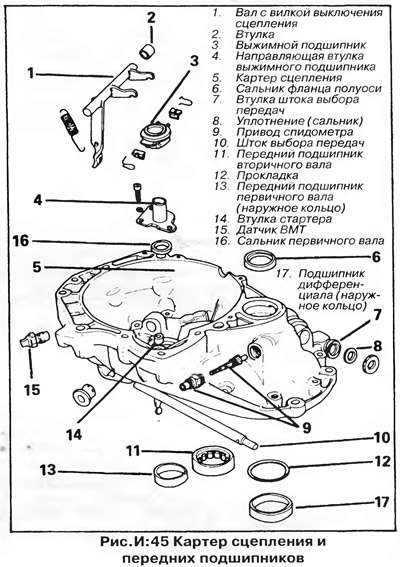
Clean the clutch housing and inspect it for damage or cracks. The clutch housing contains the speedometer driven gear, the gear selector shaft, and the front bearings of the input and output shafts. If necessary, replace these parts as follows:
1. Remove the inner gear selector shaft seal, lubricate the new seal and press it into place evenly, without skewing, using a metal tube. To remove the shaft, you need to unscrew the gear selector finger and pull out the shaft (10, figure I:45). Installation is carried out in reverse order.
2. Unscrew the sleeve of the driven gear of the speedometer drive and pull out the gear (9, figure I:45). Inspect the parts, especially the bushing, and reassemble the speedometer drive in reverse order.
3. Outer rings of the front bearings of the primary and secondary shafts, as well as the starter bushing (11, 13 and 14, Figure I:45) can be pressed out using a metal tube or knocked out with a punch of a suitable size after removing the corresponding seals.
4. Install the bearings with new seals in the reverse order of removal. Lubricate the seals before installation.
NOTE: The input shaft seal should be recessed approximately 2.5 mm below the crankcase surface.
Gearbox housing (figure I:36)
1. Inspect the transmission housing for damage and leaks.
2. Check the pawl, gearshift lever and shaft, and shaft bushings for wear. If replacement is necessary, loosen the bolt, remove the lever and pull out the shaft with the pawl. Knock out the bushings using a punch of the appropriate size. Lubricate the new bushings and press them into place using a mandrel. Install the shaft, pawl and lever in the reverse order of removal.
3. Inspect the reverse gear shaft for excessive wear. If replacement is necessary, heat the shaft mounting area in the gearbox housing with a blowtorch and knock the shaft out of the housing. Press the new shaft into the housing after heating it (with a blowtorch or in a vessel with boiling water for several minutes). The end of the axle should be 83.3 mm from the outer surface of the crankcase.
4. Inspect the shift rods and forks (2, 5, and 6, Figure I:36) for wear, damage or excessive play, replace if necessary.
Gearbox assembly 084
1. Install the secondary shaft bearing into the gearbox housing with the closed side facing inward.
2. Lubricate the locking crackers of the rods and insert them into the crankcase. Move the gear shift dog to the side using a wire hook, overcoming the resistance of the spring.
3. Install the fork with the 1/2 gear shift rod into the groove of the synchronizer sliding sleeve on the secondary shaft.
4. Place the reverse idler gear onto the axle and hold it up with a wire hook.
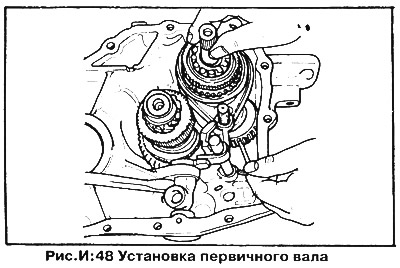
5. Lower the secondary shaft together with the fork and the 1/2 gear rod into the crankcase. At the same time, install the reverse gear over the first gear gear, lifting it with a wire hook (figure I:48). Make sure the shift rod is in neutral and the reverse gear can move freely.
6. After replacing the secondary shaft or its bearing, determine the bearing preload as follows:
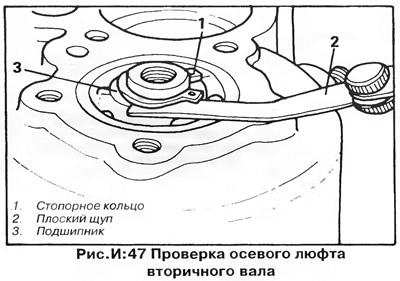
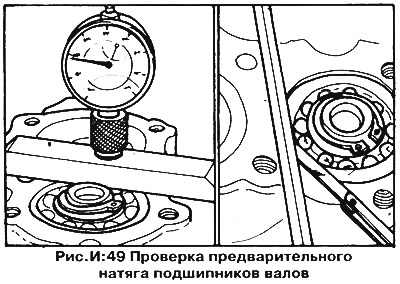
Install the bearing retaining ring and measure the clearance between the retaining ring and the bearing inner ring using feeler gauges (figure I:47). Select a gasket so that the gap is 0-0.05 mm and install it under the retaining ring. Measure the gap between the crankcase surface (without gasket) and the outer ring of the bearing using a ruler and feeler gauges or a special device VAG No.382/7 (figure I:49). Adding 0.27-0.31 mm to the obtained value, you will get the thickness of the large adjusting gasket, which must be installed on the outer ring of the bearing under the cover.
7. Install the 3/4 shift fork and rod into the synchronizer sliding sleeve groove on the input shaft.
8. Lower the primary shaft with the fork and gearshift rod into the crankcase and engage the gears with the secondary shaft gears. Raise the reverse gear to allow the primary shaft first gear to pass.
9. Secure the input shaft with the process retaining plate, then remove the wire hook from the reverse gear.
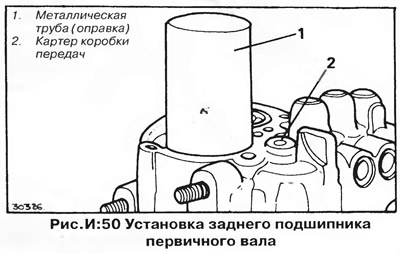
10. Press the rear bearing of the input shaft into the gearbox housing and onto the shaft using a metal mandrel (figure I:50). The closed side of the bearing must face the inside of the gearbox.
11. Check, if necessary, determine the thickness of the large and small adjusting shims, and install them on the end of the input shaft as described earlier for the secondary shaft.
12. Remove the process plate from the input shaft.
13. Install the lever on the reverse gear engagement rod, then lower them into the crankcase and engage the lever with the reverse gear gear (in this case the gears will need to be slightly raised).
14. Position the lever approximately 2.0mm from the 1/2 shift rod and ensure the pin on the rod is flush with the fork.
15. Tighten the reverse gear lever screw, placing a washer under its head, and tighten it to the torque specified in the section "Technical data". The gap between the reverse gear lever and the gear shift rod should be within 1.3–2.8 mm.
16. Insert plungers, springs and retainer sleeves into the gearbox housing, then install plugs with washers. Tighten the plugs with a hex key.
17. Move the gearshift shaft lever to ensure that each gear engages easily. Make sure that it is not possible to engage two gears at the same time.
18. Install large shims of the correct thickness onto the input and output shaft bearings, then install the end cover with a new shim.
19. Install the differential.
20. Clean the mating surfaces of the gearbox and clutch housing. Install new gaskets.
21. Install the magnetic metal chip catcher into the groove of the gearbox housing.
22. Check the gearshift rods - they should be in neutral. Lower the clutch housing onto the gearbox housing, ensuring that the pin engages with the gearshift shaft lever.
23. Align the dowel pins, then insert the bolts and tighten them evenly in a diagonal sequence to the torque specified in Section "Technical data".
24 Insert the axle shaft flanges into the differential as described earlier in this chapter.
25. Install the reverse light switch and gear shift/fuel consumption sensor (if available).
26. Install the shaft with the fork and the clutch release bearing as described earlier.
27. Install the gearbox in the reverse order of removal. Fill the gearbox with oil.
Visitor comments