



General instructions
New tires only achieve optimum grip after driving for about 100 km, so during this period you should drive carefully and at a limited speed. It also has a positive effect on tire durability.
Depending on the design features, material and tread pattern, the wear rate of different tires (different types and from different manufacturers) may be different.
Periodically check the integrity of the tires (the presence of cuts, punctures, swelling). Remove any foreign bodies stuck in the rubber.
To avoid damage to tires and wheel rims, curbs and other similar obstacles should be driven slowly and at an angle close to a straight line.
Tire and rim damage is often invisible to the naked eye. If you suspect the possibility of damage, be sure to have the wheel checked at a service station. Keep tires away from oil, fuel and other petroleum products.
Replace lost valve caps immediately.
When dismantling tires and wheels, they should be marked so that during subsequent installation the same direction of rotation of the tire is preserved.
Removed wheels and tires should always be stored in a cool, dry and, if possible, dark place. Tires without rims should be stored upright.
Tire durability
The durability of tires significantly depends on the following factors:
Tire pressure. Recommended pressures are printed on the inside of the fuel tank cap. Tire pressure is especially important at high speeds. Therefore, check the pressure at least once a month and before every long trip.
Don't forget to check your spare tire:
- On a small spare tire, the pressure is indicated on the side of the tire.
- The pressure in a spare tire with a regular tire should be the maximum recommended for this car model.
- Check pressure only when the tire is cold. Do not reduce the pressure if it was measured immediately after the trip.
Timely adjust the pressure in accordance with the vehicle load.
Too low or too high pressure will shorten the life of the tread and adversely affect the dynamic properties of the vehicle.
Attention: When the pressure is reduced, the tire experiences increased deformation, which, when driving at high speed for a long time, leads to its overheating. This can cause tread peeling and even sudden tire blowout while driving. Reduced tire pressure significantly increases fuel consumption.
Driving style
Fast cornering, frequent hard acceleration and braking significantly reduce tire life.
Wheel balancing
The wheels of a new car are balanced at the factory. However, during operation, as a result of various factors, their imbalance may occur, which is expressed in the beating of the wheel during movement (felt by the vibration of the steering wheel or the entire car with the speed of the wheel).
Wheel imbalance causes accelerated wear of steering parts, suspension, as well as wheel hubs and tires themselves, so such wheels must be rebalanced. In addition, the wheel must be re-balanced after installing a new tire and after each tire repair.
Running gear defects (wheel misalignment)
Violation of the wheel alignment due to malfunctions of the chassis not only causes accelerated (usually unilateral) tire wear, but also reduces traffic safety. Therefore, if uneven tire wear occurs, contact a service station.
Wear indicators
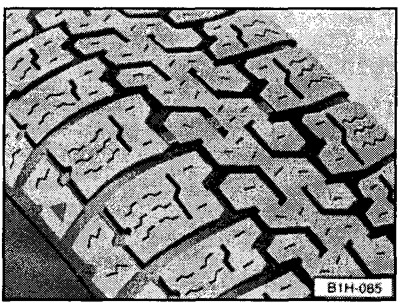
At the base of the tread of most modern tires there are transverse "wear indicators" 1.6 mm high - see picture. These indicators - depending on the model, there may be 6-8 of them - are located on the tire at the same distance from each other and appear when the residual tread depth reaches 1.6 mm.
Tire side markings (e.g. letters "TWI" or a picture of a triangle) indicate the location of the wear indicators.
Attention: If wear indicators appear, the tire must be replaced. Worn out tires do not provide the necessary grip, especially at high speeds. In addition, at shallow tread depths, hydroplaning occurs at lower speeds.
Note: The minimum permitted tread depth is 1.6 mm (in some countries these indicators may have different values).
Wheel swap
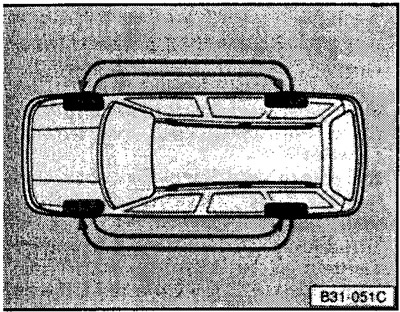
In case of predominant wear of the front tires, it is recommended to swap the front and rear wheels according to the indicated scheme. Thus, all tires will have approximately the same service life.
Under certain conditions, it may be rational to apply a diagonal rearrangement of the wheels. You can find out the details of this procedure at a Volkswagen service station.
Changing wheels/tires
Tires and rims (discs) wheels are important structural elements and also play a critical role in ensuring safe movement. Therefore, it is imperative to use wheels and tires recommended by Volkswagen, information about which can be obtained from service stations.
Mounting and repairing tires requires special skills and tools, so only specialists should perform these works. Repair, as well as replacement of wheels and tires, is best done at service stations.
To ensure the stability of the car, it is better to replace the wheels not one at a time, but at least in pairs. Tires with greater tread depth should always be placed on the front wheels.
Fit all 4 wheels with radial tires of the same design and size (with the same outside diameter), and, if possible, with the same tread pattern.
On all-wheel drive vehicles (syncro) wheels must be the same (all four) one manufacturer. Otherwise, the viscous coupling, due to the resulting difference in wheel speeds, unnecessarily increases the torque on the rear axle, which can lead to premature failure of the mechanisms.
In order to avoid unnecessary tension in the transmission mechanisms when installing a spare wheel, the syncro model is equipped with a normal-sized spare wheel, unlike other Volkswagen Passat models, which are equipped with small-sized spare wheels.
Small size spare wheels from conventional Volkswagen Passat models must not be used on all-wheel drive Sincro models.
If the model and tread of the spare wheel differs from the tires fitted to the machine (e.g. if winter or wide-profile tires are fitted), use the spare wheel only in an emergency for a short time, taking special care when driving. As soon as possible, you should put a normal wheel.
Never install used tires on a vehicle whose history you do not know.
The correct reading of the inscriptions on the tire will facilitate your choice. Radial tires have the following markings on their sidewalls:
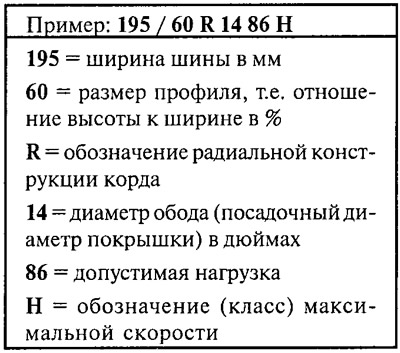
The date of manufacture is also indicated on the sidewall of the tire (usually only on the inside of the wheel): DOT...123 - means that the tire was manufactured in week 12, 1993.
Attention: Use tires older than 6 years only as a last resort, being careful when driving.
When fitting new tires and rims to your vehicle, consider the following:
Attention: For technical reasons, it is not recommended to install rims from other cars, sometimes even of the same model! The rims and their mounting bolts must match. Any wheel change (e.g. when installing alloy wheels or replacing wheels with winter) make sure that the mounting bolts fit these wheels in length and the shape of the spherical part of the head. The reliability of fastening the wheels and the operation of the brakes depend on this! The use of tires and rims not recommended by Volkswagen for your vehicle model may impair driving safety.
When installing decorative caps on the wheels, you should pay attention to the fact that sufficient air access is necessary to cool the brake discs.
Winter tires
In winter road conditions - even with all-wheel drive - the dynamic properties of a car equipped with special winter tires are significantly improved. This is especially true for vehicles with wide-profile or high-speed tires (designation H or V). Winter tires slip less on ice and snow due to their design (width, rubber composition, tread shape).
When converting to winter tires, please note the following:
- Only winter tires with belt construction may be used. Manufacturer's recommended tire sizes are listed below.
- For best driving performance, winter tires should be fitted on all four wheels.
- The pressure in winter tires should be 0.2 atm higher than in summer ones - see technical specifications.
- Winter tires greatly deteriorate their properties if the tread depth is reduced to 4 mm.
The following speed limits apply for winter tires:
| Marking | Max speed |
| Q | 160 km/h |
| T | 190 km/h |
| H | 210 km/h |
Regardless of the tires installed, you must follow the rules of the road.
- All season tires can be used instead of winter tires.
- If there is a road traffic regulation requiring the use of winter tires, this also applies to vehicles with all-wheel drive.
- In the event of a wheel failure, observe the instructions for use! spare wheel!
- Do not use winter tires in summer, as the vehicle's performance on snow and ice-free roads is impaired by winter tires.
Summer tires also reduce noise, tire wear and fuel consumption.
Anti-skid chains
The use of snow chains is possible for all tire sizes. The chains can only be installed on the front wheels, even on syncro models.
The use of a snow chain on a small spare wheel is not possible for technical reasons.
It is recommended to use chains with small links (no longer than 15 mm, including lock link).
Remove wheel covers when using chains. Wheel bolts should be closed with caps for reliability.
When driving on a road without snow cover, the chains must be removed, because. they degrade the dynamic properties, damage the tires and quickly fail themselves.
Visitor comments