



Contents: Preventing damage to wheels and tires ↓ Tire storage ↓ New tires ↓ Hidden damage ↓ Directional tread tires ↓ Checking tire pressure ↓ Tire pressure ↓ Tire mileage ↓ Tire wear indicators ↓ Tire rotation ↓ Wheel balancing ↓ Winter tires ↓ Anti-skid chains ↓
Preventing damage to wheels and tires
Drive over curbs and other similar obstacles slowly and at right angles if possible.
Protect your tires from oil, grease and fuel.
Check your tires regularly for damage (punctures, cuts, cracks). Remove foreign objects from the tread.
Tire storage
Mark the removed tires so that when reinstalling them on the vehicle, the original direction of rotation of the tire is maintained.
Store removed wheels and tires in a cool, dry and dark place.
Place tires upright if they are not mounted on a rim.
New tires
New tires need to be "broken in".
Depending on the design and tread profile, the tread depth of new tires may vary for different tire designs and different manufacturers.
Hidden damage
Damage to tires and wheels is often not visible. Unusual vibration or the car pulling to one side may indicate a tire defect. In this case, you should definitely have the tires checked at a Volkswagen service center.
Directional tread tires
Tires with a directional tread pattern have arrows on the sidewall. The specified direction must be ensured when mounting the wheels on the car. This will realize all the advantages of such tires in terms of road grip, wear, noise and aquaplaning.
Checking tire pressure
NOTE: The tire pressure rating is shown on the sticker on the end of the driver's door.
Check the sticker to see what the tire pressure should be.
Place the pressure gauge directly on the dust cap without unscrewing it.
Always check the pressure when the tires are cold. Do not release air when the tires are hot and the pressure is too high.
Match the tire pressure to the vehicle load.
Tire pressure
Having the correct tire pressure is especially important when driving at high speeds. Tire pressure should be checked at least once a month and before each long trip.
Tire mileage
NOTE: Tire life depends on tire pressure, driving style and quality of installation on wheel rims.
Tire wear indicators
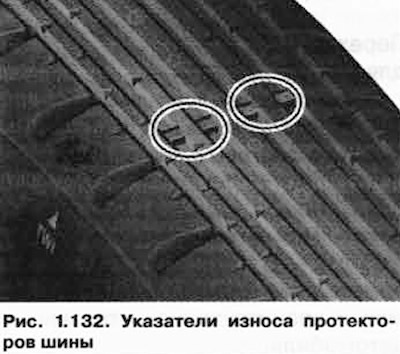
The tread pattern has 1.6 mm high tire wear indicators located across the tread (fig. 1.132). These indicators, 6 to 8 in number, are located at equal distances from each other on the tyre tread. Markings on the sidewall of the tyre (e.g. "TWI" symbols or pictograms) indicate the location of the wear indicators. A residual tread height of 1.6 mm - measured in the profile groove near the wear indicator - is the minimum for allowing the vehicle to be used. Worn tyres should be replaced.
Incorrect tire pressure leads to increased tire wear and can even cause a tire blowout. Therefore, you should check your tire pressure at least once a month.
High-speed cornering, sharp acceleration and braking also increase tire wear.
Tire rotation
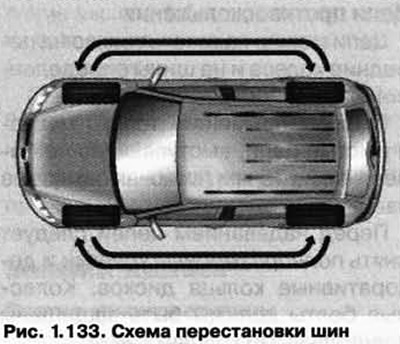
If the wear of the front tires is clearly increased, it is recommended to swap the front and rear wheels in accordance with the diagram in Figure 1.133. This will ensure that all tires have the same mileage.
Wheel balancing
The wheels of a new car are balanced. During operation, for various reasons, wheel imbalance may occur, which manifests itself in a violation of the smoothness of the ride and deterioration of the car's controllability.
When unbalanced, the wear of the steering, suspension and tires increases - the wheels should be rebalanced. In addition, wheel balancing is necessary when changing a tire.
Winter tires
In winter conditions, the car's performance is significantly improved by using winter tires. This also applies to all-wheel drive vehicles. Summer tires, due to their design features, (width, tread pattern, rubber composition) they slide on snow and ice.
Use winter tires on all four wheels.
The permitted sizes of winter tires are specified in the vehicle documentation. Use only radial tires. All tire sizes listed in the documentation also apply to winter tires.
Winter tyres lose a significant amount of their performance when the tread depth is reduced to 4 mm.
For winter tyres, depending on the speed index, there are the following speed limits:
- T - max 190 km/h;
- And - max. 210 km/h.
When using winter tyres with a speed rating of V, the speed limit and tyre pressure are determined by the engine power. Ask your Volkswagen service partner for the maximum permitted speed and the required tyre pressure.
Anti-skid chains
Chains can only be fitted to the front wheels and to tyres of a certain size.
Only fine mesh chains with a protrusion of no more than 15 mm should be used (including locking links).
Before putting on the chains, remove the full-size caps and decorative rings of the disks. Wheel bolts should be protected with special caps.
Visitor comments