



Contents: Turning out the towing eye ↓ Tow rope or rigid tow ↓ Movement ↓ Towing cars with automatic…↓ Towing a 4WD vehicle ↓ Towing to start the engine ↓
When using a towing rope, please follow the instructions below.
To the driver of the towing vehicle.
Start moving smoothly so that the rope gradually tightens. Then carefully add gas.
When starting off, release the clutch pedal especially smoothly, and with an automatic transmission, release the gas gradually.
Remember that the power steering and brakes do not work on a towed vehicle. Brake early and smoothly.
To the driver of the towed vehicle.
Make sure the rope is kept taut at all times.
Turning out the towing eye
Remove the towing eye and wheel lug wrench (fig. 1.152).
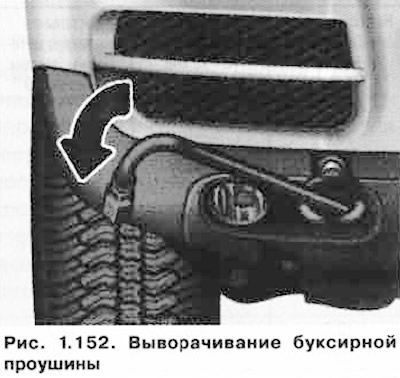
Fold the front cover down and let it hang.
Use a screwdriver to pry off the back cover (fig. 1.153) and leave it hanging.
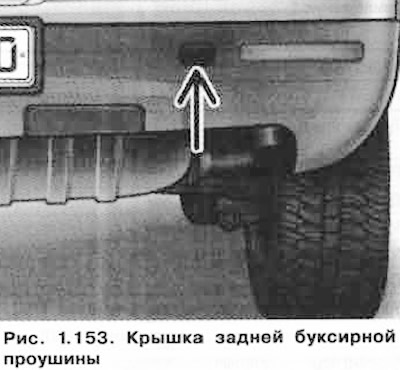
Screw the eye counterclockwise until it stops into the corresponding threaded hole.
Tighten the eye using the wheel wrench.
Tow rope or rigid tow
It is better to use a rigid towbar. Only when there is no rigid towbar, use a tow rope.
The towing rope must be flexible enough to avoid damaging both vehicles. Use a rope made of synthetic fiber or other flexible material.
Attach the towing rope or rigid towbar only to the eyes provided for this purpose.
Movement
Towing requires some experience, especially when using a tow rope. Both drivers must be familiar with the specifics of driving while towing. An inexperienced driver should not operate either vehicle.
When driving, it is necessary to constantly ensure that there are no jerks or significant slack in the cable. When towing a car along the edge of an improved dirt road, there is always a risk that the shoulder will be overloaded and destroyed.
The ignition of the towed vehicle must be on so that the steering is not locked and the direction indicators, horn, windscreen wipers and washers can be used.
Since the brake booster does not function when the engine is not running, the driver must press the brake pedal harder than usual.
The original can be viewed on the portal: www.VWManual.ru
Since the power steering also does not work, more force must be applied to the steering wheel when turning.
Towing cars with automatic transmission
NOTE: Observe traffic regulations when towing.
In accordance with traffic regulations, turn on the exterior lighting.
A car with an automatic transmission cannot be towed.
Take into account the peculiarities of towing a four-wheel drive vehicle.
If there is no oil in the gearbox of a faulty vehicle, such a vehicle can only be towed with the drive wheels raised.
For towing distances greater than 50 km, the vehicle should be towed with the drive wheels raised.
If there is no current in the on-board network, the steering remains locked. Such a vehicle should be towed with the front wheels raised.
If the air suspension is faulty, the ground clearance is extremely low. Towing with one axle raised is impossible.
Towing a 4WD vehicle
Before towing a 4WD vehicle, please read the general instructions again. When towing a 4WD vehicle, please note the following:
- the vehicle speed must not exceed 50 km/h. The towing distance must not exceed 50 km;
- the vehicle must not be towed with the front or rear wheels off the ground.
NOTE: If normal towing is not possible or if the towing distance is more than 50 km, the vehicle must be transported on a tow truck.
Towing to start the engine
NOTE: It is preferable to use another vehicle's battery to start the engine.
Visitor comments