
English Русский
Български
Беларускі
Український
Српски
Hrvatski
Română
Polski
Slovenský
Magyar
  |  Articles  |  Sitemap  |  Contacts  |    |
Car maintenance Ford Car maintenance Hyundai Car maintenance Chevrolet Car maintenance BMW Car maintenance Audi Car maintenance Opel Car maintenance AvtoVAZ
VWmanual.ru


Main   Passat   Golf   Polo   Touareg   Tiguan   Sharan   Transporter   Others  
Passat B2 (1981-1988) Passat B3 (1988-1993) Passat B4 (1988-1996) Passat B5 (1996-2005) Passat B6 (2005-2010)

Towing a car (VW Passat B3)

  • Main
  • Passat
  • Passat B3
  • General information
  • Maintenance instructions
  • Towing a car
            0


Contents: Front towing eye ↓ Rear towing eye ↓ General instructions ↓ Towing for the purpose of starting…↓ Towing a car with automatic…↓ Towing a 4WD vehicle (Syncro) ↓

Front towing eye


The towing eye is located at the front right under the bumper.

Rear towing eye
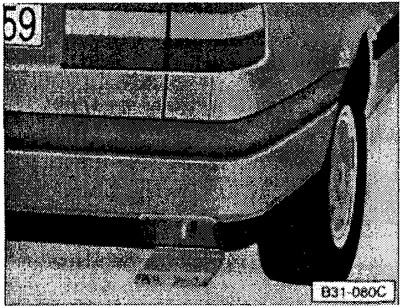


Rear towing eye


The rear towing eye is located in the rear bumper on the right and is covered by a cover. To access the eye, fold the cover down. When towing is complete, lift the cover - it should lock into place.

General instructions


Attach the towing rope to these eyes only.

The towing rope must be flexible to prevent both vehicles from being jerked around too much. Use a rope made of synthetic or similar material. However, it is safer to use a towing rod (rigid coupling)! When towing, always ensure that no unacceptable tensile forces or jolt loads occur. When towing off-road, there is always a risk of overloading and damage to body parts.

Before starting the engine by towing, always use another vehicle's battery to start the engine if possible-see. previous chapter.

When towing, please consider the following:
  • Observe the traffic regulations regarding towing.
  • Both drivers must be familiar with the specifics of driving a vehicle when towing.
  • When using a towing rope, the driver of the towing vehicle must engage the clutch especially gently.
  • The driver of the towed vehicle must ensure that the cable is constantly tensioned, braking promptly if the cable begins to sag.
  • Both vehicles must have their hazard warning lights on, and the towing vehicle must have its low beam headlights on.
  • When towing a vehicle, it is recommended to turn on the ignition to unlock the steering wheel and ensure that the turn signals and windshield wipers operate.
  • Since the brake booster only operates when the engine is running, the brake pedal on a towed vehicle must be pressed harder than usual.
  • In vehicles with power steering, when the engine is not running, more force is required to turn the steering wheel.
  • If there is no oil in the gearbox, the vehicle can only be towed with the drive wheels raised.


Towing for the purpose of starting the engine (including all-wheel drive vehicles)


When starting the engine by towing, consider the following:
  • Before starting towing, engage second or third gear.
  • Turn on the ignition.
  • Once the engine starts, depress the clutch and shift out of gear to avoid hitting the towing vehicle.
  • Vehicles with a catalytic converter in the exhaust system must not be towed more than 50 m away (this does not apply to 55 kW diesel engines) - otherwise, unburned fuel, getting into the catalyst, can damage it.
  • Starting the engine by towing on a car with an automatic transmission is not possible for technical reasons!

Towing a car with automatic transmission


When towing a vehicle with an automatic transmission, in addition to the above, the following must be taken into account:
  • Set the selector lever to the "N" position
  • When towing, do not exceed 50 km/h!
  • The maximum towing distance is 50 km!
  • When towing over a longer distance, the drive wheels (front of the car) must be raised above the ground.

Reason: When the engine is not running, the automatic transmission pump does not work, so the transmission is not lubricated enough and may fail during prolonged driving.

  • If the rear axle is damaged, the vehicle must not be towed in reverse with only the rear axle raised - in this case, the vehicle must be completely loaded onto the platform.

Reason: When reversing, the drive shafts rotate in the opposite direction, and the planetary gears of the automatic transmission gearbox reach such a rotation speed that the transmission fails in a short time.


Towing a 4WD vehicle (Syncro)


The car can be towed like a two-wheel drive Volkswagen Passat.

The vehicle can be towed with either the front or rear axle raised. If the vehicle must be towed with the rear axle raised (in reverse), and the rear wheels are locked due to an accident or breakdown, you should make sure that the free play of the rear axle is not blocked by the all-wheel drive clutch. To remove the lock, with the ignition on, briefly shift to first gear, and then move the lever back to neutral.

This article is available at russian, bulgarian, belarusian, ukrainian, serbian, croatian, romanian, polish, slovak, hungarian
The text has been checked: Medvedeva Elena

Share information:

Previous articles
Starting the engine from an external battery
Lifting a car
Fuses for electrical circuits
Spare tire of a car
Operating a vehicle in other countries
Car wheels and tires
Next articles
Car wash
Paint and varnish care
Protection of the underbody and body cavities with anti-corrosion agents
Protection of the engine compartment with anti-corrosion agents
Caring for cushion upholstery
Essential tools for car maintenance


Similar articles from other manuals for VW cars:
Towing a car trailer (s) Golf 2 (1984-1993, petrol)
Towing a car Polo 4 (2001-2009)
Additional equipment of the vehicle with a towing hitch Touareg 1 (2002-2006)
Towing a car Transporter T4 (1990-2003)
Link to this page in different formats


Visitor comments


No comments yet


How much will 33 + 47 =


Passat B6 
  • General information
  • User manual
  • Maintenance
  • Petrol engine 1.6L
  • Engine repair
  • Cooling and lubrication system
  • Fuel injection system
  • Petrol engine 2.0L
  • Engine repair
  • Lubrication system
  • Cooling system
  • Fuel and exhaust systems
  • Diesel engine 2.0L
  • Engine repair
  • Cooling and lubrication system
  • Fuel and exhaust systems
  • Transmission
  • Clutch
  • Mechanical gearbox
  • Automatic gearbox
  • Drive shafts
  • Chassis
  • Wheels and tires
  • Car suspension
  • Steering
  • Brake system
  • Body
  • Exterior (external elements)
  • Electrical equipment
  • Power devices
  • Lighting and appliances
  • Electrical circuits
Passat B5 
  • General information
  • User manual
  • Weekly checks
  • Maintenance
  • Power unit
  • Engine repair
  • Cooling system
  • Fuel system (petrol)
  • Fuel system (diesel)
  • Engine management
  • Exhaust system
  • Transmission
  • Clutch
  • Car gearbox
  • Drive shafts
  • Chassis
  • Car suspension
  • Wheels and tires
  • Steering
  • Brake system
  • Body
  • Exterior (external elements)
  • Interior (internal elements)
  • Doors and covers
  • Ventilation and heating
  • Electrical equipment
  • Power devices
  • Lighting and appliances
  • Electrical circuits
Passat B4 
  • General information
  • User manual
  • Maintenance
  • Technical data
  • 8-valve engine
  • Engine repair
  • Cooling and lubrication system
  • Supply system
  • Ignition system
  • Fuel injection «Mono-Jetronic»
  • Control system «Mono-Motronic»
  • Control system «Digifant»
  • Control system «Simos»
  • 16-valve engine
  • Engine repair
  • Cooling and lubrication system
  • Fuel injection «K-Jetronic»
  • Control system «KE-Motronic»
  • Control system «Digifant»
  • Diesel engine
  • Engine repair
  • Cooling and lubrication system
  • Power and control system
  • Turbocharging system
  • Digital control system
  • Transmission
  • Clutch
  • Manual gearbox
  • Hydromechanical gearbox
  • Front wheel drive
  • Chassis
  • Car suspension
  • Steering
  • Brake system
  • Body
  • Body elements
  • Electrical equipment
  • Power devices
  • Lighting and appliances
  • Electrical circuits
Passat B3 
  • General information
  • User manual
  • Driving Tips
  • Maintenance instructions
  • Technical data
  • Power unit
  • Engine repair
  • Ignition system
  • Lubrication system
  • Cooling system
  • Supply system
  • Petrol injection system
  • Diesel engine
  • Exhaust system
  • Transmission
  • Clutch
  • Car gearbox
  • Chassis
  • Suspension
  • Steering
  • Brake system
  • Wheels and tires
  • Body
  • Exterior
  • Interior
  • Heating system
  • Electrical equipment
  • Power devices
  • Lighting system
  • Equipment and devices
  • Wiper system
  • Electrical circuits
Passat B2 
  • General information
  • Introduction to instructions
  • User manual
  • Power unit
  • Engines 4-cylinder FZ
  • Engines 4-cylinder
  • Engines 5-cylinder
  • Transmission
  • Clutch
  • Four-speed gearbox
  • Five-speed gearbox
  • Hydromechanical gearbox
  • Front wheel drive
  • Chassis
  • Front suspension
  • Rear suspension
  • Steering
  • Brake system
  • Body
  • Body elements
  • Electrical equipment
  • Equipment and devices
  • Electrical circuits
VWmanual.ru © 2016-2026 | Mobile version | News and articles | Sitemap: EN BG BY UA RS HR RO PL SK HU | Write message | Site search
Passat B2 • Passat B3 • Passat B4 • Passat B5 • Passat B6 • Golf 1, diesel • Golf 1, petrol • Golf 2, petrol • Golf 2 • Golf 3 • Golf 4 • Golf 5 • Polo 3 • Polo 4 • Touareg 1 • Tiguan 1 • Sharan 1 • Transporter T3 • Transporter T4 • LT 28 • LT 2D • Beetle • Caddy 3 •
Our website uses cookies to ensure functionality and convenience.