



The camshaft is located at the top of the cylinder head. The ovoid cams are used to open or close the valves at a certain position of the pistons. This is determined by the so-called valve timing. The camshaft rotates on five bearings: the drive is carried out by a toothed belt from the crankshaft. The valves are thus driven along the shortest path from the camshaft: the shaft eccentric presses on the "intermediate bearing" - the tappet, which then, in turn, presses the valve down, overcoming the force of the valve spring. Thus, the gap between the plate and the valve seat becomes free - the valve opens. However, the cams do not touch the tappet exactly in the middle, but are slightly offset. This leads to the valves turning a small distance relative to their axis with each downward stroke. Thus, the valves beat unevenly and leaks form over time.
The intake and exhaust valves are arranged in mirror image to each other, and for reasons of better heat distribution, the exhaust valves are additionally coated with a hard metal (stellite) coating. These valves are located on the end face of the engine.
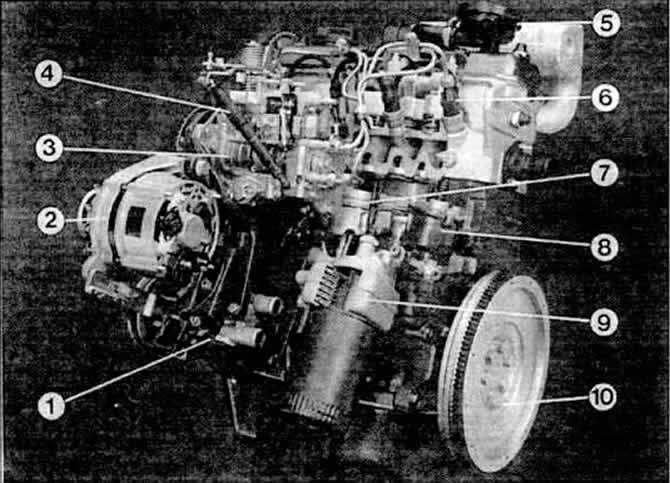
Sectional view of suction diesel engine:
1 - thermostat housing
2 - generator
3 - Fuel injection pump
4 - Gas-filled shock absorber (see chapter "Diesel injection system")
5 - Crankcase ventilation pressure regulator valve
6 - injectors
7 - piston
8 - vacuum pump for brake booster
9 - oil radiator
10 - flywheel
Note: A strong noise of valves in an engine with a hydraulic tappet may occur at first after the first start of the engine, which has been idle for a long time. This effect occurs when all the oil has leaked out of the hydraulic tappets and as a result, a gap has appeared in the valve drive again (see next section). There is no reason to worry: the noise will disappear after a short time and the valve drive will work without gaps again.
[The information is available on the website: VWManual]
The cylinder head also houses swirl rings along with injectors and glow plugs.
Visitor comments