



Contents: Safety valve ↓ Oil pump ↓ Pressure reducing valve ↓ Oil radiator ↓ Oil temperature ↓ Oil pressure ↓
In the engine, a number of bearings and friction pairs require lubrication. Motor oil is pumped there under pressure from the oil pump. The pump sucks oil through a mesh oil receiver and sends it to the oil filter. From the filter, the oil gets through holes in the cylinder block to the lubrication points of the crankshaft, intermediate shaft and cylinder head with the camshaft.
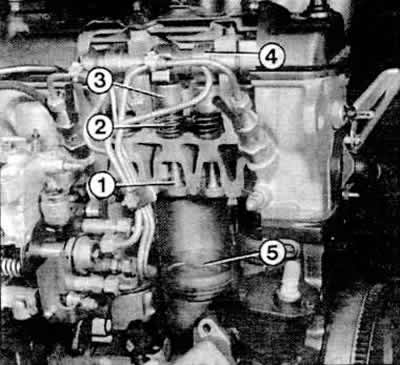
This sectional view of a diesel engine provides a good understanding of the relationship between the crankshaft and the valve control mechanism:
1 - valve
2 - valve spring
3 - pusher
4 - camshaft
5 - piston
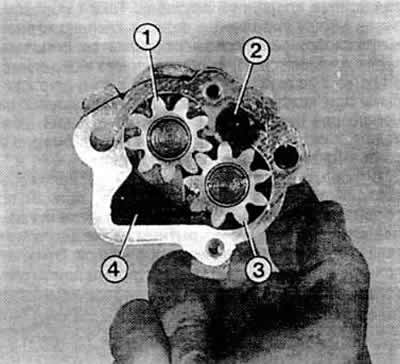
Oil pump (removed from the engine) consists of two gear wheels (1 and 3) meshed with each other. Engine oil is sucked in through chamber 4, and oil under pressure is supplied through chamber 2 to the engine lubrication points.
The oil drains back into the oil pan through the holes and can be sucked up by the oil pump for a new lubrication cycle.
Safety valve
If the oil filter element is dirty due to untimely replacement, the safety valve comes into action. It opens and the filter is bypassed by the oil flow, ensuring the flow of oil into the lubrication system. In this case, however, unfiltered motor oil increases engine wear.
Oil pump
About 35 liters of oil per minute are pumped through the engine at full throttle. The oil pump is driven by the already mentioned intermediate shaft. On the Golf/Vento models we used a conventional gear pump. Two meshing gears pump oil from the suction chamber to the pressure chamber.
Pressure reducing valve
To prevent the oil pressure in the lubrication system from becoming too high, there is a pressure reducing valve on the oil path from the oil pump to the oil filter, which opens when necessary and excess oil flows back to the suction pipe.
Oil radiator
The Volkswagen Golf/Vento and diesel are equipped with a through oil cooler, which is built in between the oil filter and the oil filter holder. The oil in the radiator is constantly cooled by the pumped coolant or, when the engine is cold, is slightly warmed by the already heated coolant.
Oil temperature
For optimum engine performance, oil temperature plays a decisive role. Due to the lack of an oil temperature gauge, it is impossible to monitor how the engine's thermal balance is maintained. Low oil temperatures are more dangerous than high ones. At temperatures below 60°C, oil additives are not yet fully effective, which leads to significant engine wear. Therefore, if possible, the engine speed should not be increased after a cold start above 3,500 rpm until the oil reaches a temperature of approximately 60°C. As a basis, it can be assumed that engine oil reaches 60°C in about 10 minutes in winter, and after 6 minutes in warm weather.
(The information is posted on this website: «vwmanual.ru»)
Oil pressure
At an oil temperature of 80°C, the pressure at 2000 rpm must reach at least 2 bar. This cannot be monitored in this form. As a standard monitoring option, there is a control switch, which, at a pressure above 0.15-0.45 bar, extinguishes the signal lamp on the instrument panel, as well as a second switch, which signals at high engine speeds that the pressure is too low. If the pressure drops at an engine speed of more than 2150 rpm to a value below 0.9 bar, the control lamp flashes and an audible signal sounds. More details on monitoring the oil pressure are available in the "Tools and devices" section.
Visitor comments