



Contents: Removal the cylinder head cover ↓ Removal the camshaft ↓ Hydraulic pusher ↓ Finding a defective hydraulic tappet ↓ Removal the hydraulic tappet ↓ Removal the cylinder head ↓ Checking the cylinder head ↓ Installing the cylinder head ↓ Selecting the correct cylinder block…↓
A torque wrench is required for most work on the cylinder head. A long T55 socket head cap wrench is also required to completely remove the head.
Removal the cylinder head cover
Remove the engine crankcase ventilation hose.
Remove the cover from the three retaining nuts.
Unscrew the nuts and remove the washers and gasket underneath them.
Place the parts next to the open cylinder head.
Carefully remove the cylinder head cover. If it is firmly seated, tap it with a hammer handle to release it.
Replace the rubber gasket of the cylinder head cover only if damaged.
Removal the camshaft
If the camshaft is removed from the removed cylinder head, then in addition to the already mentioned work on removing the toothed belt, the injection timing adjustment of the high-pressure fuel pump is added.
Set the first cylinder to the TDC position.
Remove the camshaft gear.
Number the camshaft bearing caps with a punch or chalk lines (for subsequent correct installation).
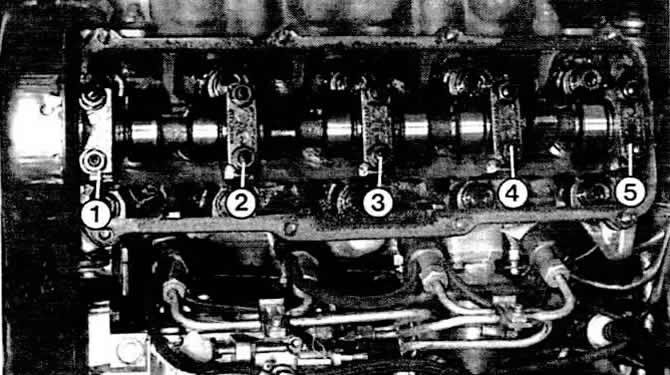
Remove bearing caps number 1, 3 and 5.
Loosen the nuts of bearing caps 2 and 4 alternately in a crosswise pattern.
Remove the camshaft.
For installation, lubricate all rubbing parts.
Insert the camshaft so that the cams of the first cylinder point upward at the same time.
First install bearing caps 2 and 4.
Note: The bearing hole is not in the middle. Therefore, pay attention to the installation location.
Tighten the nuts crosswise to a torque of 20 Nm.
Install the remaining bearing caps (moment 20 Nm).
Caution: The engine must not be started for the next 30 minutes. The hydraulic tappets, relieved of load, are pressed by their springs to the position of greatest extension. Because of this, the valves open so far during the first revolution of the camshaft that they collide with the pistons. After waiting for half an hour, the pressure in the hydraulic tappets decreases. To be sure, the engine should be turned twice by hand to be sure that the pistons cannot collide with the valves.
Hydraulic pusher
In general, valve knocking on a car with a hydraulic valve clearance compensator indicates one or more faulty hydraulic tappets. In this case, the corresponding tappet is not repaired, but must be replaced.
Valve noise can also appear with serviceable hydraulic lifters, including when:
- Immediately after starting, the pushrod is not yet supplied with oil.
- The car was driven hard at high ambient temperatures for a short time before starting and the oil became more fluid.
- The car has not been used for a long time. The knocking should disappear after reaching operating temperature.
Finding a defective hydraulic tappet
Warm up the engine and let it run until the electric fan of the cooling system turns on for the first time.
Increase the speed to 2800 rpm and maintain it for about two minutes.
If the valve noise does not disappear, turn off the engine and remove the cylinder head cover.
Set the cylinder to TDC. The camshaft cams should point upwards.
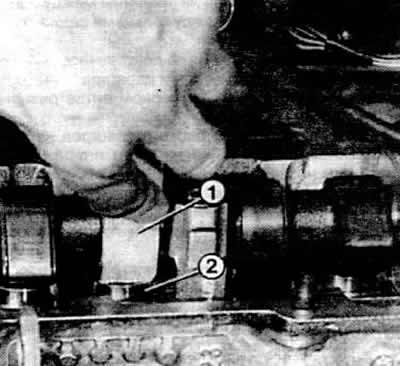
Press on the hydraulic tappet being tested using a wooden or plastic object (definitely not metallic).
If the pusher moves more than 0.1 mm, it must be replaced.
Caution: A knocking noise from hydraulic tappets may be caused by a faulty cylinder head gasket, which will allow exhaust gases to enter the oil system.
Removal the hydraulic tappet
Remove the camshaft.
Mark the pushers (you can use a felt-tip pen) so that when installing them they can be installed in the same order.
Pull the pusher up.
Place the tappet on a clean cloth with the side facing the camshaft down to prevent oil from leaking out.
After installing a new or unloaded tappet, the engine should not be started for 30 minutes.
This is done to prevent the valves from hitting the pistons.
Removal the cylinder head
In addition to special devices for removing the timing belt, a cylinder head gasket of the required thickness and a set of new cylinder head bolts are also used. Bolts with an internal hexagon on a diesel engine must be replaced.
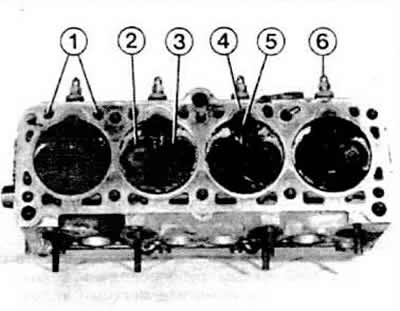
1 - channels for coolant
2 - one of the exhaust valves
3 - one of the intake valves
4 - vortex chamber insert
5 - hole of the "shuss" channel
6 - glow plug
Remove the ground cable from the battery.
Drain the coolant into a suitable container.
Remove the suction hose from the air filter housing.
Remove the cylinder head cover.
Remove the high pressure fuel lines and place them on a clean cloth.
Close the holes of the injectors and the fuel injection pump with plugs (made of plastic or, at worst, paper).
Remove the return line (excess fuel drain tubes) from injectors to fuel injection pump.
Disconnect the wires from the glow plugs.
Remove the plugs from the oil switch and temperature sensor.
Disconnect the exhaust pipe from the exhaust manifold.
Remove the timing belt.
Remove the coolant hoses from the cylinder head.
Bend the cold start accelerator rod to the side.
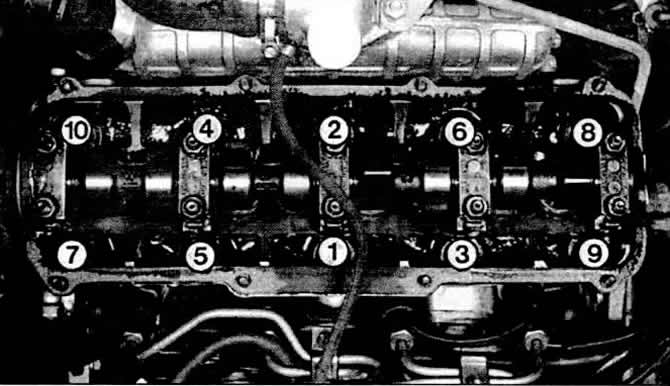
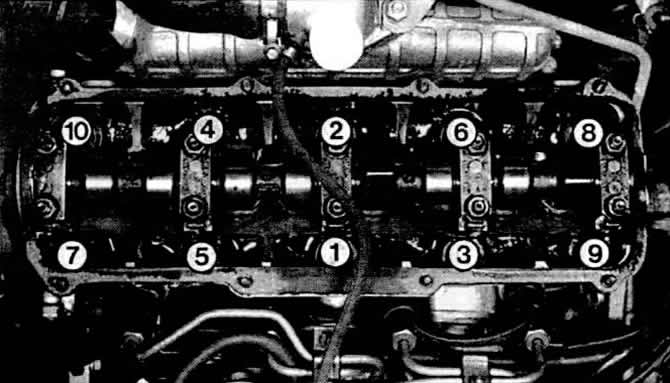
Loosen the cylinder head bolts in the reverse order to that shown in the figure. To do this, the engine must be cool so that the warm cylinder head can be handled after removal.
Lift the cylinder head together with the intake and exhaust pipes. If it does not go easily, help with light blows of a plastic hammer.
Remove the old cylinder head gasket.
Checking the cylinder head
The contact surfaces of the cylinder block and cylinder head must be absolutely clean and free of gasket residue.
Do not scratch the soft surfaces of the cylinder head gasket with a hard tool. Notches may cause subsequent damage to the cylinder head gasket.
Check for cracks between the valve seats or between the valve seat rings and the injector threads.
Light scratches no wider than 0.5 mm or cracks only on the first thread of the injectors do not affect the durability of the engine.
Check the cylinder head for warpage, especially if the gaskets have been damaged due to overheating.
Place a long metal ruler or a guaranteed straight metal corner along the cleaned surface of the cylinder head.
Check with a feeler gauge that the gap between the plane and the ruler is no more than 0.1 mm.
We do not recommend regrinding the cylinder head. If the gap is larger, the head should be replaced.
Installing the cylinder head
Now you must select the correct cylinder head gasket thickness as indicated earlier.
The threads on the cylinder head bolts and in the bolt holes must be clean and undamaged, otherwise the correct torque cannot be achieved when tightening the bolts.
There must be no oil or water in the bolt holes on the cylinder block, otherwise the metal in the thread area may tear.
Turn the crankshaft so that the pistons are not in the TDC position, otherwise the open valve may collide with the piston when the head is seated.
Place the cylinder head gasket on the cylinder block with the "top" marking facing the cylinder head.
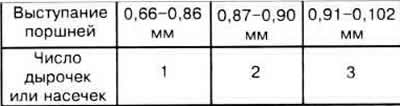
The thickness of the cylinder head gasket used can be determined according to the number of holes or notches in the place indicated by the black arrow. The relationship is given in the table below.
Install the cylinder head. To do this, the factory screws two guide bolts into the holes for bolts 8 and 10 when the cylinder block no longer has centering pins for the cylinder head gasket. The connection is given in the table below.
Install the cylinder head. To do this, the factory screws two guide bolts into the holes for bolts 8 and 10 when the cylinder block no longer has centering pins for the cylinder head gasket.
Two metal rods the thickness of the cylinder head bolts will also work temporarily. Without auxiliary means, the gasket and head will definitely shift during installation.
Install the cylinder head bolts and then tighten them with the engine cold according to the tightening diagram and the tightening torque given in the table below.
Install the remaining parts in the reverse order of dismantling.
The article is posted on the portal VWmanual.ru
Note: If the cylinder head was removed due to gasket damage, the coolant must be completely replaced. The same must be done when installing a cylinder head purchased as an exchange.
Cylinder head tightening torques

Selecting the correct cylinder block gasket
The diesel engine is equipped with cylinder head gaskets of different thicknesses. Their thickness depends on whether the pistons used in the engine have technological deviations at the top or bottom. Since the cylinder head gasket is located between the cylinder block and the cylinder head, it is possible to vary the height of the combustion chamber by choosing its thickness and thus equalize the different heights of the pistons. The thickness of the gasket is determined by the number of small holes or notches on the side of the gasket shown in the figure. The holes or notches are visible from the outside on the already installed cylinder head.
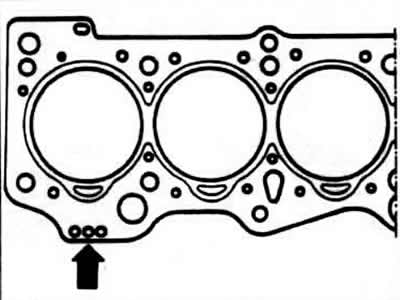
If only the cylinder head is being replaced on the engine or the old head is being removed and then installed, you can buy a new gasket simply based on the old one, i.e. with the same number of holes or notches. If piston group parts are being replaced (crankshaft, connecting rods, pistons) or the cylinder block is replaced completely, it is necessary to re-measure the piston protrusion. This is an indicator of how much the pistons protrude above the cylinder block. The required gasket is selected according to the table.
Visitor comments