
English Русский
Български
Беларускі
Український
Српски
Hrvatski
Română
Polski
Slovenský
Magyar
  |  Articles  |  Sitemap  |  Contacts  |    |
Car maintenance Ford Car maintenance Hyundai Car maintenance Chevrolet Car maintenance BMW Car maintenance Audi Car maintenance Opel Car maintenance AvtoVAZ
VWmanual.ru


Main   Passat   Golf   Polo   Touareg   Tiguan   Sharan   Transporter   Others  
Golf 1 (1974-1984, diesel) Golf 1 (1974-1984, petrol) Golf 2 (1984-1993, petrol) Golf 2 (1984-1993) Golf 3 (1991-1997) Golf 4 (1997-2004) Golf 5 (2003-2008)

Removal and installation the engine (VW Golf 3)

  • Main
  • Golf
  • Golf 3
  • Diesel engine
  • Engine repair
  • Removal and installation the engine
            0


Contents: Removal ↓ Installation ↓
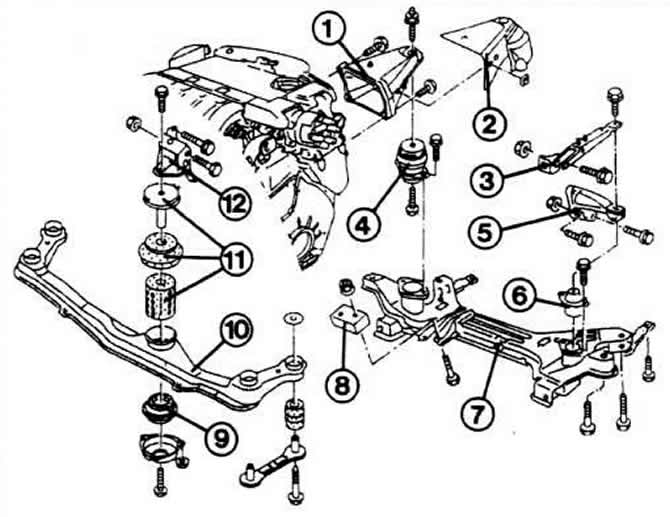
1 - right engine console

1 - right engine console
2 - casing (not installed on our models)
3 - gearbox support
4 - rubber-metal support
5 - left gearbox console
6 - rubber-metal support
7 - aggregate beam
8 - counterweight
9 - rubber-metal support
10 - engine beam
11 - rubber-metal support
12 - Front engine console


The engine is pulled out upwards together with the gearbox. To do this, you will need a lift that you can hang stably at the required height.

It is recommended to carry out this work with an assistant. Before work, look at the picture of the engine compartment so that you know where the parts described are located.

Since the Golf model has a large number of electrical wires and vacuum hoses, you must first mark all their connection points in order to install them correctly.

Removal


Remove the battery.

Remove the engine hood.

On vehicles with air conditioning, do not open the coolant line!

Since the compressor is removed when there is an air conditioning system, it must be secured together with the closed hoses on the front side of the car in such a way that the hoses are not under tension.


Unscrew the air conditioning fluid reservoir and leave it hanging freely.

Remove the front of the vehicle. If the vehicle has an air conditioning system, the front of the vehicle must be placed on a crossbar due to the coolant hoses and secured with wire to prevent it from rolling away.
Remove the front of the vehicle. If the vehicle has an air conditioning system, the front of the…


Remove the air filter housing together with the front and rear suction hoses from the engine.

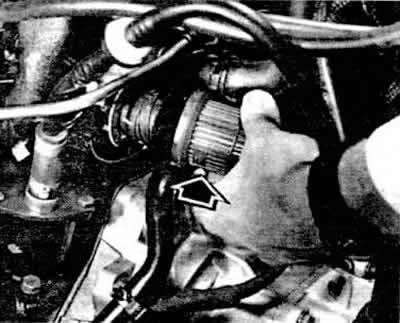
Separate the central plug of the engine. To do this, hold the narrow part of the plug (arrow) and turn the wide ring.

Remove the cable plugs from the reverse light switch and the tachometer sensor.

Loosen the ground connections on the gearbox and pull it out.

Hang the gas rod on the fuel injection pump lever and on the stop. Insert the safety cover back into the cut (maintains adjustment during assembly).

Disconnect the cold start acceleration rod from the fuel injection pump.

Close the connection point on the high-pressure fuel pump again with a wooden plug.

Remove the hose between the vacuum pump and the brake booster.

Disconnect the clutch rod from the lever and set it aside.

Loosen the two bolts on the servo pump tensioner.

Loosen the two bolts on the servo pump tensioner.


Loosen the three mounting bolts of the pivot arm and remove the V-belt.

Set the power steering pump and plugged hoses aside.

Drain the coolant.

Remove all coolant hoses between the radiator, heating system heat exchanger, engine and expansion tank.

For vehicles with automatic transmission, remove the notched V-belt.

Remove the shock absorber and water pump pulley.

Stop the car from the front.

Remove the shift rod and the short rod of the gearshift lever. To do this, on the long rod on the left in the direction of travel, pull the clamping lever on the plastic head with a screwdriver, pull the hose away from the head.

On an automatic transmission, set the gearshift lever to position "P" and remove the rod from the transmission.

Unscrew the front wheel drive cardan shafts on the right and left of the gearbox and tie them to the body with wire.

Unscrew the counterweight from the aggregate beam.

If present, unscrew the heat shield for the inner joint of the right cardan shaft.

Unscrew the exhaust pipe from the exhaust manifold.

"Let go" of the car.

Disconnect the ABS sensor plug connection on the right engine console (anti-lock braking system).

Unscrew the bolt between the right engine console and the rubber-metal support.

Release the gearbox console from the rubber-metal support.

Raise the engine/gearbox assembly slightly (power unit).

Remove the crankcase.

Remove the bolt from the top of the front rubber-metal support.

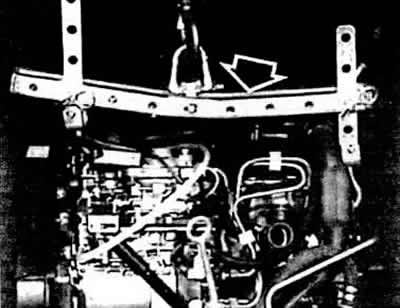
Pass two chains or suitable steel cables through the axles on the right and left of the engine and attach them to the hoist.

Unscrew the supports and gearbox consoles.

Gently pull out the power unit by turning it slightly.

When lifting the engine, carefully guide it by hand so that engine or body parts do not interfere with lifting.

Loosen the engine mounting bolts to the gearbox.

Separate the engine from the gearbox by pressing, for example, with a crowbar.

Installation


All work is carried out in reverse order.

Replace all self-locking nuts.

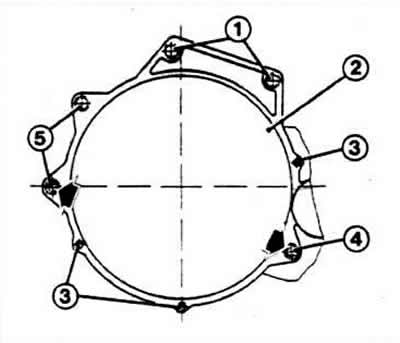
Check whether the guide bushings are inserted into the cylinder block - they serve to center the engine and gearbox.
Check whether the guide bushings are inserted into the cylinder block - they serve to center the…


Bolt the engine to the gearbox

Bolt tightening torques:
  • 1 - 80 Nm (M12x55)
  • 2 - 10 Nm (M6x8)
  • 3 - 10 Nm (M7x12)
  • 4 - 80 Nm (M12x64)
  • 5 - 60 Nm (M10X140)

Arrows indicate guide bushings for centering the engine and gearbox.

Lower the power unit into the vehicle.

When installing the engine mounts, the recess on the front and rear suspension console must fit into the clamping pin of the rubber-metal mount.

Align the power unit with shaking movements, tighten the screw connections.

Depress the clutch pedal at least five times all the way.

Press the attached control lever approximately 10 mm in the opposite direction to its direction of movement; it should move freely.

It is necessary to adjust the throttle, gear shifting, idle speed and, after installing the front part of the car, the lighting devices.

Tightening torques
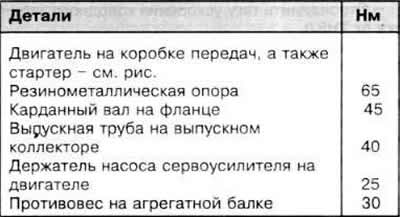
Tightening torques

This article is available at russian, bulgarian, belarusian, ukrainian, serbian, croatian, romanian, polish, slovak, hungarian
The text has been checked: Medvedeva Elena

Share information:

Previous articles
Bearing damage
Work on the cylinder head
Cylinder Head Gasket Fault Diagnosis
Timing Belt Fault Diagnosis
Engine fault diagnostics
Measuring compression pressure
Next articles
Turbocharged diesel engine
Boost pressure regulator
Removal the turbocharger
Troubleshooting


Similar articles from other manuals for VW cars:
Starting the car engine Passat B3 (1988-1993)
Starting the engine from an auxiliary battery Polo 3 (1995-2003)
Car engine number Touareg 1 (2002-2006)
Car engine number Tiguan 1 (2007-2015)
Checking the engine oil level and replacing it Sharan 1 (1995-2000)
Starting the engine from another source Transporter T4 (1990-2003)
Visual inspection of parts in the engine compartment and on the… Caddy 3 (2003-2010)
Link to this page in different formats


Visitor comments


No comments yet


How much will 21 + 42 =


Golf 5 
  • General information
  • User manual
  • Maintenance
  • Troubleshooting
  • Power unit
  • Engine repair
  • Cooling and ventilation system
  • Fuel system
  • Ignition system
  • Transmission
  • Clutch
  • Mechanical gearbox
  • Automatic gearbox
  • Chassis
  • Brake system
  • Car suspension
  • Steering
  • Body
  • Interior (internal elements)
  • Exterior (external elements)
  • Doors and covers
  • Electrical equipment
  • Power devices
  • Washers and wipers
  • Lighting and appliances
  • Electrical circuits
Golf 4 
  • General information
  • User manual
  • Weekly checks
  • Maintenance
  • Power unit
  • Petrol engines
  • Diesel engines
  • Cooling system
  • Fuel system (petrol)
  • Control system (petrol)
  • Fuel system (diesel)
  • Exhaust system
  • Transmission
  • Clutch
  • Car gearbox
  • Drive shafts
  • Chassis
  • Car suspension
  • Steering
  • Wheels and tires
  • Brake system
  • Body
  • Exterior (external elements)
  • Interior (internal elements)
  • Ventilation and heating
  • Car doors and sunroof
  • Washers and glass cleaners
  • Electrical equipment
  • Power devices
  • Lighting and appliances
  • Electrical circuits
Golf 3 
  • Petrol engine
  • Engine repair
  • Lubrication system
  • Cooling system
  • Ignition system
  • Diesel engine
  • Engine repair
  • Diesel injection system
  • Pre-glow system
  • Transmission
  • Clutch
  • Gearbox and drive shafts
  • Chassis
  • Steering
  • Wheels and suspension
  • Brake system
  • Electrical equipment
  • Lighting and appliances
  • Electrical circuits
Golf 2 
  • General information
  • Introduction to guide
  • User manual
  • Petrol engines 1.3 l
  • Engine repair
  • Lubrication system
  • Cooling system
  • Carburetors
  • Supply system
  • Ignition system
  • Petrol engines 1.6/1.8 l
  • Engine repair
  • Supply system
  • Ignition system
  • Diesel engines
  • Engine repair
  • Lubrication system
  • Cooling system
  • Power and exhaust system
  • Transmission
  • Clutch
  • 4-speed gearbox 084
  • 5-speed gearbox 085
  • 4-speed gearbox 020/4R
  • 5-speed gearbox 020/4T
  • Automatic gearbox
  • Drive shafts
  • Chassis
  • Steering
  • Car suspension
  • Brake system
  • Body
  • Body elements
  • Doors, locks and windows
  • Electrical equipment
  • Equipment and devices
  • Power devices
Golf 2 (petrol) 
  • General information
  • Characteristics
  • Car care
  • Maintenance
  • Power unit
  • Engine repair
  • Engine 1.05/1.30
  • Engine 1.60/1.80
  • Cooling and lubrication system
  • Power and exhaust system
  • Transmission
  • Clutch
  • Car gearbox
  • Drive shafts
  • Chassis
  • Brake system
  • Steering
  • Suspension
  • Body
  • Body and equipment
  • Electrical equipment
  • Lighting and appliances
  • Electrical circuits
Golf 1 (petrol) 
  • General information
  • Characteristics
  • User manual
  • Maintenance
  • Power unit
  • Engine adjustment
  • Engine 1.1/1.3
  • Engine 1.5/1.6/1.8
  • Engine electrical equipment
  • Cooling system
  • Fuel system
  • Transmission
  • Clutch and manual gearbox
  • Automatic gearbox
  • Chassis
  • Steering
  • Front suspension
  • Rear suspension
  • Brake system
  • Electrical equipment
  • Lighting and appliances
  • Electrical circuits
  • Body
  • Body and equipment
  • Optional equipment
Golf 1 (diesel) 
  • General information
  • Specifications
  • Maintenance
  • Power unit
  • Engine repair
  • Exhaust and turbocharger
  • Cooling system
  • Fuel system
  • Fuel injection system
  • Transmission
  • Clutch and drive shafts
  • Car gearbox
  • Chassis
  • Suspension and wheels
  • Steering
  • Brake system
  • Wheels and tires
  • Body
  • Heating and ventilation
  • Exterior (external elements)
  • Interior (internal elements)
  • Doors and windows
  • Electrical equipment
  • Equipment and devices
  • Lighting system
  • Power devices
  • Electrical circuits
VWmanual.ru © 2016-2026 | Mobile version | News and articles | Sitemap: EN BG BY UA RS HR RO PL SK HU | Write message | Site search
Passat B2 • Passat B3 • Passat B4 • Passat B5 • Passat B6 • Golf 1, diesel • Golf 1, petrol • Golf 2, petrol • Golf 2 • Golf 3 • Golf 4 • Golf 5 • Polo 3 • Polo 4 • Touareg 1 • Tiguan 1 • Sharan 1 • Transporter T3 • Transporter T4 • LT 28 • LT 2D • Beetle • Caddy 3 •
Our website uses cookies to ensure functionality and convenience.