
English Русский
Български
Беларускі
Український
Српски
Hrvatski
Română
Polski
Slovenský
Magyar
  |  Articles  |  Sitemap  |  Contacts  |    |
Car maintenance Ford Car maintenance Hyundai Car maintenance Chevrolet Car maintenance BMW Car maintenance Audi Car maintenance Opel Car maintenance AvtoVAZ
VWmanual.ru


Main   Passat   Golf   Polo   Touareg   Tiguan   Sharan   Transporter   Others  
Golf 1 (1974-1984, diesel) Golf 1 (1974-1984, petrol) Golf 2 (1984-1993, petrol) Golf 2 (1984-1993) Golf 3 (1991-1997) Golf 4 (1997-2004) Golf 5 (2003-2008)

Engine oil change (VW Golf 2)

  • Main
  • Golf
  • Golf 2
  • Power unit
  • Cooling and lubrication system
  • Engine oil change
            0


Contents: Replacing the oil filter in 1.1 and…↓ Replacing the oil filter in 1.6 and…↓
It is necessary to install the car on a flat surface. Unscrew the drain plug of the oil pan and drain the used oil into a previously prepared container of the appropriate size. Drain the oil when it is hot. Warming up the engine while parked (what is often done in workshops) is harmful to the engine and lasts much longer. Therefore, before the scheduled oil change, you should drive at least two kilometers to warm up the engine. Both at the choke and at low speeds, the carburetor supplies a rich mixture. In this mixture, the fuel does not evaporate to a large extent and flows into the cylinder as a liquid. Liquid fuel thoroughly washes oil from the surface of the cylinder, accelerating its wear. During oil leakage (minimum five minutes) we replace the oil filter.

When the oil drain is complete, screw in the drain plug (in models 1.6 and 1.8 it is also necessary to replace the o-ring of the drain plug) and fill the oil to the required level. Remember that you need to wait about five minutes after filling the oil to find out the correct level on the dipstick.

Replacing the oil filter in 1.1 and 1.3 L engines


The oil filter is located on the side wall of the engine housing on the same side as the generator. It is necessary to place the appropriate reservoir (tank) under the filter, then, using a special self-tightening key, unscrew it and remove it. Then wipe the sealing surface on the cylinder block clean and cover it with fresh oil. Lubricate the sealing rubber on the new filter with oil and press the filter manually, without using a key. Lubricate the mating surface with oil so that the rubber gasket slides along the housing during pressing. This will ensure its normal placement and proper sealing of the connection. If a leak appears after starting the engine, you can try to press the filter harder. However, screwing it in manually is usually enough.


Replacing the oil filter in 1.6 and 1.8 L engines


The oil filter is bolted to a bracket attached to the engine body, below the distributor. This is called a side filter. On fuel-injected models, the oil cooler is connected between this bracket and the filter insert. The filter should be replaced every 10,000 km.

1. Place a suitable container under the filter, then use a clamping wrench (photo 2.20) to unscrew the filter and remove it. To have better access to the filter, you must either raise the front of the car with a jack or place the car over a groove or on a ramp.
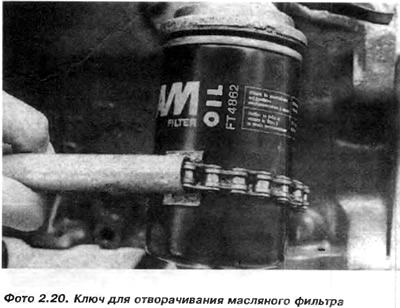
1. Place a suitable container under the filter, then use a clamping wrench (photo 2.20) to unscrew…


2. Wipe clean the sealing surfaces of the filter and oil cooler bracket.

3. If it is necessary to remove the oil cooler (fuel injection models), the cooling system should be drained and the elastic coolant hoses disconnected. The rubber o-ring between the oil cooler and the bracket should be replaced.

4. If the oil filter bracket needs to be removed, disconnect the oil pressure sensor wire, loosen the mounting bolts and remove the bracket and gasket. The oil pressure sensor can be unscrewed from the top of the bracket if necessary. Remove and replace the sensor's rubber o-ring.


5. Install the oil filter in the reverse order of removal. Replace the bracket gasket and sealing rings if necessary.

6. Spread the engine oil over the sealing rubber of the new filter. If this is not done, the sealing rubber may be warped during final compression. Then secure and tighten the filter manually (or according to the recommendations given on the filter insert).

7. Top up the engine oil. Start the engine and check for any oil leaks near the filter bracket. If any leaks appear, press the filter harder or replace the filter seal manually.

This article is available at russian, bulgarian, belarusian, ukrainian, serbian, croatian, romanian, polish, slovak, hungarian
The text has been checked: Semenova Anna

Share information:

Previous articles
Checking the engine oil level
Lubrication system device
Water temperature sensor, thermal switches
Water pump — 1.6 and 1.8L engines
Water pump — 1.1 and 1.3L engines
Thermostat — 1.6 and 1.8 L engines
Next articles
Oil pump — 1.1 and 1.3L engines
Oil pump — 1.6 and 1.8L engines


Similar articles from other manuals for VW cars:
Engine oil change Passat B4 (1988-1996)
Maintenance with engine oil change Polo 4 (2001-2009)
Car engine number Touareg 1 (2002-2006)
Car engine number Tiguan 1 (2007-2015)
Engine oil change Sharan 1 (1995-2000)
Engine oil change Transporter T4 (1990-2003)
Visual inspection of parts in the engine compartment and on the… Caddy 3 (2003-2010)
Link to this page in different formats


Visitor comments


No comments yet


How much will 11 + 44 =


Golf 5 
  • General information
  • User manual
  • Maintenance
  • Troubleshooting
  • Power unit
  • Engine repair
  • Cooling and ventilation system
  • Fuel system
  • Ignition system
  • Transmission
  • Clutch
  • Mechanical gearbox
  • Automatic gearbox
  • Chassis
  • Brake system
  • Car suspension
  • Steering
  • Body
  • Interior (internal elements)
  • Exterior (external elements)
  • Doors and covers
  • Electrical equipment
  • Power devices
  • Washers and wipers
  • Lighting and appliances
  • Electrical circuits
Golf 4 
  • General information
  • User manual
  • Weekly checks
  • Maintenance
  • Power unit
  • Petrol engines
  • Diesel engines
  • Cooling system
  • Fuel system (petrol)
  • Control system (petrol)
  • Fuel system (diesel)
  • Exhaust system
  • Transmission
  • Clutch
  • Car gearbox
  • Drive shafts
  • Chassis
  • Car suspension
  • Steering
  • Wheels and tires
  • Brake system
  • Body
  • Exterior (external elements)
  • Interior (internal elements)
  • Ventilation and heating
  • Car doors and sunroof
  • Washers and glass cleaners
  • Electrical equipment
  • Power devices
  • Lighting and appliances
  • Electrical circuits
Golf 3 
  • Petrol engine
  • Engine repair
  • Lubrication system
  • Cooling system
  • Ignition system
  • Diesel engine
  • Engine repair
  • Diesel injection system
  • Pre-glow system
  • Transmission
  • Clutch
  • Gearbox and drive shafts
  • Chassis
  • Steering
  • Wheels and suspension
  • Brake system
  • Electrical equipment
  • Lighting and appliances
  • Electrical circuits
Golf 2 
  • General information
  • Introduction to guide
  • User manual
  • Petrol engines 1.3 l
  • Engine repair
  • Lubrication system
  • Cooling system
  • Carburetors
  • Supply system
  • Ignition system
  • Petrol engines 1.6/1.8 l
  • Engine repair
  • Supply system
  • Ignition system
  • Diesel engines
  • Engine repair
  • Lubrication system
  • Cooling system
  • Power and exhaust system
  • Transmission
  • Clutch
  • 4-speed gearbox 084
  • 5-speed gearbox 085
  • 4-speed gearbox 020/4R
  • 5-speed gearbox 020/4T
  • Automatic gearbox
  • Drive shafts
  • Chassis
  • Steering
  • Car suspension
  • Brake system
  • Body
  • Body elements
  • Doors, locks and windows
  • Electrical equipment
  • Equipment and devices
  • Power devices
Golf 2 (petrol) 
  • General information
  • Characteristics
  • Car care
  • Maintenance
  • Power unit
  • Engine repair
  • Engine 1.05/1.30
  • Engine 1.60/1.80
  • Cooling and lubrication system
  • Power and exhaust system
  • Transmission
  • Clutch
  • Car gearbox
  • Drive shafts
  • Chassis
  • Brake system
  • Steering
  • Suspension
  • Body
  • Body and equipment
  • Electrical equipment
  • Lighting and appliances
  • Electrical circuits
Golf 1 (petrol) 
  • General information
  • Characteristics
  • User manual
  • Maintenance
  • Power unit
  • Engine adjustment
  • Engine 1.1/1.3
  • Engine 1.5/1.6/1.8
  • Engine electrical equipment
  • Cooling system
  • Fuel system
  • Transmission
  • Clutch and manual gearbox
  • Automatic gearbox
  • Chassis
  • Steering
  • Front suspension
  • Rear suspension
  • Brake system
  • Electrical equipment
  • Lighting and appliances
  • Electrical circuits
  • Body
  • Body and equipment
  • Optional equipment
Golf 1 (diesel) 
  • General information
  • Specifications
  • Maintenance
  • Power unit
  • Engine repair
  • Exhaust and turbocharger
  • Cooling system
  • Fuel system
  • Fuel injection system
  • Transmission
  • Clutch and drive shafts
  • Car gearbox
  • Chassis
  • Suspension and wheels
  • Steering
  • Brake system
  • Wheels and tires
  • Body
  • Heating and ventilation
  • Exterior (external elements)
  • Interior (internal elements)
  • Doors and windows
  • Electrical equipment
  • Equipment and devices
  • Lighting system
  • Power devices
  • Electrical circuits
VWmanual.ru © 2016-2026 | Mobile version | News and articles | Sitemap: EN BG BY UA RS HR RO PL SK HU | Write message | Site search
Passat B2 • Passat B3 • Passat B4 • Passat B5 • Passat B6 • Golf 1, diesel • Golf 1, petrol • Golf 2, petrol • Golf 2 • Golf 3 • Golf 4 • Golf 5 • Polo 3 • Polo 4 • Touareg 1 • Tiguan 1 • Sharan 1 • Transporter T3 • Transporter T4 • LT 28 • LT 2D • Beetle • Caddy 3 •
Our website uses cookies to ensure functionality and convenience.