English Русский
Български
Беларускі
Український
Српски
Hrvatski
Română
Polski
Slovenský
Magyar
  |  Articles  |  Sitemap  |  Contacts  |    |
Car maintenance Ford Car maintenance Hyundai Car maintenance Chevrolet Car maintenance BMW Car maintenance Audi Car maintenance Opel Car maintenance AvtoVAZ
VWmanual.ru


Main   Passat   Golf   Polo   Touareg   Tiguan   Sharan   Transporter   Others  
Golf 1 (1974-1984, diesel) Golf 1 (1974-1984, petrol) Golf 2 (1984-1993, petrol) Golf 2 (1984-1993) Golf 3 (1991-1997) Golf 4 (1997-2004) Golf 5 (2003-2008)

Radiator — removal and installation (VW Golf 2)

  • Main
  • Golf
  • Golf 2
  • Power unit
  • Cooling and lubrication system
  • Radiator — removal and installation
            0


Contents: Extraction ↓ Radiator installation ↓

Extraction


1. Disconnect the negative battery cable.

2. Drain the liquid from the cooling system.

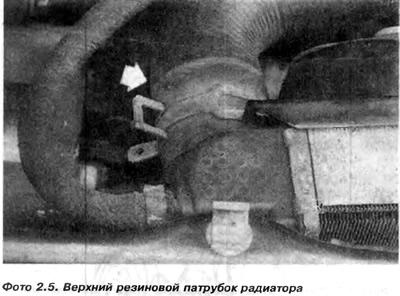
3. Disconnect the electrical wire from the thermal switch and from the radiator fan motor (photo 2.3 and 2.4) and disconnect the upper hose from the radiator (photo 2.5).
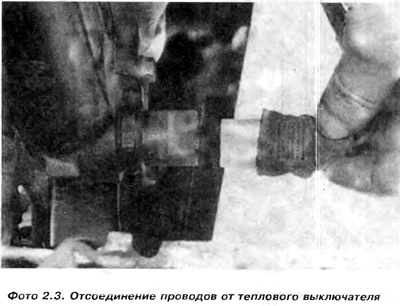
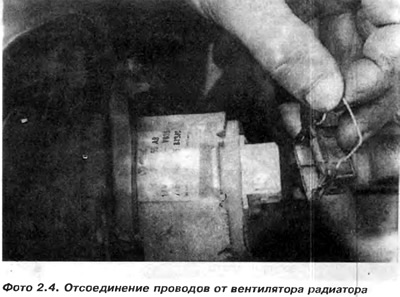
3. Disconnect the electrical wire from the thermal switch and from the radiator fan motor (photo…


3. Disconnect the electrical wire from the thermal switch and from the radiator fan motor (photo…


3. Disconnect the electrical wire from the thermal switch and from the radiator fan motor (photo…


5. Disconnect the air outlet pipe from the fitting 2 of the equalizing tank (photo 2.1).
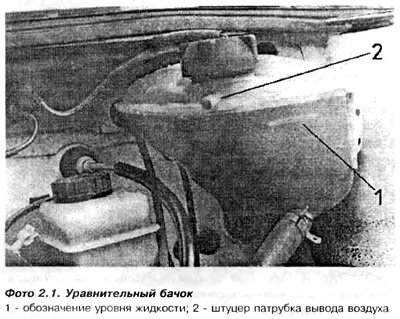


5. Disconnect the air outlet pipe from the fitting 2 of the equalizing tank (photo 2.1).


6. Remove the two bolts securing the radiator to the front area (photo 2.6, 2.7 and 2.8).
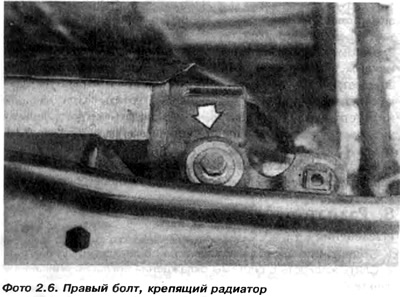
6. Remove the two bolts securing the radiator to the front area (photo 2.6, 2.7 and 2.8).
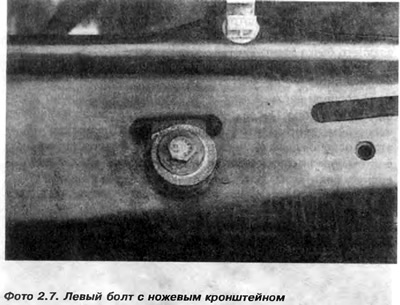

6. Remove the two bolts securing the radiator to the front area (photo 2.6, 2.7 and 2.8).
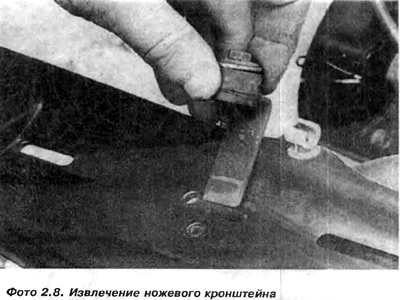

6. Remove the two bolts securing the radiator to the front area (photo 2.6, 2.7 and 2.8).


The bolt in the middle of the upper plane of the front zone secures the radiator bracket. After unscrewing this bolt, we remove the bracket by moving it upwards. The right side of the radiator is then released. The left side of the radiator is screwed with a bolt through a rubber-metal bushing. It is enough to unscrew the bolt to also release the left side.


7. Remove the plastic radiator cover 4 (see figure 11.1).

8. Unscrew the four fastening bolts, left and right air guides 1 and 6 (figure 2.2) from the sides of the radiator.
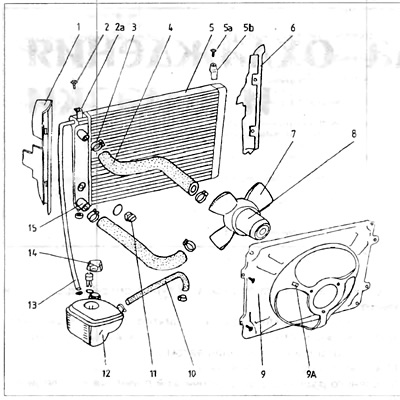
Figure 2.2. Cooling system - 1.1 and 1.3 l engines

Figure 2.2. Cooling system - 1.1 and 1.3 l engines
1 - left cover; 2 - bolt securing the radiator; 2a - permanent mounting bracket; 3 - pressure belt; 4 - head/radiator pipe; 5 - radiator; 5a - fastening bolt; 5b - removable bracket, 6 - right cover. 7 fan blades 8 - fan motor, 9 - fan cover; 9a - fastening the wires supplying the fan; 10 - expansion tank pipe/heater pipe; 11 - radiator thermal switch; 12 - expansion tank. 13 - expansion tank/radiator pipe; 14 - cork; 15 - outlet fitting.


9. Remove the radiator from the engine chamber, being careful not to damage it (photo 2.9). If necessary, you can unscrew the four upper bolts that secure the front part to the wings and bend this part slightly.
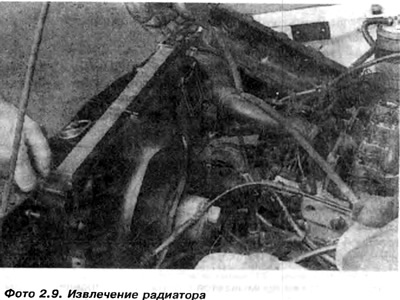
9. Remove the radiator from the engine chamber, being careful not to damage it (photo 2.9). If…


10. Unscrew the screws and remove the casing together with the fan from the radiator (photo 2.10).
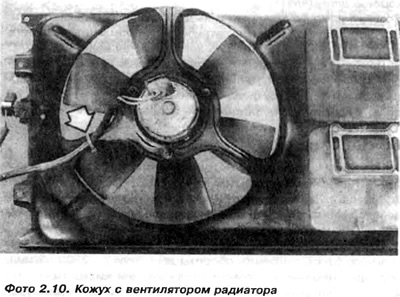
10. Unscrew the screws and remove the casing together with the fan from the radiator (photo 2.10).


11. Repairing a radiator is impossible without special equipment, although small leaks can be sealed with a sealing agent.

12. Clean the radiator tubes from insects and small leaves with a soft brush or water from a hose. Then flush the radiator in the opposite direction as described in point 5. Replace the hoses and clamps if they are damaged or torn.

Radiator installation


13. Installation is performed in the reverse order of removal. During installation, it is necessary to replace the shock absorber rubber on the lower bolts securing the radiator (photo 2.11). The radiator fixing bolts must be inserted into the corresponding holes in the cross beam.
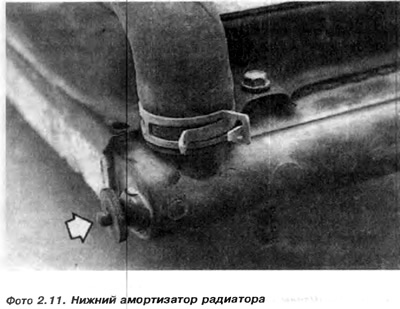
13. Installation is performed in the reverse order of removal. During installation, it is necessary…


14. Insert the central bracket into the radiator socket (photo 2.8) and press it down. Insert and tighten the second bolt securing the radiator (photo 2.6).

15. Fill the cooling system with liquid.

16. Connect the radiator fan motor wires and secure them to the 9A rib (figure 2.2) fan shroud.

(The original article is available on the website: vwmanual.ru)

This article is available at russian, bulgarian, belarusian, ukrainian, serbian, croatian, romanian, polish, slovak, hungarian
The text has been checked: Semenova Anna

Share information:

Previous articles
Antifreeze — General Information and Replacement
Filling the lubrication and cooling system
Rinsing the system
Draining the coolant
Periodic maintenance of the lubrication and cooling system
Operation of the cooling system
Next articles
Radiator fan
Radiator Fan Thermal Switch
Thermostat — 1.1 and 1.3L engines
Thermostat — 1.6 and 1.8 L engines
Water pump — 1.1 and 1.3L engines
Water pump — 1.6 and 1.8L engines


Similar articles from other manuals for VW cars:
Radiator fan Passat B3 (1988-1993)
Radiator grille Polo 3 (1995-2003)
Removal and installation the radiator (petrol engine) Touareg 1 (2002-2006)
Removal and installation the radiator and radiator fan V7 Tiguan 1 (2007-2015)
Oil radiator — removal and installation Sharan 1 (1995-2000)
Removal the radiator Transporter T4 (1990-2003)
Parts and components of the thermostat, radiator and expansion… Caddy 3 (2003-2010)
Link to this page in different formats


Visitor comments


No comments yet


How much will 22 + 38 =


Golf 5 
  • General information
  • User manual
  • Maintenance
  • Troubleshooting
  • Power unit
  • Engine repair
  • Cooling and ventilation system
  • Fuel system
  • Ignition system
  • Transmission
  • Clutch
  • Mechanical gearbox
  • Automatic gearbox
  • Chassis
  • Brake system
  • Car suspension
  • Steering
  • Body
  • Interior (internal elements)
  • Exterior (external elements)
  • Doors and covers
  • Electrical equipment
  • Power devices
  • Washers and wipers
  • Lighting and appliances
  • Electrical circuits
Golf 4 
  • General information
  • User manual
  • Weekly checks
  • Maintenance
  • Power unit
  • Petrol engines
  • Diesel engines
  • Cooling system
  • Fuel system (petrol)
  • Control system (petrol)
  • Fuel system (diesel)
  • Exhaust system
  • Transmission
  • Clutch
  • Car gearbox
  • Drive shafts
  • Chassis
  • Car suspension
  • Steering
  • Wheels and tires
  • Brake system
  • Body
  • Exterior (external elements)
  • Interior (internal elements)
  • Ventilation and heating
  • Car doors and sunroof
  • Washers and glass cleaners
  • Electrical equipment
  • Power devices
  • Lighting and appliances
  • Electrical circuits
Golf 3 
  • Petrol engine
  • Engine repair
  • Lubrication system
  • Cooling system
  • Ignition system
  • Diesel engine
  • Engine repair
  • Diesel injection system
  • Pre-glow system
  • Transmission
  • Clutch
  • Gearbox and drive shafts
  • Chassis
  • Steering
  • Wheels and suspension
  • Brake system
  • Electrical equipment
  • Lighting and appliances
  • Electrical circuits
Golf 2 
  • General information
  • Introduction to guide
  • User manual
  • Petrol engines 1.3 l
  • Engine repair
  • Lubrication system
  • Cooling system
  • Carburetors
  • Supply system
  • Ignition system
  • Petrol engines 1.6/1.8 l
  • Engine repair
  • Supply system
  • Ignition system
  • Diesel engines
  • Engine repair
  • Lubrication system
  • Cooling system
  • Power and exhaust system
  • Transmission
  • Clutch
  • 4-speed gearbox 084
  • 5-speed gearbox 085
  • 4-speed gearbox 020/4R
  • 5-speed gearbox 020/4T
  • Automatic gearbox
  • Drive shafts
  • Chassis
  • Steering
  • Car suspension
  • Brake system
  • Body
  • Body elements
  • Doors, locks and windows
  • Electrical equipment
  • Equipment and devices
  • Power devices
Golf 2 (petrol) 
  • General information
  • Characteristics
  • Car care
  • Maintenance
  • Power unit
  • Engine repair
  • Engine 1.05/1.30
  • Engine 1.60/1.80
  • Cooling and lubrication system
  • Power and exhaust system
  • Transmission
  • Clutch
  • Car gearbox
  • Drive shafts
  • Chassis
  • Brake system
  • Steering
  • Suspension
  • Body
  • Body and equipment
  • Electrical equipment
  • Lighting and appliances
  • Electrical circuits
Golf 1 (petrol) 
  • General information
  • Characteristics
  • User manual
  • Maintenance
  • Power unit
  • Engine adjustment
  • Engine 1.1/1.3
  • Engine 1.5/1.6/1.8
  • Engine electrical equipment
  • Cooling system
  • Fuel system
  • Transmission
  • Clutch and manual gearbox
  • Automatic gearbox
  • Chassis
  • Steering
  • Front suspension
  • Rear suspension
  • Brake system
  • Electrical equipment
  • Lighting and appliances
  • Electrical circuits
  • Body
  • Body and equipment
  • Optional equipment
Golf 1 (diesel) 
  • General information
  • Specifications
  • Maintenance
  • Power unit
  • Engine repair
  • Exhaust and turbocharger
  • Cooling system
  • Fuel system
  • Fuel injection system
  • Transmission
  • Clutch and drive shafts
  • Car gearbox
  • Chassis
  • Suspension and wheels
  • Steering
  • Brake system
  • Wheels and tires
  • Body
  • Heating and ventilation
  • Exterior (external elements)
  • Interior (internal elements)
  • Doors and windows
  • Electrical equipment
  • Equipment and devices
  • Lighting system
  • Power devices
  • Electrical circuits
VWmanual.ru © 2016-2026 | Mobile version | News and articles | Sitemap: EN BG BY UA RS HR RO PL SK HU | Write message | Site search
Passat B2 • Passat B3 • Passat B4 • Passat B5 • Passat B6 • Golf 1, diesel • Golf 1, petrol • Golf 2, petrol • Golf 2 • Golf 3 • Golf 4 • Golf 5 • Polo 3 • Polo 4 • Touareg 1 • Tiguan 1 • Sharan 1 • Transporter T3 • Transporter T4 • LT 28 • LT 2D • Beetle • Caddy 3 •
Our website uses cookies to ensure functionality and convenience.