



Contents: Removal ↓ Installation ↓
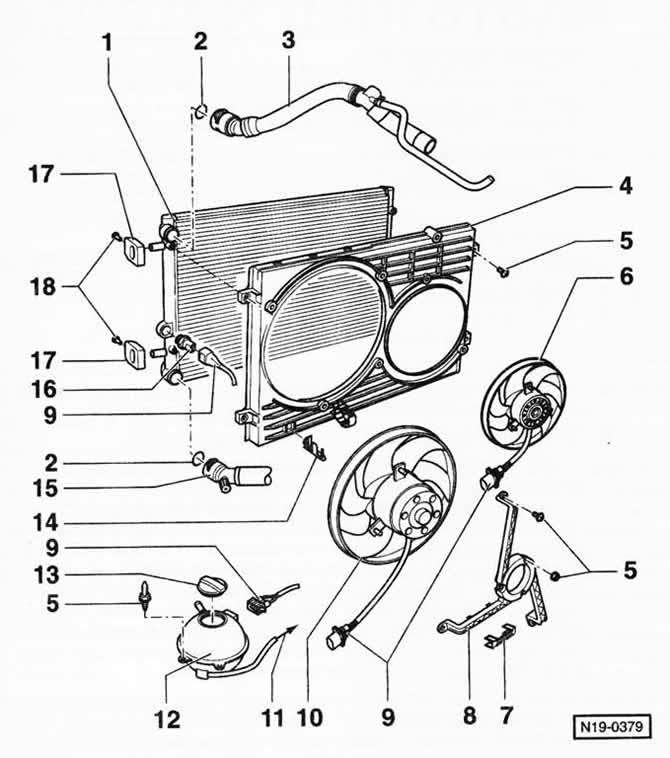
1 — radiator
2 - sealing ring
Always replace.
3 - Upper coolant hose
Attached to the radiator with a clamp. Check the reliability of the fastening.
4 - air guide box
5 - screw, 5 Nm
6 - additional fan
For vehicles with air conditioning.
7 — clamp
Check the reliability of the fastening.
8 — holder
For electric fan.
9 - connecting plugs
10 — radiator fan
11 - to the thermostat housing
12 - expansion tank
13 — lid
Control pressure: 1.4-1.6 bar.
14 — holder
For plug connector of electric fan.
15 - Lower coolant hose
Attached to the radiator with a clamp. Check the reliability of the fastening.
16 - thermal switch, 35 Nm
- Switching on the first mode: 92-97°C
- Switching off the first mode: 84-91°C
- Switching on the second mode: 99-105°C
- Switching off the second mode: 91-98°C
17 — holder
For radiator. Please note the installation position/different design.
18 - bolts, 10 Nm
Note: The figure applies to a 1.2-/1.4-liter petrol engine.
Removal
1.4-/1.9L engine: Remove front bumper cover, see page 238.
Move the lock beam to the maintenance position, see page 237.
The description applies to vehicles with manual transmission.
Drain the coolant, see the relevant chapter.
Disconnect the coolant hoses from the radiator. To do this, loosen the corresponding clamps and move them onto the hoses.
Disconnect the plug connectors at the thermal switch and the electric fan.
Loosen the radiator mounting bolts and remove the radiator together with the fan in a downward motion.
Installation
Installation is carried out in reverse order.
Instructions for the air conditioning system:
Do not open the refrigerant circuit of the air conditioning system, as the refrigerant may cause frostbite if it comes into contact with the skin. In case of accidental contact with the skin, immediately rinse the area of contact with the refrigerant with cold water for 15 minutes. The refrigerant is colorless, odorless and heavier than air. If the cooling system is leaking near the floor or in the inspection pit, there is a risk of suffocation (is not noticed).
To avoid damage to the condenser and pipes/hoses, care must be taken to ensure that the pipes and hoses are not twisted, kinked or bent.
Loosen the clamps holding the refrigerant lines.
Unscrew the condenser fastening to the radiator and hang the condenser on the lock beam using wire.
Visitor comments