
English Русский
Български
Беларускі
Український
Српски
Hrvatski
Română
Polski
Slovenský
Magyar
  |  Articles  |  Sitemap  |  Contacts  |    |
Car maintenance Ford Car maintenance Hyundai Car maintenance Chevrolet Car maintenance BMW Car maintenance Audi Car maintenance Opel Car maintenance AvtoVAZ
VWmanual.ru


Main   Passat   Golf   Polo   Touareg   Tiguan   Sharan   Transporter   Others  
Golf 1 (1974-1984, diesel) Golf 1 (1974-1984, petrol) Golf 2 (1984-1993, petrol) Golf 2 (1984-1993) Golf 3 (1991-1997) Golf 4 (1997-2004) Golf 5 (2003-2008)

Oil pump — 1.6 and 1.8L engines (VW Golf 2)

  • Main
  • Golf
  • Golf 2
  • Power unit
  • Cooling and lubrication system
  • Oil pump — 1.6 and 1.8L engines
            0


To remove the oil pump, you need to:

1. Remove the oil pan.

2. Loosen the two mounting bolts and pull the pump unit down together with the suction tube and suction cup.

3. Place the oil pump on the workshop table, lift the cover with a screwdriver and wash the suction screen in kerosene. Insert the screen back and press the cover.

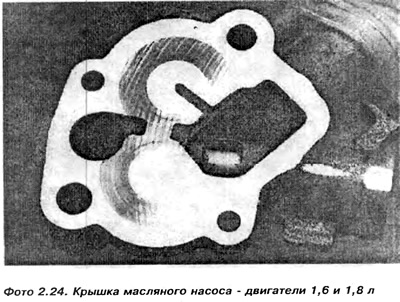
4. Unscrew the two small bolts and remove the cover from the pump housing. Check the surface of the cover. As can be seen in the picture (photo 2.24), the gear transmission has left marks on the cover. If the depth of these marks is significant, the surface of the cover must be ground. The gap between the teeth, the gap between the front surface of the teeth and the housing, or finally the gap between the side surfaces of the gears and the pump cover, cause a leak through which oil flows from the pressure chamber into the pre-chamber. Some of the oil circulates through the pump instead of the oil line. As a result, the pump's performance decreases (or the amount of oil supplied to the lubrication system), and oil pressure. The second parameter is very important. At very low pressure, the oil film in the bearings may break, which will cause their accelerated wear.
4. Unscrew the two small bolts and remove the cover from the pump housing. Check the surface of the…


Therefore, if there is any doubt about the correct operation of the pump, it is better and more economical to replace it with a new one. Re-extracting the pump is an expensive operation, but in the event of failure of the liners, the cost of repair will exceed the price of a new pump several times.


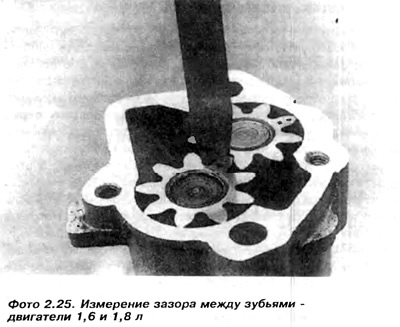
5. Remove the gear and wash the housing and gears in clean kerosene. Dry and assemble the gear, lubricating with clean motor oil. Measure the gap between the gears with a feeler gauge, the so-called gap between the teeth (photo 2.25). It should be from 0.05 to 0.20 mm.

View the original on this resource vwmanual.ru
5. Remove the gear and wash the housing and gears in clean kerosene. Dry and assemble the gear,…


6. Place the guide bar on the pump body and measure the gap between the gears and the guide bar with a feeler gauge. This gap between the side surfaces of the gears and the pump cover should not exceed 0.15 mm.

7. Measure the gap between the tip of the gear tooth and the wall of the pump housing with a feeler gauge. This gap should not exceed 0.25 mm. Usually, if this gap is larger than the permissible value, this indicates wear of the bushings in which the pump drive shaft is located on bearings. If the gap in the bushings exceeds 0.20 mm, the pump housing must be equipped with bushings.

Usually, if something in the pump is worn out, especially the gears or the housing, the entire pump must be replaced. If the wear is within acceptable limits, the pump is assembled and installed on the engine.


Installation


8. Before fixing the pump, check that the working surfaces are clean. Then insert the pump into the hole and tighten the fastening bolts to the specified torque.

9. Install a new oil pan gasket, but do not use sealant (because it makes it difficult to separate from the body during the next repair). Secure the oil pan and tighten the fastening bolts evenly.

10. Screw in the oil drain plug together with a new O-ring.

This article is available at russian, bulgarian, belarusian, ukrainian, serbian, croatian, romanian, polish, slovak, hungarian
The text has been checked: Semenova Anna

Share information:

Previous articles
Oil pump — 1.1 and 1.3L engines
Engine oil change
Checking the engine oil level
Lubrication system device
Water temperature sensor, thermal switches
Water pump — 1.6 and 1.8L engines
Next articles


Similar articles from other manuals for VW cars:
Water pump (1.8-I and 1.6-I ADP engines) Passat B5 (1996-2005)
Removal and installation the coolant pump (petrol engines) Polo 4 (2001-2009)
Removal and installation the water pump (petrol engine) Touareg 1 (2002-2006)
Removal and installation the cooling system pump Tiguan 1 (2007-2015)
Removal and installation the oil pump Sharan 1 (1995-2000)
Windshield Washer Water Pump — Checking and Replacing Transporter T4 (1990-2003)
Replacing the fuel pump drive toothed belt (diesel engines AGX,… LT 2D (1996-2003)
Link to this page in different formats


Visitor comments


No comments yet


How much will 27 + 31 =


Golf 5 
  • General information
  • User manual
  • Maintenance
  • Troubleshooting
  • Power unit
  • Engine repair
  • Cooling and ventilation system
  • Fuel system
  • Ignition system
  • Transmission
  • Clutch
  • Mechanical gearbox
  • Automatic gearbox
  • Chassis
  • Brake system
  • Car suspension
  • Steering
  • Body
  • Interior (internal elements)
  • Exterior (external elements)
  • Doors and covers
  • Electrical equipment
  • Power devices
  • Washers and wipers
  • Lighting and appliances
  • Electrical circuits
Golf 4 
  • General information
  • User manual
  • Weekly checks
  • Maintenance
  • Power unit
  • Petrol engines
  • Diesel engines
  • Cooling system
  • Fuel system (petrol)
  • Control system (petrol)
  • Fuel system (diesel)
  • Exhaust system
  • Transmission
  • Clutch
  • Car gearbox
  • Drive shafts
  • Chassis
  • Car suspension
  • Steering
  • Wheels and tires
  • Brake system
  • Body
  • Exterior (external elements)
  • Interior (internal elements)
  • Ventilation and heating
  • Car doors and sunroof
  • Washers and glass cleaners
  • Electrical equipment
  • Power devices
  • Lighting and appliances
  • Electrical circuits
Golf 3 
  • Petrol engine
  • Engine repair
  • Lubrication system
  • Cooling system
  • Ignition system
  • Diesel engine
  • Engine repair
  • Diesel injection system
  • Pre-glow system
  • Transmission
  • Clutch
  • Gearbox and drive shafts
  • Chassis
  • Steering
  • Wheels and suspension
  • Brake system
  • Electrical equipment
  • Lighting and appliances
  • Electrical circuits
Golf 2 
  • General information
  • Introduction to guide
  • User manual
  • Petrol engines 1.3 l
  • Engine repair
  • Lubrication system
  • Cooling system
  • Carburetors
  • Supply system
  • Ignition system
  • Petrol engines 1.6/1.8 l
  • Engine repair
  • Supply system
  • Ignition system
  • Diesel engines
  • Engine repair
  • Lubrication system
  • Cooling system
  • Power and exhaust system
  • Transmission
  • Clutch
  • 4-speed gearbox 084
  • 5-speed gearbox 085
  • 4-speed gearbox 020/4R
  • 5-speed gearbox 020/4T
  • Automatic gearbox
  • Drive shafts
  • Chassis
  • Steering
  • Car suspension
  • Brake system
  • Body
  • Body elements
  • Doors, locks and windows
  • Electrical equipment
  • Equipment and devices
  • Power devices
Golf 2 (petrol) 
  • General information
  • Characteristics
  • Car care
  • Maintenance
  • Power unit
  • Engine repair
  • Engine 1.05/1.30
  • Engine 1.60/1.80
  • Cooling and lubrication system
  • Power and exhaust system
  • Transmission
  • Clutch
  • Car gearbox
  • Drive shafts
  • Chassis
  • Brake system
  • Steering
  • Suspension
  • Body
  • Body and equipment
  • Electrical equipment
  • Lighting and appliances
  • Electrical circuits
Golf 1 (petrol) 
  • General information
  • Characteristics
  • User manual
  • Maintenance
  • Power unit
  • Engine adjustment
  • Engine 1.1/1.3
  • Engine 1.5/1.6/1.8
  • Engine electrical equipment
  • Cooling system
  • Fuel system
  • Transmission
  • Clutch and manual gearbox
  • Automatic gearbox
  • Chassis
  • Steering
  • Front suspension
  • Rear suspension
  • Brake system
  • Electrical equipment
  • Lighting and appliances
  • Electrical circuits
  • Body
  • Body and equipment
  • Optional equipment
Golf 1 (diesel) 
  • General information
  • Specifications
  • Maintenance
  • Power unit
  • Engine repair
  • Exhaust and turbocharger
  • Cooling system
  • Fuel system
  • Fuel injection system
  • Transmission
  • Clutch and drive shafts
  • Car gearbox
  • Chassis
  • Suspension and wheels
  • Steering
  • Brake system
  • Wheels and tires
  • Body
  • Heating and ventilation
  • Exterior (external elements)
  • Interior (internal elements)
  • Doors and windows
  • Electrical equipment
  • Equipment and devices
  • Lighting system
  • Power devices
  • Electrical circuits
VWmanual.ru © 2016-2026 | Mobile version | News and articles | Sitemap: EN BG BY UA RS HR RO PL SK HU | Write message | Site search
Passat B2 • Passat B3 • Passat B4 • Passat B5 • Passat B6 • Golf 1, diesel • Golf 1, petrol • Golf 2, petrol • Golf 2 • Golf 3 • Golf 4 • Golf 5 • Polo 3 • Polo 4 • Touareg 1 • Tiguan 1 • Sharan 1 • Transporter T3 • Transporter T4 • LT 28 • LT 2D • Beetle • Caddy 3 •
Our website uses cookies to ensure functionality and convenience.