
English Русский
Български
Беларускі
Український
Српски
Hrvatski
Română
Polski
Slovenský
Magyar
  |  Articles  |  Sitemap  |  Contacts  |    |
Car maintenance Ford Car maintenance Hyundai Car maintenance Chevrolet Car maintenance BMW Car maintenance Audi Car maintenance Opel Car maintenance AvtoVAZ
VWmanual.ru


Main   Passat   Golf   Polo   Touareg   Tiguan   Sharan   Transporter   Others  
Golf 1 (1974-1984, diesel) Golf 1 (1974-1984, petrol) Golf 2 (1984-1993, petrol) Golf 2 (1984-1993) Golf 3 (1991-1997) Golf 4 (1997-2004) Golf 5 (2003-2008)

Removal and installation the fuel tank (VW Golf 1)

  • Main
  • Golf
  • Golf 1
  • Power unit
  • Fuel system
  • Removal and installation the fuel tank
            0


Contents: Fuel tank modifications ↓ Removal and installation the fuel…↓
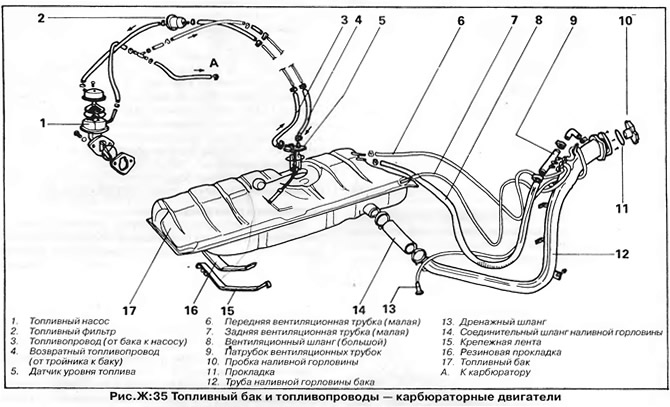
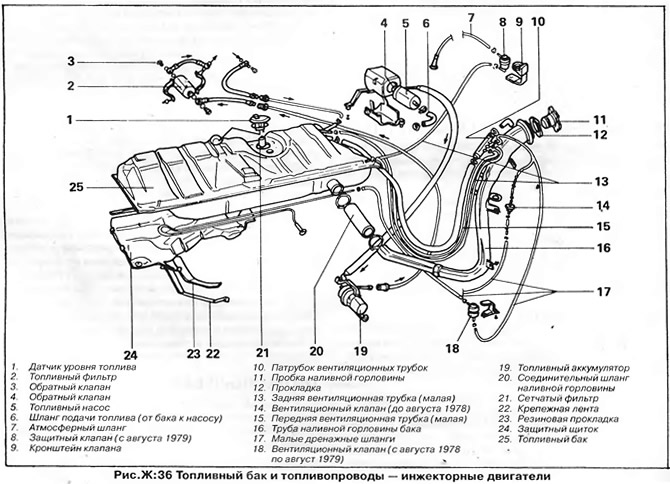
The fuel tank is mounted at the rear of the vehicle and secured with two mounting straps (drawing W:35 and W:36). It should be remembered that the fuel tanks and associated parts of carburetor and injection models are different.

The fuel tank is mounted at the rear of the vehicle and secured with two mounting straps (drawing…


The fuel tank is mounted at the rear of the vehicle and secured with two mounting straps (drawing…


Fuel tank modifications


In January 1976, the location of the fuel level sensor was changed - the sensor was moved from the right side to the upper surface of the tank. In August 1979, thicker tank ventilation tubes were installed instead of thin ones.

The top-mounted fuel level sensor is accessible through a hole in the floor of the vehicle under the rear seat. The sensor is secured to the tank with a bayonet retaining ring that is easy to remove. When installing the sensor, ensure that the electrical connector is facing forward, or slightly to the left on fuel-injected models.


On injection models, a ventilation valve is built into the tank ventilation tube. On cars manufactured before August 1979, the valve has two branches, and on later models, a third one is added - an atmospheric branch. Since August 1979, a safety valve is installed instead of the ventilation valve, which closes under the force of gravity. Since that time, safety valves have also been installed on carburetor models. Safety valves come in different types, and the valve can only be replaced with a valve of the same type. Valves are distinguished by color markings. The safety valve must be installed vertically, with the "CANISTER" marking facing up.

The fuel cap on cars manufactured before August 1979 had a vent hole, while on later models the vent hole in the cap is missing. The caps are distinguished by the inscription on the back: the cap without a vent hole has the inscription "ohne Luftung", and a cork with ventilation - "mit Luftung".

Early fuel injected models had threaded fuel filler caps, but these were replaced by bayonet-type ones, the same as those used on carburettor models from August 1979.

Removal and installation the fuel tank - Golf/Jetta models


1. Disconnect the ground wire from the battery.

2. Pump out the remaining fuel from the tank through the filler neck.

3. If the fuel level sensor is located on top, remove the rear seat and remove the cover to gain access to the sensor. Disconnect the electrical connector from the sensor and (on carburetor models) both fuel pipes. Mark one of the pipes with chalk to ensure proper installation during assembly.


4. If the fuel level sensor is installed on the side of the tank, it can be accessed from under the vehicle.

5. On injection models, disconnect the wires and tubes from the fuel pump and remove the fuel pump. Disconnect the fuel supply and return tubes from the fuel tank.

6. Loosen the rear wheel mounting bolts, lift and place the rear of the vehicle on supports (see chapter "Basic rules for carrying out work"). Remove the rear wheels.

7. To remove the fuel tank, you need to separate the rear axle from the body. Disconnect the brake hoses from the rear axle on both sides (plug the pipes and hoses to prevent brake fluid from leaking out), disconnect the rear axle mounts from the body, turn the axle down and leave it hanging on the handbrake cable casings.

8. Unhook the exhaust system hangers.

9. Disconnect the filler hose from the fuel tank and close the opening in the tank.

10. Disconnect the two fastening straps from the body and lower the tank.

11. Remove the vent tubes from the tank connections, then remove the tank from under the vehicle.

Installation is carried out in the reverse order of removal. Install rubber gaskets between the fuel tank and the fastening bands. Use new clamps to secure the hoses.

This article is available at russian, bulgarian, belarusian, ukrainian, serbian, croatian, romanian, polish, slovak, hungarian
The text has been checked: Tarasov Ivan

Share information:

Previous articles
Fuel injection system
Carburetor Pierburg 2E2
Zenith 2B2/2B5 Carburetors
Carburetors Pierburg/Zenith 1B3
Solex PICT/PIC carburetors
Removal and installation the carburetor
Next articles
Possible malfunctions of the fuel system


Similar articles from other manuals for VW cars:
Fuel tank filler flap Passat B6 (2005-2010)
Fuel tank cap Polo 3 (1995-2003)
Fuel tank filler flap Touareg 1 (2002-2006)
Fuel tank device Tiguan 1 (2007-2015)
Fuel level sensor in the tank Sharan 1 (1995-2000)
Fuel tank — design description Transporter T3 (1979-1992)
Fuel tank filler pipe installation (models with 2.4L engine) LT 28 (1975-1991)
Link to this page in different formats


Visitor comments


No comments yet


How much will 22 + 16 =


Golf 5 
  • General information
  • User manual
  • Maintenance
  • Troubleshooting
  • Power unit
  • Engine repair
  • Cooling and ventilation system
  • Fuel system
  • Ignition system
  • Transmission
  • Clutch
  • Mechanical gearbox
  • Automatic gearbox
  • Chassis
  • Brake system
  • Car suspension
  • Steering
  • Body
  • Interior (internal elements)
  • Exterior (external elements)
  • Doors and covers
  • Electrical equipment
  • Power devices
  • Washers and wipers
  • Lighting and appliances
  • Electrical circuits
Golf 4 
  • General information
  • User manual
  • Weekly checks
  • Maintenance
  • Power unit
  • Petrol engines
  • Diesel engines
  • Cooling system
  • Fuel system (petrol)
  • Control system (petrol)
  • Fuel system (diesel)
  • Exhaust system
  • Transmission
  • Clutch
  • Car gearbox
  • Drive shafts
  • Chassis
  • Car suspension
  • Steering
  • Wheels and tires
  • Brake system
  • Body
  • Exterior (external elements)
  • Interior (internal elements)
  • Ventilation and heating
  • Car doors and sunroof
  • Washers and glass cleaners
  • Electrical equipment
  • Power devices
  • Lighting and appliances
  • Electrical circuits
Golf 3 
  • Petrol engine
  • Engine repair
  • Lubrication system
  • Cooling system
  • Ignition system
  • Diesel engine
  • Engine repair
  • Diesel injection system
  • Pre-glow system
  • Transmission
  • Clutch
  • Gearbox and drive shafts
  • Chassis
  • Steering
  • Wheels and suspension
  • Brake system
  • Electrical equipment
  • Lighting and appliances
  • Electrical circuits
Golf 2 
  • General information
  • Introduction to guide
  • User manual
  • Petrol engines 1.3 l
  • Engine repair
  • Lubrication system
  • Cooling system
  • Carburetors
  • Supply system
  • Ignition system
  • Petrol engines 1.6/1.8 l
  • Engine repair
  • Supply system
  • Ignition system
  • Diesel engines
  • Engine repair
  • Lubrication system
  • Cooling system
  • Power and exhaust system
  • Transmission
  • Clutch
  • 4-speed gearbox 084
  • 5-speed gearbox 085
  • 4-speed gearbox 020/4R
  • 5-speed gearbox 020/4T
  • Automatic gearbox
  • Drive shafts
  • Chassis
  • Steering
  • Car suspension
  • Brake system
  • Body
  • Body elements
  • Doors, locks and windows
  • Electrical equipment
  • Equipment and devices
  • Power devices
Golf 2 (petrol) 
  • General information
  • Characteristics
  • Car care
  • Maintenance
  • Power unit
  • Engine repair
  • Engine 1.05/1.30
  • Engine 1.60/1.80
  • Cooling and lubrication system
  • Power and exhaust system
  • Transmission
  • Clutch
  • Car gearbox
  • Drive shafts
  • Chassis
  • Brake system
  • Steering
  • Suspension
  • Body
  • Body and equipment
  • Electrical equipment
  • Lighting and appliances
  • Electrical circuits
Golf 1 (petrol) 
  • General information
  • Characteristics
  • User manual
  • Maintenance
  • Power unit
  • Engine adjustment
  • Engine 1.1/1.3
  • Engine 1.5/1.6/1.8
  • Engine electrical equipment
  • Cooling system
  • Fuel system
  • Transmission
  • Clutch and manual gearbox
  • Automatic gearbox
  • Chassis
  • Steering
  • Front suspension
  • Rear suspension
  • Brake system
  • Electrical equipment
  • Lighting and appliances
  • Electrical circuits
  • Body
  • Body and equipment
  • Optional equipment
Golf 1 (diesel) 
  • General information
  • Specifications
  • Maintenance
  • Power unit
  • Engine repair
  • Exhaust and turbocharger
  • Cooling system
  • Fuel system
  • Fuel injection system
  • Transmission
  • Clutch and drive shafts
  • Car gearbox
  • Chassis
  • Suspension and wheels
  • Steering
  • Brake system
  • Wheels and tires
  • Body
  • Heating and ventilation
  • Exterior (external elements)
  • Interior (internal elements)
  • Doors and windows
  • Electrical equipment
  • Equipment and devices
  • Lighting system
  • Power devices
  • Electrical circuits
VWmanual.ru © 2016-2026 | Mobile version | News and articles | Sitemap: EN BG BY UA RS HR RO PL SK HU | Write message | Site search
Passat B2 • Passat B3 • Passat B4 • Passat B5 • Passat B6 • Golf 1, diesel • Golf 1, petrol • Golf 2, petrol • Golf 2 • Golf 3 • Golf 4 • Golf 5 • Polo 3 • Polo 4 • Touareg 1 • Tiguan 1 • Sharan 1 • Transporter T3 • Transporter T4 • LT 28 • LT 2D • Beetle • Caddy 3 •
Our website uses cookies to ensure functionality and convenience.