
English Русский
Български
Беларускі
Український
Српски
Hrvatski
Română
Polski
Slovenský
Magyar
  |  Articles  |  Sitemap  |  Contacts  |    |
Car maintenance Ford Car maintenance Hyundai Car maintenance Chevrolet Car maintenance BMW Car maintenance Audi Car maintenance Opel Car maintenance AvtoVAZ
VWmanual.ru


Main   Passat   Golf   Polo   Touareg   Tiguan   Sharan   Transporter   Others  
Golf 1 (1974-1984, diesel) Golf 1 (1974-1984, petrol) Golf 2 (1984-1993, petrol) Golf 2 (1984-1993) Golf 3 (1991-1997) Golf 4 (1997-2004) Golf 5 (2003-2008)

Carburetor Pierburg 2E2 (VW Golf 1)

  • Main
  • Golf
  • Golf 1
  • Power unit
  • Fuel system
  • Carburetor Pierburg 2E2
            0


Contents: Increased idle speed ↓ Air Damper Starting Gap - Stage 1 ↓ Air Damper Starting Gap - Stage 2 ↓ Combining the housing and cover of…↓ Accelerator pump ↓
Adjustment of idle speed and CO content in exhaust gases is described in the chapter "Engine adjustment". Remove the air filter and adjust the carburetor as follows:

Increased idle speed


1. Connect a tachometer to the engine.

2. Plug the vacuum hose of the air filter thermostat (air filter removed).

3. Remove the tee (A) from the vacuum hose (B) - Figure G:21 - and plug the hose.
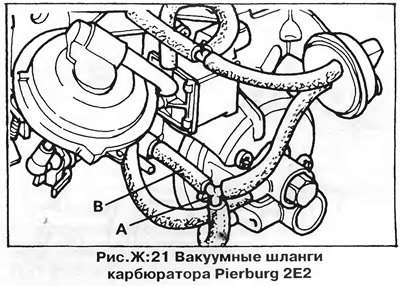
3. Remove the tee (A) from the vacuum hose (B) - Figure G:21 - and plug the hose.


4. Start the engine and measure the high idle speed value.

5. If the idle speed is outside the limits specified in section "Technical data", adjust them by turning the adjusting screw (A, figure W:22).
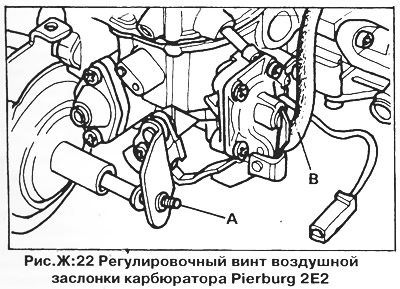
5. If the idle speed is outside the limits specified in section «Technical data», adjust them by…


6. Connect the vacuum hose, adjust the idle speed if necessary (see chapter "Engine adjustment").


7. Fix the adjusting screw (A) with paint.

Initial position of the throttle valve (basic adjustment) — primary chamber.

The throttle valve limit screw position is factory set and should not be changed. The initial throttle valve position should only be adjusted if the screw position has been changed.

1. Turn the heating mode control cam (A, figure W:23) so that the pin (B) on the throttle lever does not touch the cam.

1. Turn the heating mode control cam (A, figure W:23) so that the pin (B) on the throttle lever…


2. Lock the cam in this position using a screwdriver (D) by inserting it between the cam and the lever (C).

3. Remove the hoses from the three vacuum drive pipes and plug the pipes (B, figure W:24).
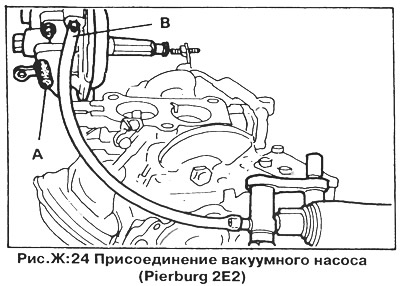
3. Remove the hoses from the three vacuum drive pipes and plug the pipes (B, figure W:24).


4. Connect the vacuum pump to the pipe (A, figure W:24) and create the vacuum necessary to hold the diaphragm in the throttle closing position.


5. Make sure there is clearance between the high idle speed adjustment screw and the diaphragm plunger.

6. Loosen the limit screw (A, figure W:25) so that between it and the throttle limiter (B, figure G.25) a gap appeared.
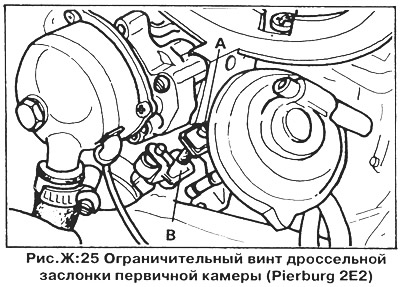
6. Loosen the limit screw (A, figure W:25) so that between it and the throttle limiter (B, figure…


7. Tighten the screw until it touches the stop.

8. Tighten the adjusting screw another 1/4 turn and seal its threads with paint.

Initial position of the throttle valve (basic adjustment) - secondary chamber.

The throttle position is factory set and should not be changed. The initial throttle position should only be adjusted if the setting has been changed.

1. Remove the carburetor as described earlier in this chapter.

2. Fully open the throttle valve of chamber I and firmly fix it in this position (A, figure W:28).
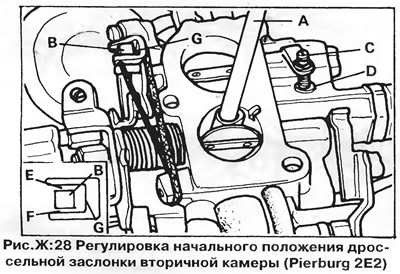
2. Fully open the throttle valve of chamber I and firmly fix it in this position (A, figure W:28).


3. Using a rubber band, tighten the throttle lever of the I camera (B, figure W:28).

4. Loosen the limit screw (C) so that a gap appears between the screw and the stop (D, figure W:28).

5. Tighten the limit screw until it touches the stop.

6. Tighten the limit screw another 1/4 turn.

7. Release both throttle valves and check the clearance in the throttle actuator mechanism (E and F, figure G:28).

8. Adjust the gap by bending the lever (shown by arrow), if the gap value is outside the limits specified in the section "Technical data".

Air Damper Starting Gap - Stage 1


1. Remove the automatic air damper cover.

2. Turn the choke lever clockwise and secure it in this position with a rubber band.

3. Remove the vacuum hose from the carburetor and attach a vacuum pump in its place (B, figure G:22 and A, figure G:24).

4. Remove the vacuum hose (C, figure W:26), but don't drown it out.

4. Remove the vacuum hose (C, figure W:26), but don't drown it out.


5. Create and maintain a vacuum of 200-300 mbar.

6. Check the air damper clearance using a drill bit of the appropriate diameter (D, figure W:26).

7. If the gap is outside the limits specified in section "Technical data", adjust it with the Allen screw (B, figure W:26). Cover the adjusting screw with paint.

Air Damper Starting Gap - Stage 2


1. Plug the vacuum hose (E, figure W:26).

2. Create a vacuum of 200 mbar using a vacuum pump.

3. Check the air damper clearance with a drill (B, figure W:27).
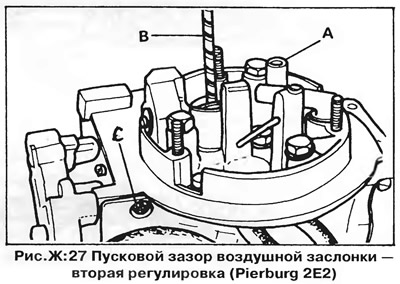
3. Check the air damper clearance with a drill (B, figure W:27).


4. If the gap is outside the limits specified in section "Technical data", adjust it with the screw (C, figure W:27).

5. Cover the screw with paint.

Combining the housing and cover of the air damper drive


The marks on the body and cover of the air damper drive must be aligned.

Accelerator pump


1. Connect the vacuum pump to the vacuum drive pipe (A, figure W:24).

2. Plug the open vacuum hose (B, figure W:24).

3. Create the vacuum necessary to hold the diaphragm in the closed throttle position. There should be an air gap between the high idle speed adjusting screw and the diaphragm pushrod.

4. Turn the warm-up control lever so that the throttle lever pin does not touch it.

5. Secure the warm-up mode control lever in this position by inserting an M8x20 bolt between the lever and the carburetor body.

6. Place a measuring container under the carburetor mixing chamber to collect the fuel.

7. Open and close the throttle valve five times within 15 seconds.

8. Measure the amount of fuel that has entered the container, divide this value by 5 and compare the obtained value with the one specified in the section "Technical data".

9. If the pump performance is not within the specified limits, loosen the clamp screw (A, figure W:29) and adjust the pump by turning the high idle cam (B). After adjustment, install the carburetor on the engine and check the idle speed and CO content (see "Engine adjustment").
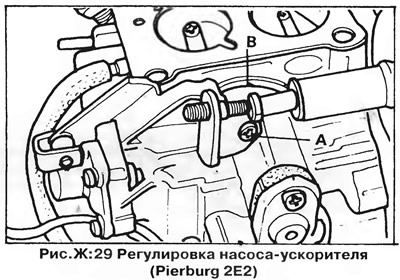
9. If the pump performance is not within the specified limits, loosen the clamp screw (A, figure…

This article is available at russian, bulgarian, belarusian, ukrainian, serbian, croatian, romanian, polish, slovak, hungarian
The text has been checked: Tarasov Ivan

Share information:

Previous articles
Zenith 2B2/2B5 Carburetors
Carburetors Pierburg/Zenith 1B3
Solex PICT/PIC carburetors
Removal and installation the carburetor
Carburetor drive
Air filter
Next articles
Fuel injection system
Removal and installation the fuel tank
Possible malfunctions of the fuel system


Similar articles from other manuals for VW cars:
Operating principle of the Pierburg 2E2 carburetor Passat B2 (1981-1988)
Carburetor / fuel injection device Transporter T3 (1979-1992)
Carburetor — design description Beetle (1960-1986)
Link to this page in different formats


Visitor comments


No comments yet


How much will 17 + 32 =


Golf 5 
  • General information
  • User manual
  • Maintenance
  • Troubleshooting
  • Power unit
  • Engine repair
  • Cooling and ventilation system
  • Fuel system
  • Ignition system
  • Transmission
  • Clutch
  • Mechanical gearbox
  • Automatic gearbox
  • Chassis
  • Brake system
  • Car suspension
  • Steering
  • Body
  • Interior (internal elements)
  • Exterior (external elements)
  • Doors and covers
  • Electrical equipment
  • Power devices
  • Washers and wipers
  • Lighting and appliances
  • Electrical circuits
Golf 4 
  • General information
  • User manual
  • Weekly checks
  • Maintenance
  • Power unit
  • Petrol engines
  • Diesel engines
  • Cooling system
  • Fuel system (petrol)
  • Control system (petrol)
  • Fuel system (diesel)
  • Exhaust system
  • Transmission
  • Clutch
  • Car gearbox
  • Drive shafts
  • Chassis
  • Car suspension
  • Steering
  • Wheels and tires
  • Brake system
  • Body
  • Exterior (external elements)
  • Interior (internal elements)
  • Ventilation and heating
  • Car doors and sunroof
  • Washers and glass cleaners
  • Electrical equipment
  • Power devices
  • Lighting and appliances
  • Electrical circuits
Golf 3 
  • Petrol engine
  • Engine repair
  • Lubrication system
  • Cooling system
  • Ignition system
  • Diesel engine
  • Engine repair
  • Diesel injection system
  • Pre-glow system
  • Transmission
  • Clutch
  • Gearbox and drive shafts
  • Chassis
  • Steering
  • Wheels and suspension
  • Brake system
  • Electrical equipment
  • Lighting and appliances
  • Electrical circuits
Golf 2 
  • General information
  • Introduction to guide
  • User manual
  • Petrol engines 1.3 l
  • Engine repair
  • Lubrication system
  • Cooling system
  • Carburetors
  • Supply system
  • Ignition system
  • Petrol engines 1.6/1.8 l
  • Engine repair
  • Supply system
  • Ignition system
  • Diesel engines
  • Engine repair
  • Lubrication system
  • Cooling system
  • Power and exhaust system
  • Transmission
  • Clutch
  • 4-speed gearbox 084
  • 5-speed gearbox 085
  • 4-speed gearbox 020/4R
  • 5-speed gearbox 020/4T
  • Automatic gearbox
  • Drive shafts
  • Chassis
  • Steering
  • Car suspension
  • Brake system
  • Body
  • Body elements
  • Doors, locks and windows
  • Electrical equipment
  • Equipment and devices
  • Power devices
Golf 2 (petrol) 
  • General information
  • Characteristics
  • Car care
  • Maintenance
  • Power unit
  • Engine repair
  • Engine 1.05/1.30
  • Engine 1.60/1.80
  • Cooling and lubrication system
  • Power and exhaust system
  • Transmission
  • Clutch
  • Car gearbox
  • Drive shafts
  • Chassis
  • Brake system
  • Steering
  • Suspension
  • Body
  • Body and equipment
  • Electrical equipment
  • Lighting and appliances
  • Electrical circuits
Golf 1 (petrol) 
  • General information
  • Characteristics
  • User manual
  • Maintenance
  • Power unit
  • Engine adjustment
  • Engine 1.1/1.3
  • Engine 1.5/1.6/1.8
  • Engine electrical equipment
  • Cooling system
  • Fuel system
  • Transmission
  • Clutch and manual gearbox
  • Automatic gearbox
  • Chassis
  • Steering
  • Front suspension
  • Rear suspension
  • Brake system
  • Electrical equipment
  • Lighting and appliances
  • Electrical circuits
  • Body
  • Body and equipment
  • Optional equipment
Golf 1 (diesel) 
  • General information
  • Specifications
  • Maintenance
  • Power unit
  • Engine repair
  • Exhaust and turbocharger
  • Cooling system
  • Fuel system
  • Fuel injection system
  • Transmission
  • Clutch and drive shafts
  • Car gearbox
  • Chassis
  • Suspension and wheels
  • Steering
  • Brake system
  • Wheels and tires
  • Body
  • Heating and ventilation
  • Exterior (external elements)
  • Interior (internal elements)
  • Doors and windows
  • Electrical equipment
  • Equipment and devices
  • Lighting system
  • Power devices
  • Electrical circuits
VWmanual.ru © 2016-2026 | Mobile version | News and articles | Sitemap: EN BG BY UA RS HR RO PL SK HU | Write message | Site search
Passat B2 • Passat B3 • Passat B4 • Passat B5 • Passat B6 • Golf 1, diesel • Golf 1, petrol • Golf 2, petrol • Golf 2 • Golf 3 • Golf 4 • Golf 5 • Polo 3 • Polo 4 • Touareg 1 • Tiguan 1 • Sharan 1 • Transporter T3 • Transporter T4 • LT 28 • LT 2D • Beetle • Caddy 3 •
Our website uses cookies to ensure functionality and convenience.