



Contents: Increased idle speed ↓ Starting clearance of the air damper…↓ Air damper starting gap (2B5) ↓ Secondary chamber throttle actuator ↓ Float level ↓ Thermal switches ↓
Adjustment of idle speed and CO content in exhaust gases is described in the chapter "Engine adjustment". To adjust, remove the air filter as described above, then perform the following operations:
Increased idle speed
1. Connect the tachometer to the engine (see chapter "Engine adjustment").
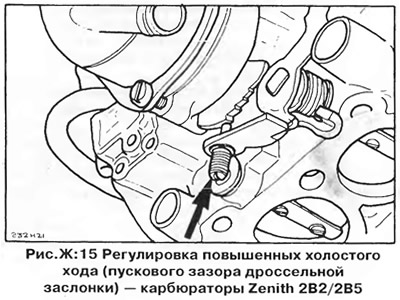
2. Open the throttle valve, close the choke valve completely, then release the throttle valve. The high idle speed adjusting screw should be at the highest step of the cam (figure W:15).
3. Start the engine without touching the accelerator pedal and note the high idle speed value.
4. If the obtained value is outside the limits specified in the section "Technical data", remove the protective plug and adjust the speed using the adjusting screw (figure W:15).
Starting clearance of the air damper (2B2)
1. Remove the automatic choke actuator cover without disconnecting the electric heater wire or coolant hoses from the cover.
2. Open the throttle valve and turn the high idle cam (from the back side of the air damper drive housing) so that the adjusting screw is at the highest step of the cam. Press the diaphragm rod with a screwdriver (A, figure W:16) until it stops and secure the choke lever with a rubber band (B, figure W:16).
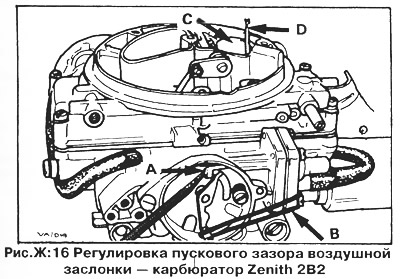
3. Press the air damper lightly (C, figure W:16), to select the play in the mechanism, and measure the gap between the lower edge of the air damper and the wall of the carburetor mixing chamber using a drill of the appropriate diameter (D, figure W:16) — see section "Technical data".
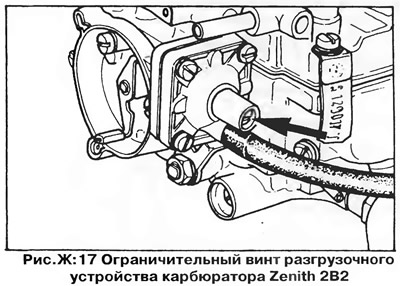
4. Adjust the gap by turning the limit screw on the diaphragm body (figure W:17).
Install the air damper actuator cover in place; the mark on the lid must be aligned with the mark on the body.
Air damper starting gap (2B5)
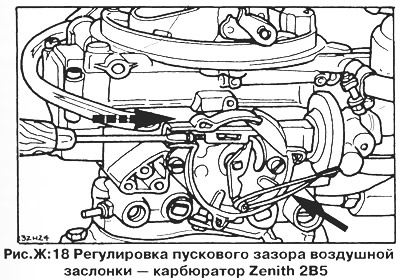
The starting clearance of the air damper is adjusted in the same way as on the 2B2 carburetor, but the adjusting screw is located at the end of the diaphragm rod (figure W:18).
Secondary chamber throttle actuator
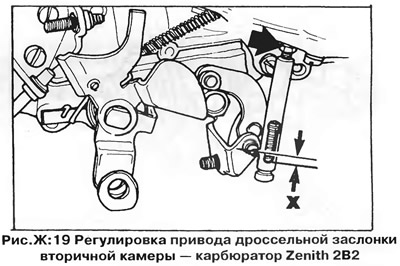
The secondary chamber throttle is controlled by a vacuum diaphragm, to which it is connected by a short rod. On the 2B5 carburetor, this device is made of plastic, the rod is not adjustable. On the 2B2 carburetor, the rod is metal, and it can be adjusted.
On early models, adjust the drive as follows: Disconnect the lower end of the rod from the ball pin on the secondary throttle lever. The lower edge of the hole in the rod should be 1-2 mm below the center of the ball head of the pin ("X", Figure 1: 19). To adjust the rod, loosen the lock nut on the top of the rod and rotate the rod until the hole is correctly positioned relative to the pin, then tighten the lock nut. Attach the rod to the secondary throttle lever.
Float level
To check the float level, remove the carburetor cover by disconnecting the choke rod. After replacing the cover, check the choke adjustment.
Turn the carburetor cover over and rotate it at a 45° angle (drawing W:20) and measure the distance from the farthest point of each float to the surface of the cap (the spring-loaded pin of the needle valve should not be pressed). Data for adjusting the floats is given in the section "Technical data".
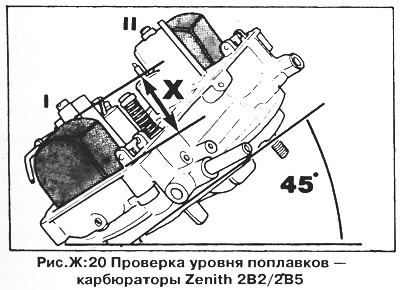
To carry out this check, it is convenient to make a template of the appropriate dimensions from rigid cardboard or similar material.
The adjustment is made by bending the tongue on the float lever (with the float removed).
Thermal switches
The 2B5 carburetor has the same block of thermal switches as the 1B3 carburetor. The thermal switches control the electric heaters of the automatic air damper drive and the intake manifold. The check is performed in the same way as for the 1B3 carburetor.
The 2B2 carburetor has only one thermal switch, which controls the operation of the automatic air damper heater. The operating temperature of this thermal switch is 30°C.
Visitor comments