



On carbureted engines, the fuel pump screen filter can be removed by unscrewing the center screw in the cover (see "Car maintenance work").
Removal and installation (carburetor engines)
1. Disconnect the ground wire from the battery.
2. Disconnect the fuel hoses from the pump. The non-detachable hose clamps installed during vehicle manufacture should be cut and replaced with strap clamps with screw clamps during assembly.
3. Unscrew the two mounting bolts and remove the pump from the engine. The pump is secured with Allen bolts.
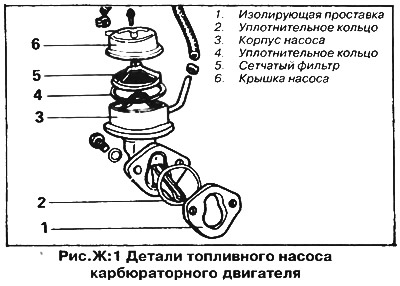
4. On models with 1.1/1.3L engine, replace the sealing ring, on models with 1.5/1.6 and 1.8L engine, make sure that the insulating spacer and sealing ring are installed between the cylinder block and the pump (see figure W:1), and the pump lever rests on the eccentric of the auxiliary shaft. Tighten the pump mounting bolts to the torque specified in Section "Technical data".
5. Connect the fuel hoses to the pump, replace the clamps if necessary.
Start the engine and check for leaks.
Removal and installation (engines with fuel injection system)
CAUTION: Be sure to replace a defective pump with a new one, since if the fuel pump is not working properly, the fuel injection system will not be able to function properly.
Raise and support the rear of the vehicle - Chapter "Basic rules for carrying out work". Disconnect the ground wire from the battery.
Disconnect the electrical wires (connector or screw connection) from the front of the pump. Disconnect the fuel outlet pipe from the pump at the front and the inlet hose from the rear (see figure W:2). Plug the inlet hose to prevent fuel from leaking out of the fuel tank
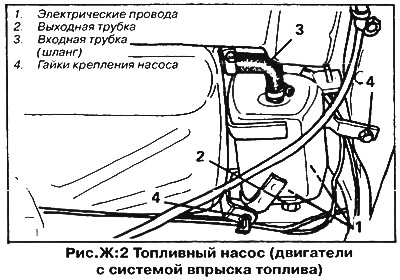
Loosen the pump mounting nuts and remove the pump.
During this procedure, it is very important to prevent dirt from entering the fuel system.
Installation is carried out in the reverse order of removal.
The pump is lubricated and cooled by the fuel in which the anchor and brushes of the pump are immersed. Do not allow the pump to run "dry" - this can lead to overheating and jamming of the electric motor.
Visitor comments