



Contents: Removal (figure G:37) ↓ Engine installation ↓
Removal (figure G:37)
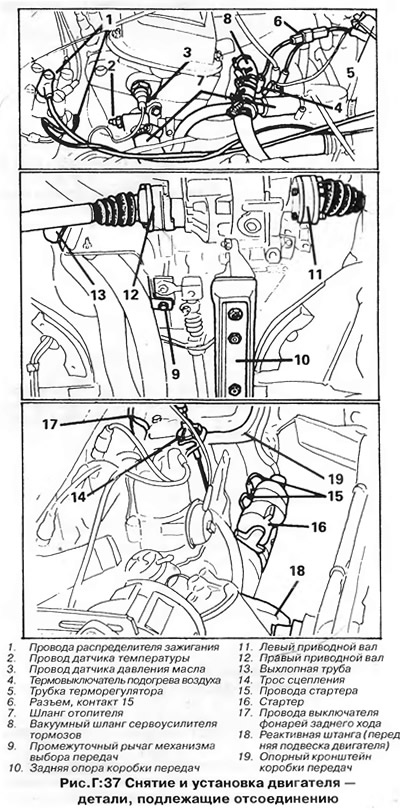
The engine is removed from the car upwards together with the transmission, then separated from it. It is not necessary to remove the hood, but this significantly increases the working space.
1. Disconnect the wires from the battery and remove the battery.
2. On carburetor engines, remove the air filter together with the hoses; close the carburetor intake ports (diffusers) to prevent dirt from entering.
3. If the windshield washer reservoir is located in the front right corner of the engine compartment, remove the reservoir together with the pump from the holder and place it in the cavity in front of the windshield.
4. On vehicles with dual headlights, remove the covers from the headlights.
5. Drain the liquid from the cooling system by disconnecting the lower radiator hose from the cooling pump housing and collect it in a clean container - the heater valve must be open (see chapter "Cooling system").
6. On models equipped with an oil cooler, remove the oil cooler located on the right side of the main radiator and place it on the engine. Do not disconnect the oil cooler hoses.
7. Remove the radiator assembly with the shroud and radiator fan.
8. Disconnect the wires from the following units, marking the cables and connectors with glued tags:
- a) Ignition distributor (high and low voltage wires).
- b) Coolant temperature sensor (on the left side of the cylinder head)
- c) Oil pressure sensor (above the temperature sensor).
- d) Thermal switch of the carburetor inlet manifold heater (if available).
- d) TDC sensor (on early models, on top of the clutch housing).
- e) Generator.
- g) Reversing light switch (at the top of the clutch housing).
- c) Starter (pull-in relay).
9. Disconnect the cooling system hoses from the pipes on the cylinder head and block.
10. Disconnect the brake booster vacuum hose from the intake manifold.
11. On models with a carburetor engine, remove (disconnect) the following details:
- a) Fuel line coming from the fuel tank - from the fuel pump.
- b) Fuel return line - from the carburetor or from the tee (models before 1979).
- c) Throttle drive cable-from the carburetor and bracket (do not remove the cable clip (if available).
- d) On models with automatic transmission: the throttle cable mounting bracket on the carburetor or cylinder head. Do not change the cable adjustment.
- d) Vacuum reservoir. Place the reservoir on the engine.
12. On fuel injection models, disconnect or remove the following parts: (figure G:38). Mark all hoses, cables and wires to facilitate their subsequent installation.
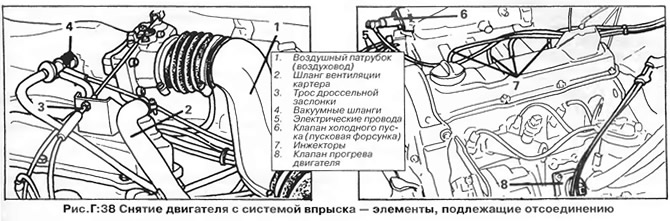
- a) Air duct (air duct) between the throttle body at the intake manifold and the air flow sensor at the fuel distributor.
- b) Crankcase ventilation hose from the tee on the valve cover.
- c) Accelerator cable from brackets on valve cover and throttle body.
- d) Vacuum hoses from the pipes on the intake manifold.
- d) Cold start valve wire connector (starting injector) on the right side of the intake manifold and the starting injector from the manifold.
- e) Injectors from the cylinder head (do not disconnect the fuel pipes from the injectors. Install protective caps on them).
- g) Connector of wires of engine warm-up regulator from cylinder block.
- c) Connector of wires from the thermal switch on the coolant outlet pipe on the cylinder head.
- i) Fuel distributor from air cleaner. Place the unit aside without disconnecting anything from it.
- c) Branch pipe (air duct) air intake from the air filter. Separate the lower part of the air filter.
13. Disconnect the speedometer drive cable from the top of the gearbox housing and plug the hole in the gearbox.
14. On models with a manual transmission, disconnect the clutch cable from the transmission.
15. On models with a manual transmission, disconnect the upper and transverse links of the gear selector mechanism from the transmission. Unscrew the upper nut securing the intermediate lever to the steering gear housing.
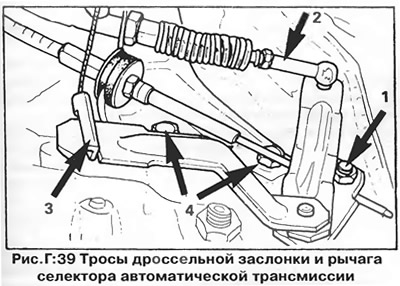
16. On models with automatic transmission, place the selector lever in the "P" position. Disconnect the selector lever cable (1) from the bracket and the lever on the transmission (figure G:39). Disconnect the throttle cable (2) from the bracket, then disconnect the accelerator pedal cable (3). Unscrew the bracket (4) from the transmission case.
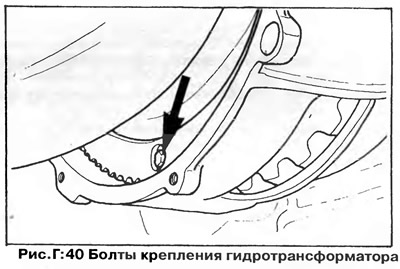
17. On models with automatic transmission, remove the bolts securing the torque converter to the drive disk (figure G:40).
18. On models with a manual transmission, unscrew the lower nut and remove the intermediate lever together with the transverse rod of the gear selector mechanism.
19. Remove the plug from the oil pan and drain the engine oil into a container; screw the cap back on.
20. Disconnect the rear support bracket from the gearbox housing and body.
21. Disconnect the drive shafts from the transmission and hang them from the body using wire hooks.
22. Disconnect the exhaust pipe from the exhaust manifold. (If the exhaust pipes are attached to the engine and gearbox with brackets, remove the brackets).
23. Secure the engine to a lifting device and lift it slightly to relieve the load on the supports (see chapter "Basic rules for carrying out work").
24. Remove the starter, then remove the reaction rod (front suspension) engine.
25. Disconnect the engine support bracket from the body side member on the right side of the vehicle (figure G:41).
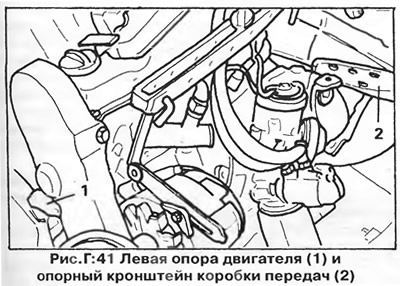
26. Disconnect the gearbox support bracket from the gearbox housing and body (left).
27. Turn the engine and transmission slightly and carefully lift the unit out of the engine compartment, guiding it so as not to damage the body.
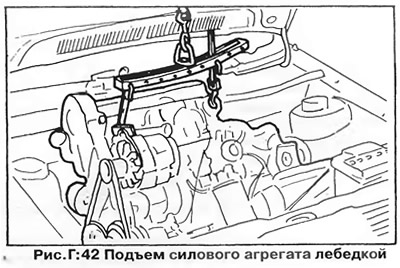
ATTENTION: On vehicles equipped with a 1VZ carburetor with a vacuum relief device for the air damper, be especially careful not to touch the protruding parts of the carburetor to the body.
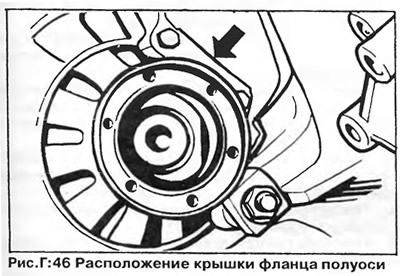
28. Separate the transmission from the engine (after removing the right axle shaft flange cover - Figure G:46).
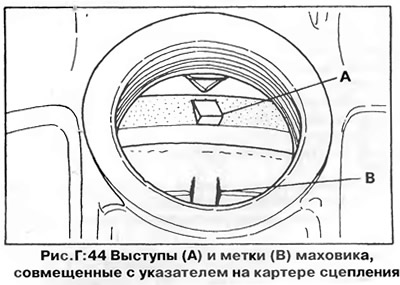
29. On cars with a manual transmission manufactured before November 1978, in order to remove the transmission from the engine, it is necessary to set the flywheel in a certain position. To do this, turn the engine crankshaft so that one of the three projections (B, figure G:44) or tags (A, figure G:44) on the flywheel aligned with the TDC indicator on the clutch housing (figure G:44). These marks should not be confused with the 0-shaped TDC mark. The gearbox has a dowel pin, so it must move away from the engine strictly along the crankshaft axis, and if the flywheel is not installed in the correct position, the flange of the right half-shaft will not be able to pass the flywheel. On cars of later production, the dowel pin is replaced by a bolt with a nut, and it is not necessary to install the flywheel in this way, since the gearbox can be turned during removal. On injection models, the flange of the right half-shaft has a cutout that should be turned towards the flywheel.
Engine installation
The engine is installed in the reverse order of removal. Please note the following:
- a) On early production vehicles that have cutouts on the flywheel, before connecting the gearbox to the engine, one of the cutouts must be aligned with the flange of the right half-shaft - see chapter "Clutch and manual transmission".
- b) Use caution when lowering the engine and transmission into the engine compartment to avoid damaging the unit and drive shafts.
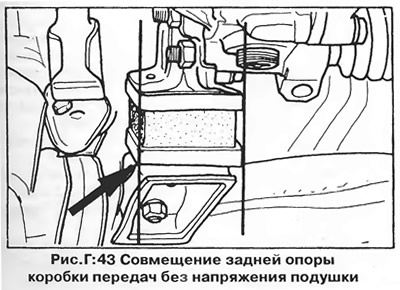
- c) First attach the left support bracket to the gearbox. Then attach the engine and gearbox mounts to the body without tightening the bolts, then align the unit and tighten the mounting bolts. The rear support should be aligned so that the rubber cushion does not experience excessive stress (figure G:43).
- d) Tighten the engine-to-gearbox mounting bolts to the torque specified in section "Technical data".
- d) Position the exhaust system so that it is not subject to excessive loads; if necessary, bend the hooks to which the system is attached.
- e) Adjust the accelerator cable as described in chapter "Fuel system".
- g) Adjust the clutch cable so that the pedal free play corresponds to that specified in section "Technical data".
- h) Fill the oil pan with the recommended brand of oil in the required quantity - see section "Technical data".
Visitor comments