



Disassembly
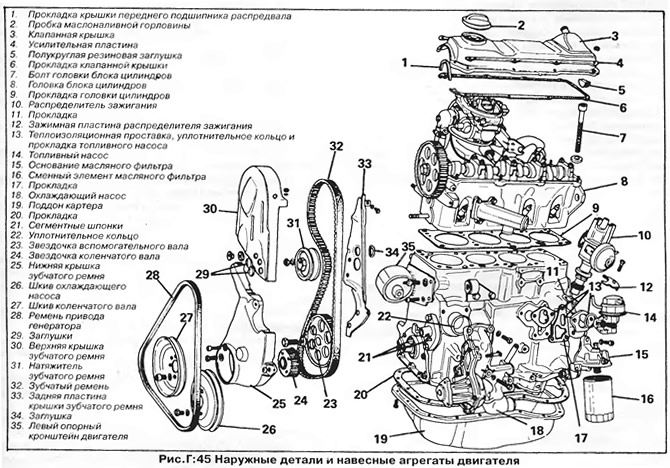
1. Loosen the alternator belt tension, remove the belt, then remove the alternator.
2. Remove the timing belt.
3. Remove the valve cover from the cylinder head, evenly loosen the cylinder head mounting bolts in the reverse order shown in figure G:20.
4. On models with a manual transmission, remove the flywheel and clutch as described in Chapter "Clutch and manual transmission". Remove the intermediate plate located on the mounting bushings at the rear of the engine.
5. On models with automatic transmission, remove the drive disc together with the reinforcement and adjustment plates (figure G:31). Remove the intermediate plate from the rear of the engine.
6. Loosen the oil filter base mounting bolts and remove the filter together with the replaceable element from the cylinder block. Disconnect the oil radiator from the oil filter (if available).
7. Remove the dipstick, turn the cylinder block over and remove the oil pan.
8. Unscrew the two bolts securing the oil pump to the oil intake and remove the entire unit.
9. Loosen the mounting bolts and remove the crankshaft rear oil seal housing.
10. Remove the crankshaft pulley and sprocket. Remove the auxiliary shaft sprocket.
11. Remove the cooling pump housing from the cylinder block.
12. Remove the fuel pump and distributor.
13. Remove the two bolts securing the auxiliary shaft cover, remove the cover from the front of the cylinder block and take out the auxiliary shaft.
14. Loosen the bolts and remove the front crankshaft oil seal housing from the cylinder block.
15. For each connecting rod in turn:
- a) Turn the crankshaft so that the connecting rod is at bottom dead center.
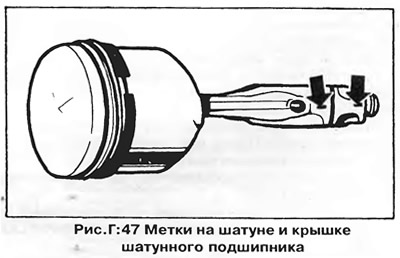
- b) Make sure that the connecting rod and connecting rod bearing cap are marked according to the cylinder number (figure G:47).
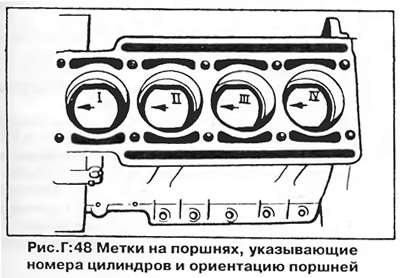
- c) Put the cylinder number on the piston bottom, mark the front side of the piston with an arrow (figure G:48).
- d) Loosen the connecting rod bearing cap fastening nuts, release the cap with light blows, then completely unscrew the nuts and remove the connecting rod cap from the connecting rod.
- d) Push the piston with the connecting rod assembly upward and carefully remove it from the cylinder block.
- e) Remove the connecting rod bearing shells from the cap and connecting rod; mark them if the liners are not to be replaced.
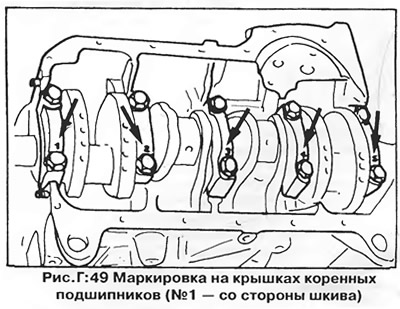
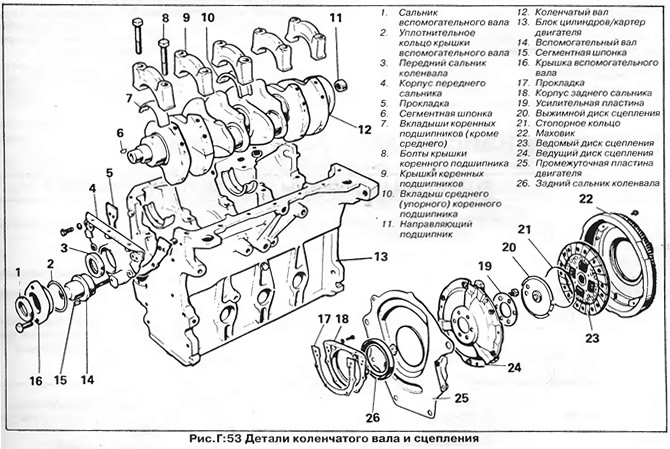
16. Loosen the main bearing cap bolts evenly, make sure they are marked correctly and remove the caps. Carefully lift the crankshaft out of the crankcase (figure G:53).
17. Remove the main bearing shells from the crankcase beds and from the covers. Mark them if further use of the shells is expected.
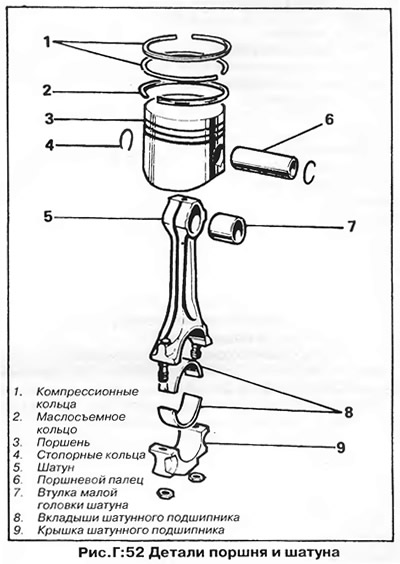
18. If necessary, disassemble the connecting rod and piston assembly in the following order: (figure G:52):
- a) Press out the retaining rings on both sides of the piston pin hole in the piston.
- b) Press out the piston pin using a suitable mandrel (preheat the piston in hot water for a few minutes).
- c) Remove the piston rings towards the piston bottom.
Inspection and repair
NOTE: Cylinder head repair was described previously in the Cylinder Head section.
Inspect the cylinders, pistons, crankshaft and other parts as described in the chapter "Engine 1.0/1.3".
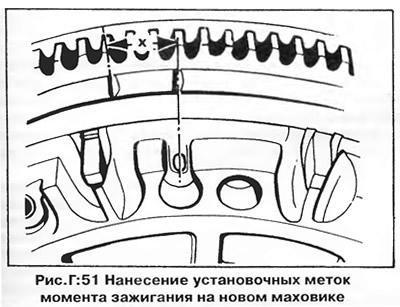
When installing a new flywheel or drive disk, apply an ignition timing mark to it (new flywheels only have a TDC mark - "0"). Using a flexible steel tape measure, measure the appropriate distance from the center of the TDC mark, as shown in Figure G:51, and make a mark (notch) on the flywheel with a triangular file.
- TDC — mark "0"
- 7.5 to TDC - X = 16 mm
- 9 to TDC - flywheel - X = 18.5 mm
- 9° to TDC - AT drive disk - X = 21 mm
Setting the ignition timing (initial ignition timing) for different models is given in the section "Technical data".
Assembly
1. Install the main bearing shells in the cylinder block and cover beds. Make sure that the lock on each shell fits correctly into the corresponding recess in the housing, the shells with oil grooves are installed in the cylinder block, and the smooth shells are installed in the covers. The shells of the middle main bearing have thrust surfaces, since the middle main bearing is thrust and limits the axial movement of the crankshaft.
2. Lubricate the working surface of the bearings and the main journals of the crankshaft with engine oil and carefully lower the crankshaft onto the bearings.
3. Install the main bearing caps in their appropriate locations and tighten the bolts to the torque specified in Section "Technical data".
4. Check the crankshaft axial play. Move the crankshaft forward as far as it will go to remove the play in one direction, then measure the clearance between the thrust surface of the center main bearing shell and the crankshaft web using feeler gauges. The axial play should be within 0.07-0.17 mm, the maximum permissible play is 0.25 mm.
5. If the pistons have separated from the connecting rods, reassemble them as follows:
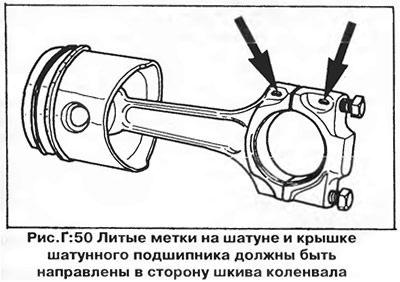
Heat the piston in hot water to 60°C and lubricate the piston pin holes in the connecting rod and piston with graphite grease. Assemble the connecting rod with the piston so that the arrow previously applied to the piston bottom and the cast marks on the connecting rod and cover are on the same side (figure G:50). Press the piston pin into the piston and secure it with circlips on both sides. Make sure that both circlips are securely fixed in the grooves.
6. Install the piston rings on the piston, putting them on through the top of the piston. The lower compression and oil scraper rings have the marking "TOP" on the surface facing the top of the piston. The repair upper rings have a groove along the upper outer edge, which allows to avoid contact of the ring with the ridge (bead) formed in the upper part of the cylinder due to wear. Such rings should be installed with the groove facing up.
To eliminate the possibility of ring breakage and piston damage, use a special tool (ring expander - Figure B:47) when installing the rings.
7. For each piston with connecting rod in turn:
- a) Make sure that the piston is assembled correctly with the connecting rod.
- b) Rotate the piston rings so that their locks are offset from each other by 120° (see chapter "Engine 1.1/1.3").
- c) Generously lubricate the inner surface of the cylinder and piston rings with clean engine oil.
- d) Install the piston with the connecting rod in the corresponding cylinder with the arrow on the piston bottom pointing towards the crankshaft pulley (figure G:48).
- d) Compress the piston rings using a special mandrel as shown in Figure B:49 in Chapter "Engine 1.0/1.3".
Do not attempt to insert the piston without a mandrel - installing the piston by hand may cause the rings to break. Push the piston out of the mandrel into the cylinder with the handle of a hammer so that the piston bottom is slightly below the top edge of the cylinder. Be careful not to damage the crankshaft journal with the connecting rod.
- e) Install the connecting rod bearing shells into the connecting rod and cap. Make sure that the lock in each shell fits securely into the corresponding recess in the bearing bed.
- g) Lubricate the crankshaft journal and liners with engine oil, tighten the connecting rod tightly to the journal and install the cover on it.
- h) Make sure that the numbers on the connecting rod and cap match each other and are on the same side.
- i) Secure the connecting rod cap with new nuts, tightening them to the torque specified in section "Technical data".
- k) Check the axial clearance of the connecting rod on the journal using feeler gauges (see section "Technical data").
8. Assemble the remaining parts in the reverse order of their removal. Install new gaskets and seals (oil seals); tighten all bolts and nuts to the specified torque.
Visitor comments