
English Русский
Български
Беларускі
Український
Српски
Hrvatski
Română
Polski
Slovenský
Magyar
  |  Articles  |  Sitemap  |  Contacts  |    |
Car maintenance Ford Car maintenance Hyundai Car maintenance Chevrolet Car maintenance BMW Car maintenance Audi Car maintenance Opel Car maintenance AvtoVAZ
VWmanual.ru


Main   Passat   Golf   Polo   Touareg   Tiguan   Sharan   Transporter   Others  
Golf 1 (1974-1984, diesel) Golf 1 (1974-1984, petrol) Golf 2 (1984-1993, petrol) Golf 2 (1984-1993) Golf 3 (1991-1997) Golf 4 (1997-2004) Golf 5 (2003-2008)

Safety measures during work (VW Golf 1)

  • Main
  • Golf
  • Golf 1
  • General information
  • User manual
  • Safety measures during work
            0


Contents: Running engine ↓ Electrical equipment ↓ Battery ↓ Brake fluid ↓ Cooling system ↓ Fuel system ↓

Running engine


When working near a running engine, pay close attention to rotating and very hot engine parts (radiator fan drive belts, exhaust manifold) there were no loose clothes, long hair or tools.

When starting the engine in a garage or other enclosed area, ensure adequate ventilation to prevent inhalation of accumulated exhaust gases.

Electrical equipment


When working on a vehicle's electrical system, always disconnect the negative battery cable to prevent accidental short circuits that could cause a fire.

Modern ignition systems generate very high voltages, which, when in electrical contact, can damage semiconductor devices (for example, electronic wristwatches). People with an implanted pacemaker should not perform any work on the ignition system.

Battery


The car battery contains sulfuric acid, which causes rapid corrosion of metals and corrodes clothing and skin. If the battery starts to leak, it should be removed from the car as soon as possible, while the electrolyte should not come into contact with painted surfaces. The battery tray and adjacent parts of the body should be washed with an alkali solution (to neutralize the acid), and then with plenty of hot water. After thorough drying, the damaged surfaces should be painted.

When charging, the battery actively releases hydrogen, which, when mixed with oxygen in the air, forms an extremely explosive gas that can be ignited by an open flame, a stray spark, or a lit cigarette. To prevent sparking, always turn off the charger before disconnecting its cables from the battery.


Never place the tool on the battery.

Brake fluid


Brake fluid is poisonous, can cause corrosion and dissolves paint very well. When filling the brake fluid reservoir or when disconnecting brake system parts, always have a sufficient number of rags ready to wipe up any spilled fluid immediately. Rags soaked in brake fluid should be thrown away immediately to avoid contaminating surrounding objects.

If brake fluid gets on painted surfaces, it should be washed off immediately with plenty of water and soap.

Remember that brake fluid is hygroscopic, so it should be stored in a hermetically sealed container. Liquid stored in an open container is not suitable for use in brake systems.

Cooling system


The cooling system maintains high pressure, which raises the boiling point of the fluid and allows the engine to operate at a higher temperature. When you remove the expansion tank cap, the pressure drops, and if the engine is hot, the coolant can suddenly boil and splash out of the tank with steam in a stream, which will lead to serious burns. For this reason, you should only check the level and add coolant when the engine is cold. If you cannot wait until the engine cools down, open the tank cap slowly, protecting your hand with a thick layer of rag and turning your face away (figure 1). After slightly unscrewing the plug and hearing the hissing of steam, wait until the pressure in the system drops, and only then completely remove the plug.
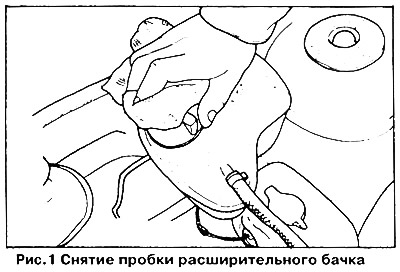
The cooling system maintains high pressure, which raises the boiling point of the fluid and allows…


It is advisable to use ethylene glycol-based antifreeze, as it is the least aggressive to aluminum engine parts. If you use methanol-based antifreeze, do not use an open flame and avoid accidental sparks near the expansion tank cap and vapor tube, as methanol is flammable.


Fuel system


Gasoline is extremely flammable, as well as toxic and irritating to the skin, so precautions must be taken when working with the fuel system and gasoline in general. Do not suck gasoline in with your mouth, as it is very toxic - use a siphon. Always ensure good ventilation to avoid poisoning by gasoline vapors and to prevent their explosive concentration.

Avoid using open flames or creating sparks when working with gasoline. Always disconnect the negative battery cable to prevent accidental electrical sparking sufficient to ignite gasoline vapors.

Since gasoline evaporates quickly, do not store it in an open container - use hermetically sealed containers. Do not drain gasoline from the tank when the car is in the inspection pit, since gasoline vapors can accumulate in the pit and remain there for a long time.

If the garage floor or the area where the car is located is covered with bitumen or tar, do not spill gasoline, as it will dissolve the coating.

This article is available at russian, bulgarian, belarusian, ukrainian, serbian, croatian, romanian, polish, slovak, hungarian
The text has been checked: Tarasov Ivan

Share information:

Previous articles
Checking engine systems
The engine stalled or won't start
Checking a car raised by a lift
Checking a car parked on the ground
Next articles
Changing a wheel, jacking up the car and installing supports
Basic tools and equipment
Basic repair operations
Charging the battery
Jump starting the engine from another car's battery
How to Crank an Engine


Similar articles from other manuals for VW cars:
Safety precautions when working with injection systems Passat B3 (1988-1993)
Important instructions for performing work operations and safety… Polo 4 (2001-2009)
Work in the engine compartment Touareg 1 (2002-2006)
Safety rules for working with the power supply system Tiguan 1 (2007-2015)
Conditions of work and tools used Sharan 1 (1995-2000)
Machine maintenance work Transporter T4 (1990-2003)
Frequency of maintenance work Caddy 3 (2003-2010)
Link to this page in different formats


Visitor comments


No comments yet


How much will 31 + 36 =


Golf 5 
  • General information
  • User manual
  • Maintenance
  • Troubleshooting
  • Power unit
  • Engine repair
  • Cooling and ventilation system
  • Fuel system
  • Ignition system
  • Transmission
  • Clutch
  • Mechanical gearbox
  • Automatic gearbox
  • Chassis
  • Brake system
  • Car suspension
  • Steering
  • Body
  • Interior (internal elements)
  • Exterior (external elements)
  • Doors and covers
  • Electrical equipment
  • Power devices
  • Washers and wipers
  • Lighting and appliances
  • Electrical circuits
Golf 4 
  • General information
  • User manual
  • Weekly checks
  • Maintenance
  • Power unit
  • Petrol engines
  • Diesel engines
  • Cooling system
  • Fuel system (petrol)
  • Control system (petrol)
  • Fuel system (diesel)
  • Exhaust system
  • Transmission
  • Clutch
  • Car gearbox
  • Drive shafts
  • Chassis
  • Car suspension
  • Steering
  • Wheels and tires
  • Brake system
  • Body
  • Exterior (external elements)
  • Interior (internal elements)
  • Ventilation and heating
  • Car doors and sunroof
  • Washers and glass cleaners
  • Electrical equipment
  • Power devices
  • Lighting and appliances
  • Electrical circuits
Golf 3 
  • Petrol engine
  • Engine repair
  • Lubrication system
  • Cooling system
  • Ignition system
  • Diesel engine
  • Engine repair
  • Diesel injection system
  • Pre-glow system
  • Transmission
  • Clutch
  • Gearbox and drive shafts
  • Chassis
  • Steering
  • Wheels and suspension
  • Brake system
  • Electrical equipment
  • Lighting and appliances
  • Electrical circuits
Golf 2 
  • General information
  • Introduction to guide
  • User manual
  • Petrol engines 1.3 l
  • Engine repair
  • Lubrication system
  • Cooling system
  • Carburetors
  • Supply system
  • Ignition system
  • Petrol engines 1.6/1.8 l
  • Engine repair
  • Supply system
  • Ignition system
  • Diesel engines
  • Engine repair
  • Lubrication system
  • Cooling system
  • Power and exhaust system
  • Transmission
  • Clutch
  • 4-speed gearbox 084
  • 5-speed gearbox 085
  • 4-speed gearbox 020/4R
  • 5-speed gearbox 020/4T
  • Automatic gearbox
  • Drive shafts
  • Chassis
  • Steering
  • Car suspension
  • Brake system
  • Body
  • Body elements
  • Doors, locks and windows
  • Electrical equipment
  • Equipment and devices
  • Power devices
Golf 2 (petrol) 
  • General information
  • Characteristics
  • Car care
  • Maintenance
  • Power unit
  • Engine repair
  • Engine 1.05/1.30
  • Engine 1.60/1.80
  • Cooling and lubrication system
  • Power and exhaust system
  • Transmission
  • Clutch
  • Car gearbox
  • Drive shafts
  • Chassis
  • Brake system
  • Steering
  • Suspension
  • Body
  • Body and equipment
  • Electrical equipment
  • Lighting and appliances
  • Electrical circuits
Golf 1 (petrol) 
  • General information
  • Characteristics
  • User manual
  • Maintenance
  • Power unit
  • Engine adjustment
  • Engine 1.1/1.3
  • Engine 1.5/1.6/1.8
  • Engine electrical equipment
  • Cooling system
  • Fuel system
  • Transmission
  • Clutch and manual gearbox
  • Automatic gearbox
  • Chassis
  • Steering
  • Front suspension
  • Rear suspension
  • Brake system
  • Electrical equipment
  • Lighting and appliances
  • Electrical circuits
  • Body
  • Body and equipment
  • Optional equipment
Golf 1 (diesel) 
  • General information
  • Specifications
  • Maintenance
  • Power unit
  • Engine repair
  • Exhaust and turbocharger
  • Cooling system
  • Fuel system
  • Fuel injection system
  • Transmission
  • Clutch and drive shafts
  • Car gearbox
  • Chassis
  • Suspension and wheels
  • Steering
  • Brake system
  • Wheels and tires
  • Body
  • Heating and ventilation
  • Exterior (external elements)
  • Interior (internal elements)
  • Doors and windows
  • Electrical equipment
  • Equipment and devices
  • Lighting system
  • Power devices
  • Electrical circuits
VWmanual.ru © 2016-2026 | Mobile version | News and articles | Sitemap: EN BG BY UA RS HR RO PL SK HU | Write message | Site search
Passat B2 • Passat B3 • Passat B4 • Passat B5 • Passat B6 • Golf 1, diesel • Golf 1, petrol • Golf 2, petrol • Golf 2 • Golf 3 • Golf 4 • Golf 5 • Polo 3 • Polo 4 • Touareg 1 • Tiguan 1 • Sharan 1 • Transporter T3 • Transporter T4 • LT 28 • LT 2D • Beetle • Caddy 3 •
Our website uses cookies to ensure functionality and convenience.