



Contents: Steering ↓ Front suspension ↓ Rear suspension ↓ Wheel hub bearings ↓ Telescopic racks (shock absorbers) ↓ Suspension springs ↓ Drive shafts ↓ Brake pipes and handbrake cable ↓ Exhaust system ↓ Wheels and tires ↓ Body ↓
Steering
Turn the front wheels from one extreme position to the other and make sure that they move smoothly, without jerking or jamming. Also make sure that the wheels and tires do not touch the body and suspension parts or the brake hoses.
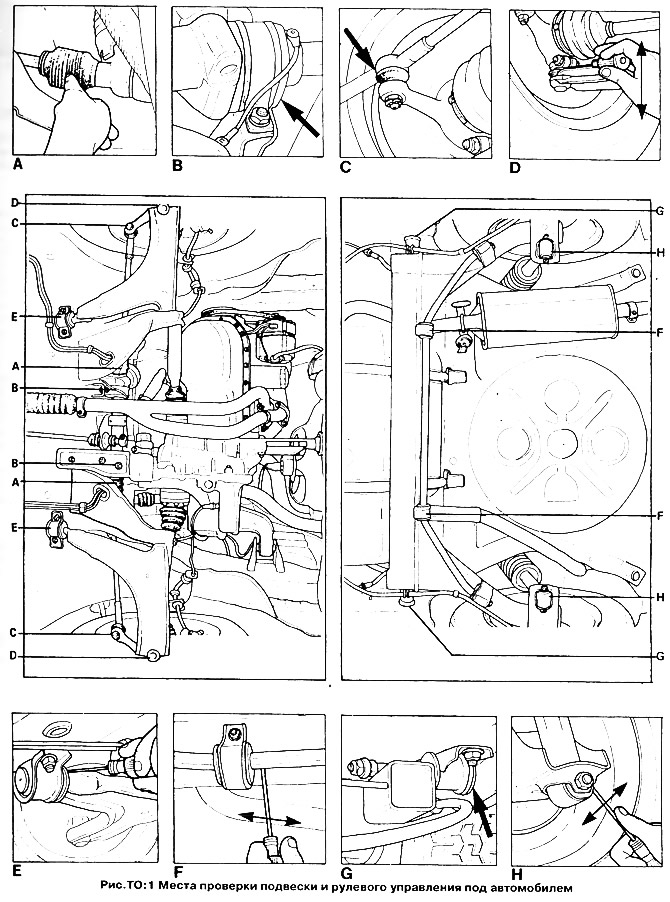
Check the condition of the rubber boots of the steering rack (A, drawing TO:1), ball joints and steering rod ends - there should be no cracks in the rubber or grease leaks. Check the tightness of the steering gear mounting bolts, as well as the condition of the steering rod joints (E, drawing TO: 1) — there should be no noticeable play in the hinges.
Front suspension
By placing the lever under the wheel (the car is on the ground), try to lift each wheel in turn, while simultaneously monitoring the relative movements of the lower suspension arm and the telescopic strut or steering knuckle. In addition, the presence of play in the ball joint can be checked by trying to move the lower arm and telescopic strut apart with a crowbar (B, drawing TO:1).
To check the condition of the lower control arm inner joint bushing, try to move the control arm relative to the suspension beam using a large screwdriver (C, drawing TO:1). Excessive play in the joint indicates wear or damage to the bushing, but minor elastic movement is acceptable. Check the tightness of the front suspension bolts and nuts, and check the anti-roll bar bushings (if available).
Rear suspension
Check the condition of the rear axle hinge bushings by pressing them away from the brackets on the body with a lever or a large screwdriver and simultaneously monitoring the relative movement of the body and the rear axle (H, drawing TO:1). A slight elastic movement is allowed, due to the natural elasticity of the rubber bushings, but excessive play indicates wear and tear of the bushing.
Check the tightness of the rear suspension bolts and nuts, as well as the condition of the rear suspension strut bushings (D, drawing TO:1).
Wheel hub bearings
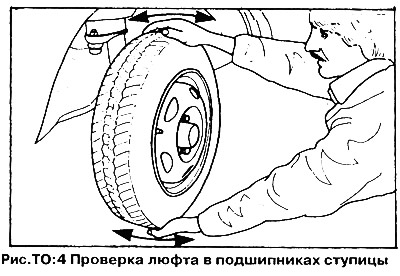
All wheels should rotate smoothly, without sticking or knocking (remember that sticking when turning the wheel can be caused by friction between the brake pads and the disc or drum). Grasp the wheel with both hands and try to rock it in different directions to feel the play in the hub bearing (drawing TO:4). If there is excessive play, the wheel will noticeably swing relative to the hub axis, and a characteristic knocking sound will be heard. Minor play in the hub is acceptable
Telescopic racks (shock absorbers)
Inspect the struts for any leaks of shock absorber fluid and for secure upper and lower mountings.
Suspension springs
Inspect the springs, looking for deep corrosion, cracks and wear on the spring support surfaces.
If the car constantly tilts to one side, it is possible that the corresponding spring is weakened. Remember that if one of the springs fails, both springs should be replaced at the same time (right and left).
Drive shafts
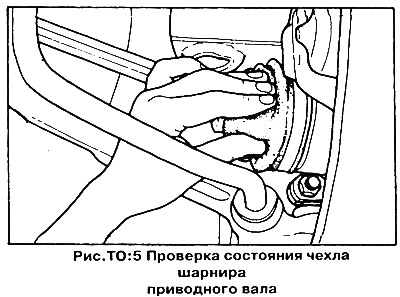
Inspect the rubber boots on the drive shaft joints (drawing TO:5) — there should be no cracks or grease leaks. Check the condition of the joints by trying to turn the drive shaft and the joint housing in different directions at the same time, observing their mutual movement. There should be no play in the joints of the drive shafts. Check the joints while the car is moving — wear of the outer joints can be determined by characteristic clicks when accelerating the car on a sharp turn. Check the reliability of the balancing weight on the right drive shaft of models with 1.0 and 1.3 l engines.
Brake pipes and handbrake cable
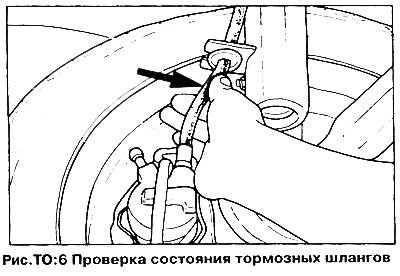
Inspect the brake lines and hoses (drawing TO:6). There should be no deep corrosion or mechanical damage to the tubes and hoses. Ask an assistant to press the brake pedal and check for internal damage to the brake hoses, noticeable by the characteristic swelling of the hose when the pedal is pressed. Carefully inspect the system for fluid leaks. Check the reliability of the tube fastening.
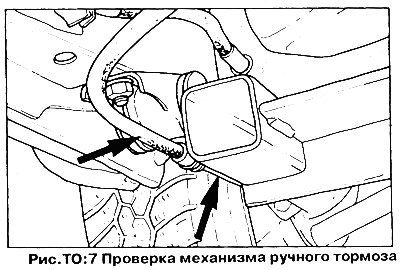
Inspect the handbrake cables. There should be no severe corrosion or mechanical damage on the cables. Check the condition of the equalizer and pulley (drawing TO:7). Check the ease of movement of the cable.
Exhaust system
Carefully inspect the entire length of the exhaust system to identify areas of severe corrosion and exhaust leaks, visible by black soot stains. Check the reliability of the rubber hangers, as well as the connecting clamps of the exhaust system (G, drawing TO:1).
Wheels and tires
Rotate each wheel and inspect the wheel rim and tire from all sides to assess the degree and uniformity of tread wear and to identify any possible damage.
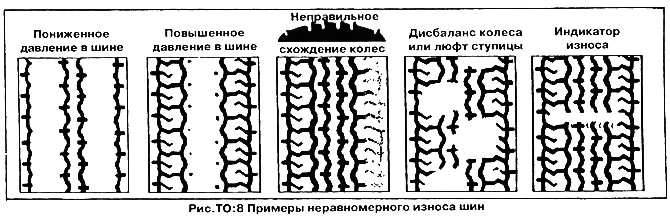
Causes of uneven wear may include incorrect tire pressure, wheel imbalance, wheel alignment issues due to wear or damage to suspension and steering components, and wear of hub bearings (drawing TO:8).
According to Russian regulations, tires must have a residual tread depth of at least 1.6 mm; there should be no damage on them that exposes the cord, as well as delamination of the frame, peeling of the tread and sidewall. Wheel disks and rims should not have cracks. In addition, if the car is equipped with diagonal tires at the same time as radial ones, it is recommended to install radial tires on the rear wheels, and diagonal ones on the front.
Body
Carefully inspect the body for mechanical damage and corrosion. Pay special attention to the attachment points of suspension units, side members and body sills, as well as seat belts - severe corrosion in these areas can make the car unsafe to operate.
Visitor comments