



Contents: Security measures ↓ What is the reason? ↓
Sooner or later, every motorist faces a situation when a car that seemed to be in perfect working order just yesterday suddenly stops starting or unexpectedly stalls on the road.
More than 50% of such cases are caused by electrical equipment faults. In addition, most faults usually occur in winter in areas with moderate and cold climates.
The information provided in this chapter will help you quickly and correctly identify the problem and fix it.
Security measures
A car stopped on the road poses a serious threat to traffic safety, so if your engine stalls while you are driving, you must first move the car off the road to a safe place, and if for some reason this is impossible, make it as visible as possible to other road users.
If you feel that the engine is stalling, try to immediately turn off the gear and use the inertia of the moving car to press against the sidewalk, pull over to the side of the road or, in extreme cases, onto the dividing strip (if it is wide enough). If this fails, be sure to first move the vehicle away from the middle of the road by any means necessary to protect yourself, your passengers, and the vehicle.
As soon as you feel a malfunction, turn on the hazard warning lights to warn other road users.
At night, do not turn off the parking lights and hazard warning lights so that the car parked on the road is clearly visible. Install an emergency stop sign on the road, which should be in the car at all times. Do not open the doors on the left side and move carefully next to the car - remember that you are not clearly visible.
What is the reason?
Once you have ensured the safety of yourself and others, try to find out the cause of the malfunction. Without panicking, carefully remember the order in which the symptoms of the malfunction appeared - this will help to assume the most likely cause. For example, if the engine stalled suddenly, then the most likely cause is an electrical malfunction, while fuel system malfunctions are usually accompanied by a gradual decrease in power and interruptions in engine operation.
In any case, troubleshooting is best done in a strict logical sequence. These pages offer a troubleshooting chart to help you quickly and correctly check. Of course, the fault may be caused by a system other than the engine (for example, a short circuit in the headlights or windshield wiper motor). In this case, refer to the chapters "ELECTRICAL EQUIPMENT" and "ENGINE ELECTRICAL EQUIPMENT".
View the original on the website VWmanual
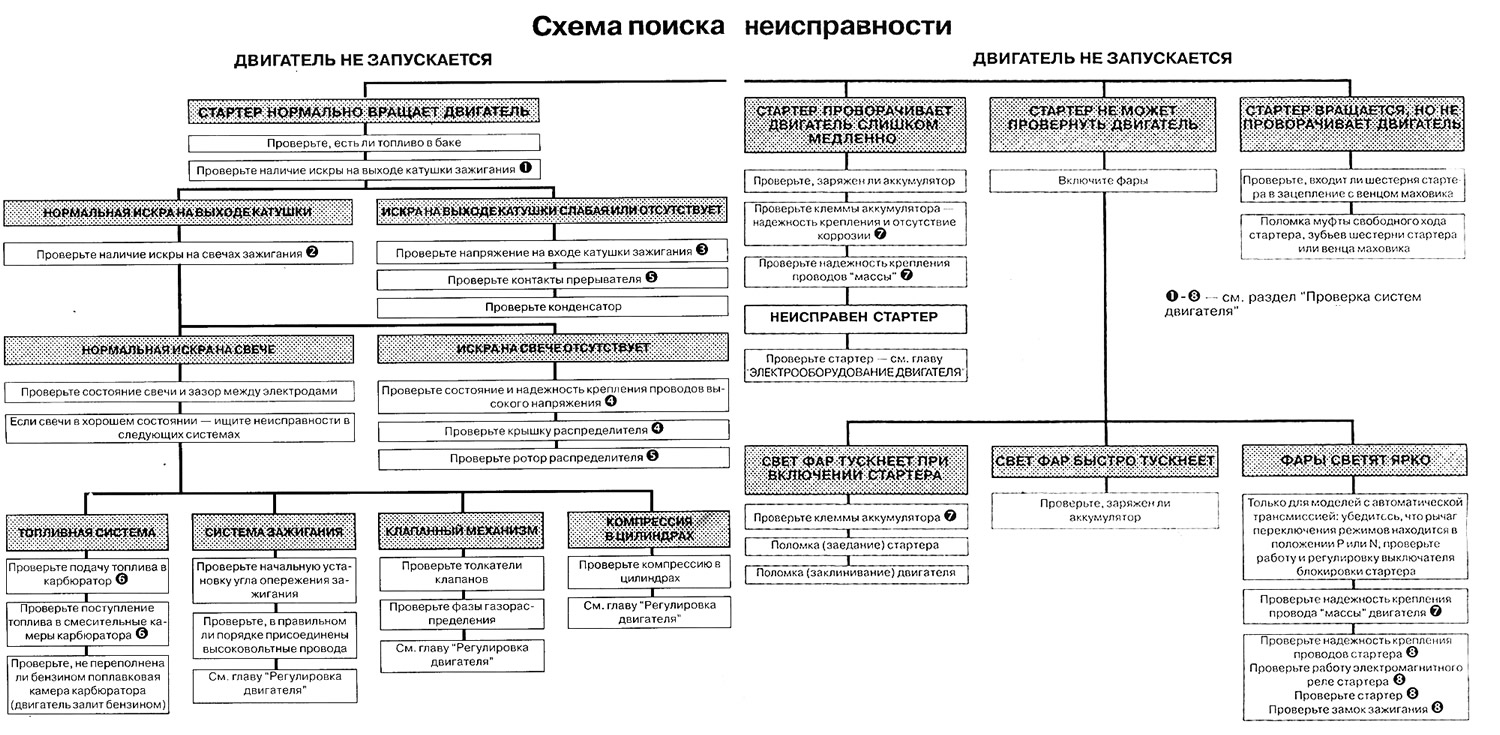
Схема поиска неисправностей
Visitor comments