



Contents: Outdoor lighting ↓ Sound signal ↓ Windscreen wipers ↓ Windshield, rear window and…↓ Steering ↓ Seat belts ↓ Wheels and tires ↓ Shock absorbers ↓ Brakes ↓ Upper suspension strut mounts ↓ Exhaust system ↓ Engine ↓ Body equipment ↓
Outdoor lighting
Check the operation of all outdoor lighting devices (low and high beam headlights, parking lights, direction indicators, brake lights, fog lights, etc.). The lamps should burn brightly - dim light from the lamps indicates corrosion of the reflector or unreliability of the electrical connections. Replace broken or opaque diffusers and corroded reflectors.
The direction indicators should flash correctly - one to two times per second. In addition, the side repeaters and the control lamp on the instrument panel should work.
The headlights must be adjusted correctly - the low beams should not blind oncoming drivers.
Sound signal
The horn should sound clear and strong. If the sound is weak or absent, check the electrical connections of the horn and steering column.
Windscreen wipers
The wiper blades should clean the glass effectively, without leaving spots or streaks. The presence of spots indicates wear of the rubber blades. The check should be carried out with the glass wet.
Windshield, rear window and headlight washers
The jet of washing fluid from each washer nozzle should be directed slightly below the upper edge of the glass or headlight. Add fluid to the washer reservoir. In cold weather, use a special low-freezing liquid for glass washers.
Steering
Grasp the steering wheel, placing your hands "at quarter to 3", and try to swing the wheel from side to side. Then place your hands on the steering wheel "for 6 hours" (drawing TO:2) and rock the wheel up and down. There should be no noticeable play in the shaft and steering wheel relative to the column, but a slight elastic movement of the steering column as a whole is allowed.
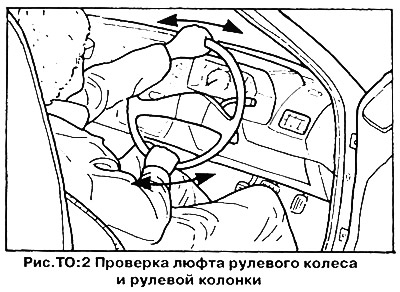
Turn the steering wheel vigorously from side to side at a small angle several times, paying attention to the amount of free play between the moments when the front wheels of the car begin to turn. The maximum allowable total play in the steering wheel should not exceed 12 mm on the steering wheel rim (Russian regulations, however, allow for a larger play of 10°).
Seat belts
According to the rules adopted in Russia, seat belts must be in working order and must not have visible tears on the strap.
Wheels and tires
According to Russian regulations, tires must have a residual tread depth of at least 1.6 mm; there should be no damage on them that exposes the cord, as well as delamination of the frame, peeling of the tread and sidewall. In addition, the tires must correspond to the car model in size and permissible load. Wheel disks and rims must not have cracks, and the wheel mounting bolts (nuts) must be securely tightened.
Also, check your tire pressure and adjust it to the correct level, as this may affect the brake test result.
Shock absorbers
Check the operation of the shock absorbers by pressing down hard and then releasing each corner of the car in turn. If the shock absorber is working properly, the car body will return to its normal position and stop there. If the body continues to swing up and down for some time, then the corresponding shock absorber is faulty.
Brakes
The parking (hand) brake must reliably lock the rear wheels when the lever is fully tightened. According to Russian regulations, the parking brake must hold the vehicle with a full load on a slope of up to 16%, and in an unladen condition - up to 23% inclusive.
Check that the handbrake lever is securely held in the tightened position by the locking mechanism and that the rear wheels are fully released when the lever is released. Make sure that the lever travel is not excessively large.
Check all pipes, the master cylinder and wheel brakes for traces of brake fluid - any leaks are unacceptable.
Check the operation of the servo amplifier, for which, with the engine not running, press the brake pedal, and then start the engine, holding the pedal pressed. When the engine starts, the pedal should move slightly downwards. While pressing the pedal, check your sensations. If the pedal is "soft", that is, the resistance smoothly increases as the pedal moves downwards, then this indicates the presence of air in the system, or an internal rupture of the brake hose (in this case, when the pedal is pressed, a characteristic swelling is noticeable on the hose). If the pedal "fails" (moves slowly or quickly to the floor with constant pressure), then there is a fluid leak in the system or the main brake cylinder is faulty. If the pedal "pumps up", i.e. meets normal resistance only on the second or third press, then this indicates excessive wear of the pads or improper adjustment of the wheel brake mechanisms.
Check the efficiency of the brakes while driving. When braking, the car should not pull to the side, and all wheels should brake simultaneously. The rules adopted in Russia define the braking distance for single passenger cars in running order as no more than 12.2 m when braking from a speed of 40 km/h on a road with a dry, clean and smooth asphalt concrete surface.
Upper suspension strut mounts
Check the strut mounts for cracks, damage, or excessive softening of the rubber. Check the bolts for tightness and examine the mount location and adjacent body parts for corrosion.
Exhaust system
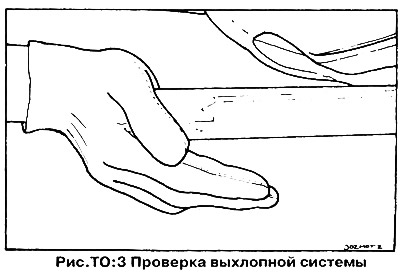
Start the engine and, having an assistant cover the exhaust pipe with a gloved hand (drawing TO:3), listen along the entire car (including under the hood) the presence of rattling or vibrating noises emitted by exhaust gases escaping through leaks.
Engine
According to the rules adopted in Russia, the content of harmful substances in exhaust gases and their smoke must not exceed the values established by the relevant GOSTs. The engine fuel system must be hermetically sealed, and the exhaust system must be in good working order.
Body equipment
According to the rules adopted in Russia, the equipment provided by the design of the car must be in good condition, including: rear-view mirrors, glass, door locks, fuel tank cap, driver's seat adjustment mechanism, speedometer, tachograph, anti-theft devices, glass heating and blowing devices, seat belts. In addition, a passenger car must have a first aid kit, a fire extinguisher and an emergency stop sign.
Visitor comments