



Contents: Fastening the B+ wire to the…↓ Checking the poly V-belt ↓ Poly V-belt running, 1.6L injection…↓ Poly V-belt running, 1.6L FSI engine ↓
The generator is the source of power supply for the car. When the engine is running, it supplies electricity to all units and charges the battery. A powerful three-phase synchronous generator is the power plant of your car. Even in idle mode, it supplies electricity to all consumers. In modern cars, the generator is capable of producing up to 2 kW of power. The generator is driven by a V-belt.
A three-phase generator produces three-phase alternating current. Since the battery must be recharged with direct current, powerful diodes convert alternating current into direct current.
Rectifiers also prevent the battery from discharging when parked. The generator requires virtually no maintenance. You can replace the generator brushes yourself after 100,000 km. In case of serious malfunction, take the generator for repair.
Fastening the B+ wire to the generator
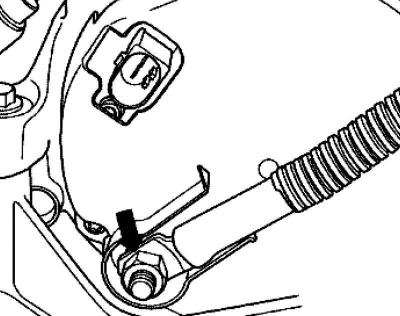
Fig. 7.7. B+ wire fastening nut
The tightening torque for the B+ wire fastening nut is found in the "Tightening Torques" table (Fig. 7.7).
Caution: If the B+ wire is not tightened with the correct tightening torque, the following risks exist:
Note: – the battery will not be fully charged.
Warning: – failure of the vehicle's electrical equipment and electronics may occur.
Caution: – there is a risk of fire due to possible sparking and damage to electronic components and control units due to overvoltage.
Checking the poly V-belt
Turn the engine at the vibration damper/belt pulley with a socket wrench.
Check the poly V-belt for the following damage:
- breaks in the carrier layer (tears, breaks in the middle, transverse breaks);
- peeling off of layers (top layer, working surface);
- torn parts of the carrier layer;
- wear of the working surface;
- edge wear (wear of material, frayed/sticking edges, hardening of edges, cracks in edges);
- traces of oil and grease.
Note: If any defects are found, be sure to replace the poly V-belt. This will prevent possible malfunctions and failure of some functions.
Poly V-belt running, 1.6L injection engine
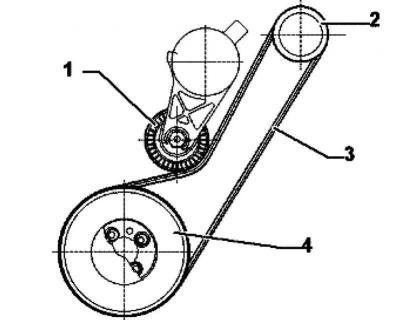
Fig. 7.8. Cars without air conditioning: 1 – tension roller; 2 – V-belt drive pulley – three-phase generator; 3 – poly V-belt; 4 – V-belt pulley – crankshaft
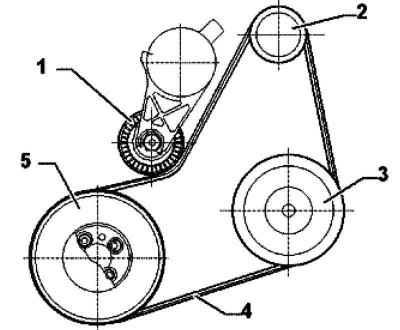
Fig. 7.9. Cars with air conditioning: 1 – tension roller; 2 – V-belt drive pulley – three-phase generator; 3 – poly V-belt pulley – air conditioning compressor; 4 – poly V-belt; 5 – V-belt pulley – crankshaft
Poly V-belt running, 1.6L FSI engine
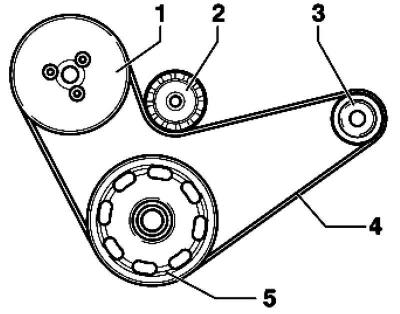
Fig. 7.10. Cars without air conditioning: 1 – V-belt pulley – cooling system pump; 2 – tension roller; 3 – V-belt drive pulley – three-phase generator; 4 – poly V-belt; 5 – V-belt pulley – crankshaft
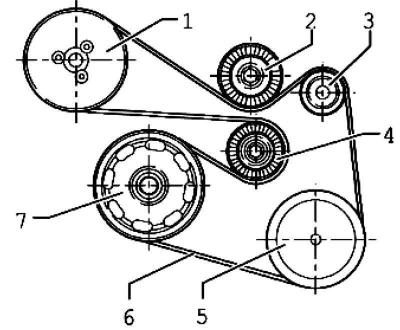
Fig. 7.11. Cars with air conditioning: 1 – V-belt pulley – cooling system pump; 2 – diverter roller; 3 – V-belt drive pulley – three-phase generator; 4 – tension roller; 5 – poly V-belt pulley – air conditioning compressor; 6 – poly V-belt; 7 – V-belt pulley – crankshaft
Visitor comments