
English Русский
Български
Беларускі
Український
Српски
Hrvatski
Română
Polski
Slovenský
Magyar
  |  Articles  |  Sitemap  |  Contacts  |    |
Car maintenance Ford Car maintenance Hyundai Car maintenance Chevrolet Car maintenance BMW Car maintenance Audi Car maintenance Opel Car maintenance AvtoVAZ
VWmanual.ru


Main   Passat   Golf   Polo   Touareg   Tiguan   Sharan   Transporter   Others  
Passat B2 (1981-1988) Passat B3 (1988-1993) Passat B4 (1988-1996) Passat B5 (1996-2005) Passat B6 (2005-2010)

Loss of air pressure in tires (VW Passat B6)

  • Main
  • Passat
  • Passat B6
  • Chassis
  • Wheels and tires
  • Loss of air pressure in tires
            0


Contents: Tire air pressure ↓ Slowly deflating a tire ↓ Rising tire temperature with…↓
Note: It is not recommended to repair radial steel cord tires that have carcass damage caused by a foreign object.


Note: Corrosion may occur on the steel wire. This will cause the rubber to separate from the steel cord.


Note: It is usually impossible to determine when a collision with a foreign object occurred. The result may be damage to the tire carcass due to driving with insufficient tire pressure.


Note: Damage to the cord wires will sooner or later result in the rubber separating from the steel cord. As a result, after some time, long after the initial damage occurred, irreparable damage to the tire may occur.


Tire air pressure


The air pressure in the tires should be checked regularly. It is recommended to check the tire pressure every 14 days. Particular attention should be paid to this issue when driving long distances or when the car is loaded. A sporty driving style also requires the correct tire pressure or even slightly higher.

Slowly deflating a tire


Slowly deflating a tire is a dangerous phenomenon, as even experienced drivers often fail to notice it.

Due to insufficient air pressure in the tire and the associated greater lateral deformation work (internal friction) the tire materials become so hot that peeling of various frame elements and rubber compounds cannot be ruled out.

The final stage is most often a completely destroyed tire.

The reason for the slow deflating of a tire cannot always be determined, as the tire ends up being badly damaged and often missing frame elements.


Rising tire temperature with insufficient pressure
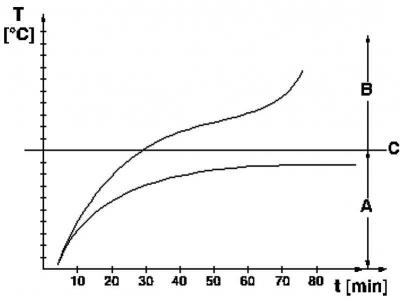


Fig. 4.25. Change in tire temperature at 180 km/h

Fig. 4.25. Change in tire temperature at 180 km/h


The graph shows the change in tire temperature at a speed of 180 km/h (Fig. 4.25).

A – Normal range. Bei Einhalten des vorgeschriebenen Luftdrucks bleibt die Temperatur im Gleichgewicht.

B – Danger zone. When the air pressure in the tire is less than 0.3 bar, the temperature rises to over 120°C at high speeds.

C – Critical temperature. Tire damage begins.

T – Temperature in°C.

t – Travel time in minutes.

This article is available at russian, bulgarian, belarusian, ukrainian, serbian, croatian, romanian, polish, slovak, hungarian
The text has been checked: Orlov Dmitry

Share information:

Previous articles
Radial tire construction
Tire damage
Eliminating lateral drift
Lateral vehicle pull
Minimization of mounted wheels
Radial and lateral runout of wheels and tires
Next articles
Tyre damage due to errors during tyre fitting (fitting damage)
Tyre sidewall markings
Wheel rotation
General provisions for wheel alignment (WAA) of the Passat
Front axle wheel alignment correction
Rear Axle Camber Adjustment


Similar articles from other manuals for VW cars:
Tires and checking tire pressure Golf 4 (1997-2004)
Checking oil pressure and oil pressure sensor Polo 3 (1995-2003)
Loss of air pressure in tires Touareg 1 (2002-2006)
Relieving pressure in the high pressure area of the fuel system Tiguan 1 (2007-2015)
Checking tire pressure Sharan 1 (1995-2000)
Checking the air pressure in the tires Transporter T4 (1990-2003)
Checking the wear status of tires Caddy 3 (2003-2010)
Link to this page in different formats


Visitor comments


No comments yet


How much will 29 + 16 =


Passat B6 
  • General information
  • User manual
  • Maintenance
  • Petrol engine 1.6L
  • Engine repair
  • Cooling and lubrication system
  • Fuel injection system
  • Petrol engine 2.0L
  • Engine repair
  • Lubrication system
  • Cooling system
  • Fuel and exhaust systems
  • Diesel engine 2.0L
  • Engine repair
  • Cooling and lubrication system
  • Fuel and exhaust systems
  • Transmission
  • Clutch
  • Mechanical gearbox
  • Automatic gearbox
  • Drive shafts
  • Chassis
  • Wheels and tires
  • Car suspension
  • Steering
  • Brake system
  • Body
  • Exterior (external elements)
  • Electrical equipment
  • Power devices
  • Lighting and appliances
  • Electrical circuits
Passat B5 
  • General information
  • User manual
  • Weekly checks
  • Maintenance
  • Power unit
  • Engine repair
  • Cooling system
  • Fuel system (petrol)
  • Fuel system (diesel)
  • Engine management
  • Exhaust system
  • Transmission
  • Clutch
  • Car gearbox
  • Drive shafts
  • Chassis
  • Car suspension
  • Wheels and tires
  • Steering
  • Brake system
  • Body
  • Exterior (external elements)
  • Interior (internal elements)
  • Doors and covers
  • Ventilation and heating
  • Electrical equipment
  • Power devices
  • Lighting and appliances
  • Electrical circuits
Passat B4 
  • General information
  • User manual
  • Maintenance
  • Technical data
  • 8-valve engine
  • Engine repair
  • Cooling and lubrication system
  • Supply system
  • Ignition system
  • Fuel injection «Mono-Jetronic»
  • Control system «Mono-Motronic»
  • Control system «Digifant»
  • Control system «Simos»
  • 16-valve engine
  • Engine repair
  • Cooling and lubrication system
  • Fuel injection «K-Jetronic»
  • Control system «KE-Motronic»
  • Control system «Digifant»
  • Diesel engine
  • Engine repair
  • Cooling and lubrication system
  • Power and control system
  • Turbocharging system
  • Digital control system
  • Transmission
  • Clutch
  • Manual gearbox
  • Hydromechanical gearbox
  • Front wheel drive
  • Chassis
  • Car suspension
  • Steering
  • Brake system
  • Body
  • Body elements
  • Electrical equipment
  • Power devices
  • Lighting and appliances
  • Electrical circuits
Passat B3 
  • General information
  • User manual
  • Driving Tips
  • Maintenance instructions
  • Technical data
  • Power unit
  • Engine repair
  • Ignition system
  • Lubrication system
  • Cooling system
  • Supply system
  • Petrol injection system
  • Diesel engine
  • Exhaust system
  • Transmission
  • Clutch
  • Car gearbox
  • Chassis
  • Suspension
  • Steering
  • Brake system
  • Wheels and tires
  • Body
  • Exterior
  • Interior
  • Heating system
  • Electrical equipment
  • Power devices
  • Lighting system
  • Equipment and devices
  • Wiper system
  • Electrical circuits
Passat B2 
  • General information
  • Introduction to instructions
  • User manual
  • Power unit
  • Engines 4-cylinder FZ
  • Engines 4-cylinder
  • Engines 5-cylinder
  • Transmission
  • Clutch
  • Four-speed gearbox
  • Five-speed gearbox
  • Hydromechanical gearbox
  • Front wheel drive
  • Chassis
  • Front suspension
  • Rear suspension
  • Steering
  • Brake system
  • Body
  • Body elements
  • Electrical equipment
  • Equipment and devices
  • Electrical circuits
VWmanual.ru © 2016-2026 | Mobile version | News and articles | Sitemap: EN BG BY UA RS HR RO PL SK HU | Write message | Site search
Passat B2 • Passat B3 • Passat B4 • Passat B5 • Passat B6 • Golf 1, diesel • Golf 1, petrol • Golf 2, petrol • Golf 2 • Golf 3 • Golf 4 • Golf 5 • Polo 3 • Polo 4 • Touareg 1 • Tiguan 1 • Sharan 1 • Transporter T3 • Transporter T4 • LT 28 • LT 2D • Beetle • Caddy 3 •
Our website uses cookies to ensure functionality and convenience.