
English Русский
Български
Беларускі
Український
Српски
Hrvatski
Română
Polski
Slovenský
Magyar
  |  Articles  |  Sitemap  |  Contacts  |    |
Car maintenance Ford Car maintenance Hyundai Car maintenance Chevrolet Car maintenance BMW Car maintenance Audi Car maintenance Opel Car maintenance AvtoVAZ
VWmanual.ru


Main   Passat   Golf   Polo   Touareg   Tiguan   Sharan   Transporter   Others  
Golf 1 (1974-1984, diesel) Golf 1 (1974-1984, petrol) Golf 2 (1984-1993, petrol) Golf 2 (1984-1993) Golf 3 (1991-1997) Golf 4 (1997-2004) Golf 5 (2003-2008)

Tires and checking tire pressure (VW Golf 4)

  • Main
  • Golf
  • Golf 4
  • General information
  • Weekly checks
  • Tires and checking tire pressure
            0


Contents: Checking the level of wear on tire…↓ Measuring the tread depth of a tire ↓ Checking tire pressure ↓ Types of tread wear ↓
Tires are the only parts of the car that are constantly in contact with the road, and even the combined contact surface of all tires is small. Therefore, it is necessary to regularly conduct a thorough inspection of tires, since both your own safety and the safety of other road users largely depends on the condition of the tires.

Regularly checking the condition of your tires will allow you to promptly detect intense wear and eliminate its cause, which will help avoid more serious consequences.

If there is uneven wear on the tires, it is necessary to find the cause and eliminate it.

Check the tires for cuts, punctures, and foreign objects in the tires. Air leaks from the tire can be identified using soapy foam.

Carefully inspect the inside sidewall of each tire for traces of brake fluid.

Proper tire pressure extends the life of your tires, so check it regularly. Check tire pressure only when your tires are cold.

Checking the level of wear on tire treads
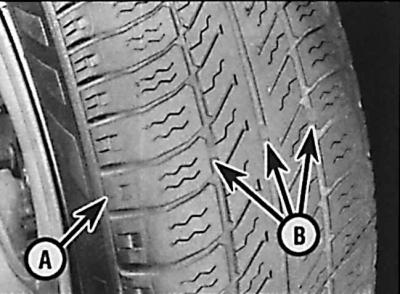


Checking the level of wear on tire treads


Wheel tyres must be replaced immediately if the special indicators (B) located at the bottom of the tread become level with the surface of the tyre tread due to wear. The position of the indicators is indicated by a triangular mark on the sidewall of the tyre (A).


Measuring the tread depth of a tire
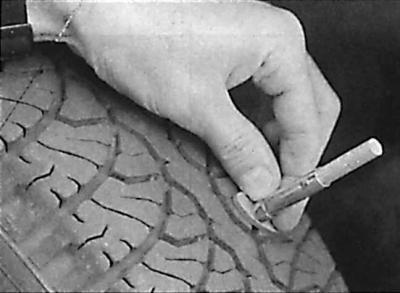


Measuring the tread depth of a tire


The depth of the tire tread pattern can be controlled with a special device. When the tire wear limit is reached, it must be replaced.

Checking tire pressure
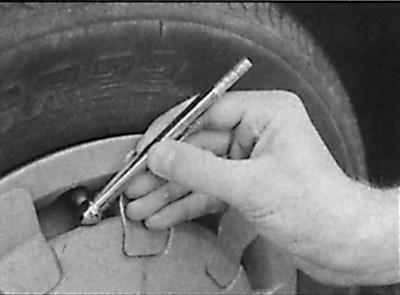


Checking tire pressure


Checking tire pressure is only done on cold tires. Optimal tire pressure increases tire life and vehicle performance.

Types of tread wear


Lateral tread wear
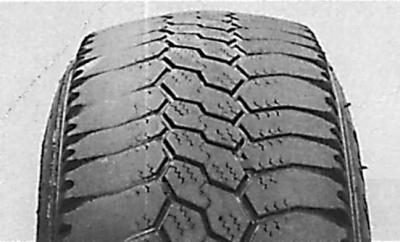
Lateral tread wear


Low tire pressure (wear on both sides). Low tire pressure leads to constant tire deformation and improper tire-to-road contact. This causes the tire cord to wear out significantly and reduces the tire's grip on the road surface. Overheating of the tire can also cause it to burst.


Incorrect camber angle (wear on one side). The suspension needs to be repaired.

Taking turns at high speed. It is necessary to reduce speed on turns.

Tread wear in the center
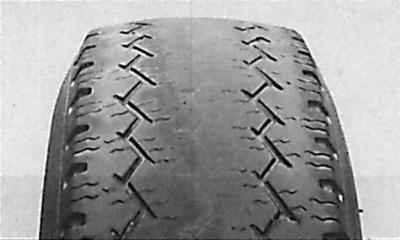
Tread wear in the center


High tire pressure. When the tire pressure is significantly higher than normal, intensive wear of the tread in the center of the tire occurs, the tire's grip on the road surface decreases, the tire does not absorb road irregularities, as a result of which all impacts are transmitted to the body and the likelihood of a tire rupture increases.

Check and adjust tire pressure to normal.

In some cases, it is necessary to increase the tire pressure, particularly when driving at high speeds or with a heavy load, but do not forget to bring the pressure up to the norm during normal operation of the car.

Uneven wear
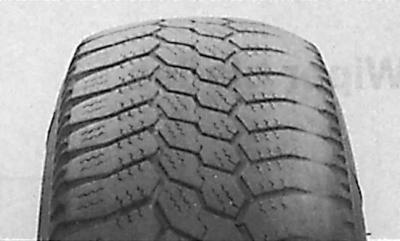
Uneven wear


The tires on the front wheels may wear unevenly due to wheel misalignment. In this case, it is necessary to adjust the wheel alignment angles.

Lateral tread wear. Balance the wheels.

This article is available at russian, bulgarian, belarusian, ukrainian, serbian, croatian, romanian, polish, slovak, hungarian
The text has been checked: Kolesnikov Artem

Share information:

Previous articles
Checking the battery
Checking the electrical system
Checking the brake fluid level
Checking the windshield washer fluid level
Checking the windshield wipers
Checking the coolant level
Next articles
Vehicle identification data


Similar articles from other manuals for VW cars:
Tires and checking tire pressure Passat B5 (1996-2005)
Checking tire inflation pressure Polo 4 (2001-2009)
Checking the radial and lateral runout of a rim with a tire… Touareg 1 (2002-2006)
Checking the fuel pressure regulator N276 Tiguan 1 (2007-2015)
Checking tire pressure Sharan 1 (1995-2000)
Checking the air pressure in the tires Transporter T4 (1990-2003)
Checking the wear status of tires Caddy 3 (2003-2010)
Link to this page in different formats


Visitor comments


No comments yet


How much will 13 + 29 =


Golf 5 
  • General information
  • User manual
  • Maintenance
  • Troubleshooting
  • Power unit
  • Engine repair
  • Cooling and ventilation system
  • Fuel system
  • Ignition system
  • Transmission
  • Clutch
  • Mechanical gearbox
  • Automatic gearbox
  • Chassis
  • Brake system
  • Car suspension
  • Steering
  • Body
  • Interior (internal elements)
  • Exterior (external elements)
  • Doors and covers
  • Electrical equipment
  • Power devices
  • Washers and wipers
  • Lighting and appliances
  • Electrical circuits
Golf 4 
  • General information
  • User manual
  • Weekly checks
  • Maintenance
  • Power unit
  • Petrol engines
  • Diesel engines
  • Cooling system
  • Fuel system (petrol)
  • Control system (petrol)
  • Fuel system (diesel)
  • Exhaust system
  • Transmission
  • Clutch
  • Car gearbox
  • Drive shafts
  • Chassis
  • Car suspension
  • Steering
  • Wheels and tires
  • Brake system
  • Body
  • Exterior (external elements)
  • Interior (internal elements)
  • Ventilation and heating
  • Car doors and sunroof
  • Washers and glass cleaners
  • Electrical equipment
  • Power devices
  • Lighting and appliances
  • Electrical circuits
Golf 3 
  • Petrol engine
  • Engine repair
  • Lubrication system
  • Cooling system
  • Ignition system
  • Diesel engine
  • Engine repair
  • Diesel injection system
  • Pre-glow system
  • Transmission
  • Clutch
  • Gearbox and drive shafts
  • Chassis
  • Steering
  • Wheels and suspension
  • Brake system
  • Electrical equipment
  • Lighting and appliances
  • Electrical circuits
Golf 2 
  • General information
  • Introduction to guide
  • User manual
  • Petrol engines 1.3 l
  • Engine repair
  • Lubrication system
  • Cooling system
  • Carburetors
  • Supply system
  • Ignition system
  • Petrol engines 1.6/1.8 l
  • Engine repair
  • Supply system
  • Ignition system
  • Diesel engines
  • Engine repair
  • Lubrication system
  • Cooling system
  • Power and exhaust system
  • Transmission
  • Clutch
  • 4-speed gearbox 084
  • 5-speed gearbox 085
  • 4-speed gearbox 020/4R
  • 5-speed gearbox 020/4T
  • Automatic gearbox
  • Drive shafts
  • Chassis
  • Steering
  • Car suspension
  • Brake system
  • Body
  • Body elements
  • Doors, locks and windows
  • Electrical equipment
  • Equipment and devices
  • Power devices
Golf 2 (petrol) 
  • General information
  • Characteristics
  • Car care
  • Maintenance
  • Power unit
  • Engine repair
  • Engine 1.05/1.30
  • Engine 1.60/1.80
  • Cooling and lubrication system
  • Power and exhaust system
  • Transmission
  • Clutch
  • Car gearbox
  • Drive shafts
  • Chassis
  • Brake system
  • Steering
  • Suspension
  • Body
  • Body and equipment
  • Electrical equipment
  • Lighting and appliances
  • Electrical circuits
Golf 1 (petrol) 
  • General information
  • Characteristics
  • User manual
  • Maintenance
  • Power unit
  • Engine adjustment
  • Engine 1.1/1.3
  • Engine 1.5/1.6/1.8
  • Engine electrical equipment
  • Cooling system
  • Fuel system
  • Transmission
  • Clutch and manual gearbox
  • Automatic gearbox
  • Chassis
  • Steering
  • Front suspension
  • Rear suspension
  • Brake system
  • Electrical equipment
  • Lighting and appliances
  • Electrical circuits
  • Body
  • Body and equipment
  • Optional equipment
Golf 1 (diesel) 
  • General information
  • Specifications
  • Maintenance
  • Power unit
  • Engine repair
  • Exhaust and turbocharger
  • Cooling system
  • Fuel system
  • Fuel injection system
  • Transmission
  • Clutch and drive shafts
  • Car gearbox
  • Chassis
  • Suspension and wheels
  • Steering
  • Brake system
  • Wheels and tires
  • Body
  • Heating and ventilation
  • Exterior (external elements)
  • Interior (internal elements)
  • Doors and windows
  • Electrical equipment
  • Equipment and devices
  • Lighting system
  • Power devices
  • Electrical circuits
VWmanual.ru © 2016-2026 | Mobile version | News and articles | Sitemap: EN BG BY UA RS HR RO PL SK HU | Write message | Site search
Passat B2 • Passat B3 • Passat B4 • Passat B5 • Passat B6 • Golf 1, diesel • Golf 1, petrol • Golf 2, petrol • Golf 2 • Golf 3 • Golf 4 • Golf 5 • Polo 3 • Polo 4 • Touareg 1 • Tiguan 1 • Sharan 1 • Transporter T3 • Transporter T4 • LT 28 • LT 2D • Beetle • Caddy 3 •
Our website uses cookies to ensure functionality and convenience.