



Lateral runout test
Pre-tension the tire dial indicator approximately 2mm.
Place the indicator against the sidewall of the tire (Fig. 4.15).
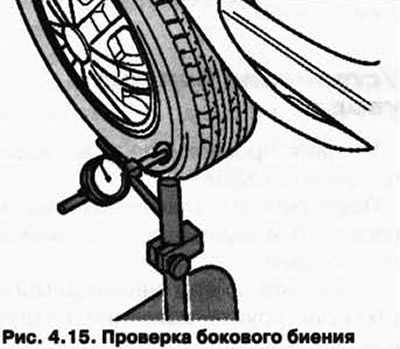
Spin the wheel slowly.
Record the minimum and maximum deflection of the arrow.
NOTE: If the difference is more than 1.3 mm, the lateral runout is considered excessive. In this case, it can be reduced by minimization. Deviations of the indicator needle due to small irregularities in the rubber should not be taken into account.
Checking the radial runout
Pre-tension the tire dial indicator by approximately 2 mm (Fig. 4.16).
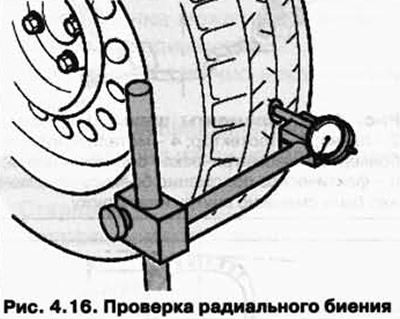
Place the indicator against the tire tread.
Spin the wheel slowly. Record the minimum and maximum deflection of the needle.
NOTE: If the difference is greater than 1 mm, the radial runout is considered excessive. In this case, it can be reduced by minimization.
Checking the radial and lateral runout of the wheel
Place the wheel on the balancing stand.
Use the collet self-expanding adapter for the VAS 5271 balancing stands.
Pre-tension the tire dial indicator approximately 2mm.
Spin the wheel slowly. Record the minimum and maximum deflection of the needle.
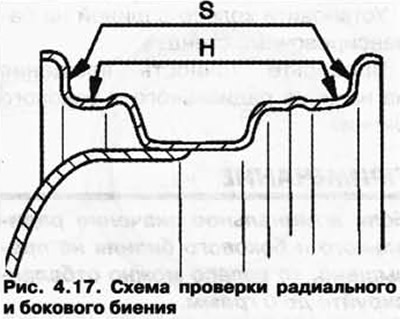
S - Lateral runout.
H - Radial runout.
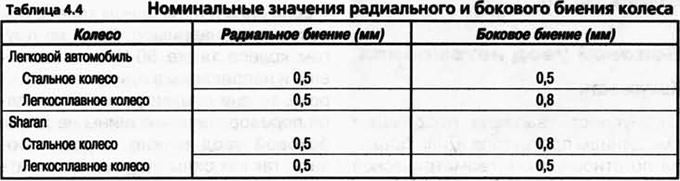
Compare the obtained value with the nominal parameters in Table 4.4.
NOTE: Deviations of the indicator needle due to small irregularities in the rubber should not be taken into account.
NOTE: If the measured value exceeds the nominal value, normal running smoothness cannot be achieved.
Visitor comments