



Contents: General instructions ↓ Radial tire construction ↓ Impact damage ↓ Internal damage to tire due to…↓
General instructions
Damage to tires can have serious consequences, so the driver and the vehicle service technician should regularly check their condition to detect possible defects early.
Tires with damage will not be able to withstand such road situations as high speed, long distances, sporty driving, etc.
Damage can be caused by various reasons.
Driving with under-inflated tires.
Error during tire fitting. Damage due to hitting an obstacle.
Aging.
Incorrect storage.
CAUTION: If a safety hazard cannot be ruled out, the tire must be replaced.
Radial tire construction
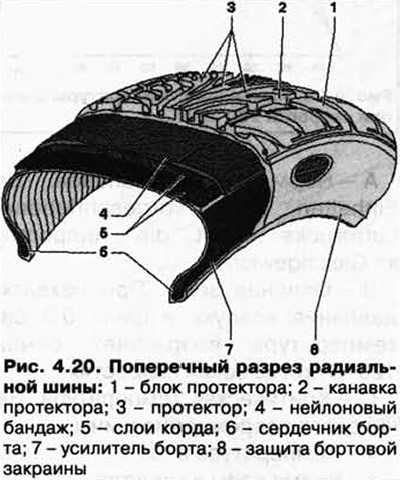
The nylon bandage 4, the cord layers 5, the bead cores 6 and the bead reinforcements 7 form the carcass. The carcass is the "load-bearing element" of the tire.
Impact damage
A bulge in the sidewall of the tire indicates damage to the carcass.
Typical "culprits" of such damage are, for example, curbs when driving over them at an acute angle (Fig. 4.21).
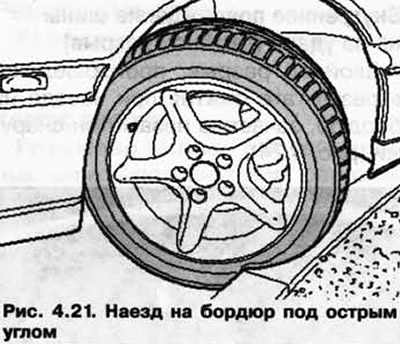
This can cause damage to the carcass of a tire that is compressed so much.
The tire carcass is then greatly stretched, which leads to the rupture of individual fibers.
The extent of damage depends on the speed and angle of impact, tire pressure, axle load and the type of obstacle.

NOTE: Driving over curbs should be avoided. If you must drive over a curb, drive over its edge at an obtuse angle and very slowly.
Due to the strong impact, the frame was pinched at the side edge and tore at the point of contact (Fig. 4.23).

Internal damage to tire due to impact (double break)
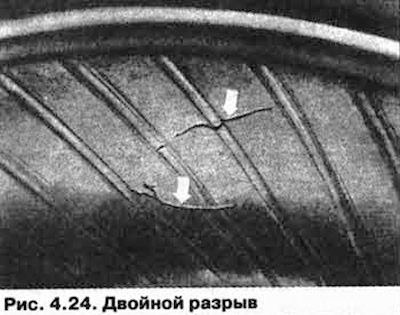
A double tear caused by compression when hitting a curb is often not visible from the outside (Fig. 4.24).
Visitor comments