



NOTE: Repairing steel cord radial tires that have carcass damage from a foreign object is not recommended. Corrosion may occur on the steel wire. This will cause the rubber to separate from the steel cord.
It is usually impossible to determine when the collision with a foreign object occurred. The result may be damage to the tire frame due to driving with insufficient tire pressure.
Damage to the cord wires will sooner or later lead to the rubber separating from the steel cord. As a result, after some time, much later than the initial damage occurred, the tire may become permanently damaged.
Tire air pressure
The air pressure in the tires should be checked regularly. It is recommended to check the tire pressure every 14 days. Particular attention should be paid to this issue when driving long distances or when the car is loaded. A sporty driving style also requires the correct tire pressure or even slightly more.
Slowly deflating a tire
Slowly deflating a tire is a very insidious phenomenon, as even experienced drivers often do not notice it.
Due to insufficient air pressure in the tire and the associated greater lateral deformation work (internal friction) the tire materials become so hot that peeling of various frame elements and rubber compounds cannot be ruled out.
The final stage is most often a completely destroyed tire.
The reason for the slow deflating of a tire cannot always be determined, as the tire ends up being badly damaged and often missing frame elements.
Rising tire temperature with insufficient pressure
The graph shows the change in tire temperature at a speed of 180 km/h (Fig. 4.25).
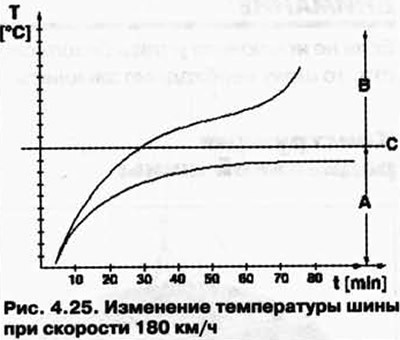
A - Normal range. Bei Einhalten des vorgeschriebenen Luftdrucks bleibt die Temperatur im Gleichgewicht.
B - Danger zone. When the air pressure in the tire is less than 0.3 bar, the temperature rises above 120°C at high speeds.
C - Critical temperature. Tire damage begins.
T - Temperature in°C.
t - Travel time in minutes.
Visitor comments