



Diagonal uneven tire wear
Diagonal spots of uneven wear run at an angle of approximately 45° relative to the circumferential direction of the tire (Fig. 4.10).
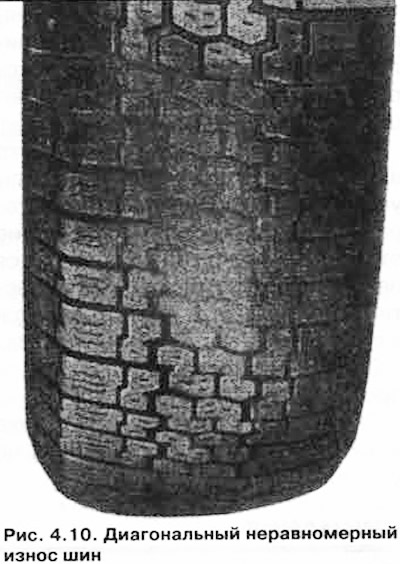
Most often, there is one such spot along the entire circumference of the tread, but sometimes there are several "worn spots".
These wear spots are found almost exclusively on non-drive tires, especially on the rear left. There are models of cars that often show this type of tire wear, and there are models that are completely free of such problems. This effect is amplified by strong toe-in. Toe-in values that are at the lower tolerance limit of the prescribed adjustments improve the wear characteristics.
The area of the most heavily worn diagonal spots often contains the joint between the tire elements.
Wheels with positive toe-in, even when moving in a straight line, roll with a lateral slip angle due to inertia. This leads to diagonal deformation in the contact zone of the tire with the road surface.
Driving with under-inflated tires will increase this type of wear. To avoid this type of wear, both rear wheels should be toe-in equally, and you should also make sure that your tires are properly inflated.
If uneven wear spots are found, it is recommended to install these wheels on the drive axle, provided that the wear is still in the early stages. Deeper uneven wear spots are incurable.
Adjustment error
If you are complaining about "diagonal spots of uneven wear", you should check the alignment. If the alignment is normal, then the cause is most likely in the tire itself.
Tires with diagonal spots of uneven wear caused by improper wheel alignment are not covered by the warranty.
The original text can be found at: VWmanual.ru
Visitor comments