



Contents: Increased lateral wear ↓ Negative toe-in ↓ Convergence or positive convergence ↓ Changes in the chassis ↓ Wear of the central part of the tread ↓ Increased tread wear ↓
The cause of one-sided wear in many cases is driving style, but sometimes also incorrect wheel alignment.
Increased lateral wear
Lateral wear, most often in combination with abrasions on the tread edges and thin cuts, always occurs when tires operate at an extremely large lateral slip angle and therefore "rub" along the road surface (Fig. 4.6).
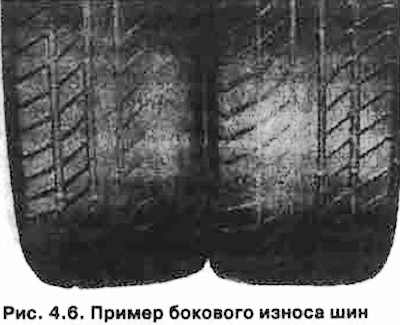
Driving fast on sections with many turns will result in increased wear, especially on the outer shoulders of the tyre.
The rounded outer shoulder of the tire, together with the high degree of wear of the outer tread blocks, indicates fast driving in bends. Such wear occurs due to the corresponding driving style.
To optimize driving characteristics, the chassis is adjusted to specific wheel alignment and camber parameters. If the tires are used under conditions other than the specified ones, one-sided and increased wear must be taken into account.
Particularly incorrect RUUK parameters can lead to greater one-sided wear, in addition to which the risk of uneven wear increases.
Negative toe-in
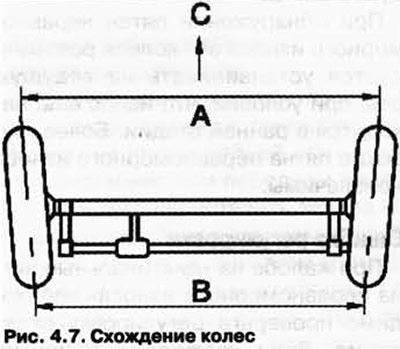
The distance between the wheels in front - A is greater than the distance B in the back (With direction of movement).
Convergence or positive convergence
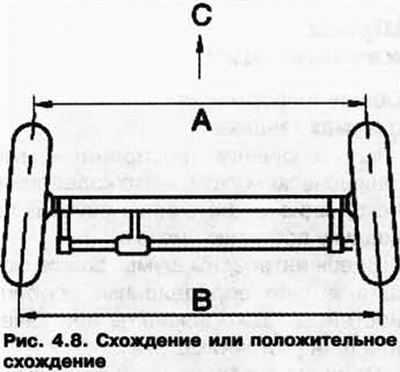
The distance between the wheels at the front A is less than the distance B at the rear (With direction of movement).
To avoid one-sided tire wear, it is necessary to ensure that the wheel alignment angles are always within the tolerance of the car manufacturer. Most often, the wheel alignment angles deviate from the nominal parameters due to external influences, such as hard contact with the curb when parking.
With RUUK it is possible to determine whether the wheel alignment angles are within tolerance or whether they need to be adjusted.
Changes in the chassis
The use of a "lowering spring kit" and/or alloy wheels not approved by VW may result in wheel alignment angles that differ from those intended by design.
Even if the wheel alignment angles are normal during the RUUK with the vehicle stationary, the change in wheel height and position during movement may cause the movement pattern of the wheel suspension to change.
Thus, uneven wear is pre-programmed.
Wear of the central part of the tread
This type of wear is seen on the drive wheels of vehicles with powerful engines that often travel long distances at high speed.
At high speeds, the tire diameter increases in the middle of the tread more than at the edges due to centrifugal force. As a result, the driving force is transferred to the road surface from the middle part of the tread. This fact is reflected in turn in the nature of wear.
This wear is especially noticeable on wide tires.
Reducing the air pressure in the tires will not prevent such wear.
CAUTION: For safety reasons, the tire pressure should never be reduced below the specified pressure.
[View the original on this portal: VWMANUAL]
More or less uniform wear can be achieved by timely rearranging the wheels from the drive axle to the non-drive axle.
Increased tread wear
A typical picture of tire wear on the drive wheels of a car with a powerful engine (Fig. 4.9).
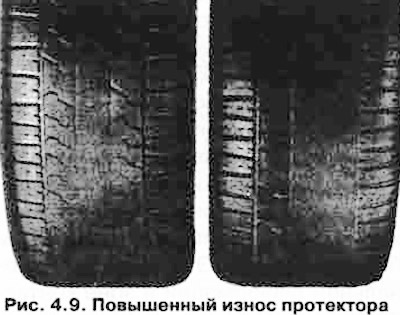
Greater wear in the middle part of the tire tread is a result of the loads caused by the centrifugal force of the tire and the transmission of driving force to the road surface.
Visitor comments