
English Русский
Български
Беларускі
Український
Српски
Hrvatski
Română
Polski
Slovenský
Magyar
  |  Articles  |  Sitemap  |  Contacts  |    |
Car maintenance Ford Car maintenance Hyundai Car maintenance Chevrolet Car maintenance BMW Car maintenance Audi Car maintenance Opel Car maintenance AvtoVAZ
VWmanual.ru


Main   Passat   Golf   Polo   Touareg   Tiguan   Sharan   Transporter   Others  
Golf 1 (1974-1984, diesel) Golf 1 (1974-1984, petrol) Golf 2 (1984-1993, petrol) Golf 2 (1984-1993) Golf 3 (1991-1997) Golf 4 (1997-2004) Golf 5 (2003-2008)

New Tires: Lifespan, Wear and Replacement (VW Golf 2)

  • Main
  • Golf
  • Golf 2
  • General information
  • Car care
  • New Tires: Lifespan, Wear and Replacement
            0


Contents: Tire life ↓ Wheel and tire replacement ↓
New tires have a fairly high slip coefficient and do not provide full traction on the ground at first.

Caution: In order to avoid losing control of the vehicle with new tires installed on it, drive at reduced speeds during the first 160 kilometers of the run, taking special care.


Tire life


The lifespan of your vehicle's tires depends primarily on the following factors.

Tire pressure

The required cold tire inflation pressure is marked on the inside of the fuel filler flap or on the driver's side door frame lock trim

Caution: Failure to maintain the correct tire pressure will result in increased tire wear, adversely affecting vehicle handling, and may ultimately result in injury.

Failure to maintain proper tire pressure may also result in unexpected tire deflation, which may result in an accident or injury.

Low tire pressure contributes to increased fuel consumption, which leads to increased environmental pollution.


Tire pressure should be checked at least once a month and always before a long trip.

Tire pressure is an extremely important factor, especially when driving at higher speeds.

Always check the pressure when the tires are cold. If the tires are warm, the tire pressure will be higher. Do not reduce the pressure when the tires are warm.

Don't forget to check the spare tire. The air pressure value in the tire tube is marked on the sidewall of the tire.

Check the tire pressure with an accurate pressure gauge. Do not exceed the maximum pressure in the studs, the value of which is marked on their side surfaces (air pressure in a cold tire chamber, pressure in the tires of a vehicle that has been stationary for at least 3 hours or has traveled no more than 1 km).


After checking the tire pressure, remember to replace the valve stem caps.

Driving techniques

Fast turns, increased acceleration, and sharp braking of the car contribute to accelerated wear of tires.

Wheel balancing

When turning the car, the wheels are balanced. However, various factors during the movement of the car lead to imbalance of the wheels, a sign of which is the presence of vibration of the steering mechanism. Due to the fact that unbalanced wheels can cause wear of the steering mechanism, suspension and tires, it is necessary to re-balance. After installing a new or old repaired tire, it is imperative to balance the wheel.

Incorrect wheel alignment


Incorrect wheel alignment will result in increased and uneven tyre wear, which will adversely affect vehicle safety. If you notice signs of tyre wear, contact your Volkswagen dealer.

Tire wear


Your car's original tires have built-in wear indicators. They are located at the bottom of the tread groove and are stripes of approximately 12 mm in size, with wear of the tread pattern up to 1.6 mm in depth. Depending on the manufacturer, the tire may have six to eight indicators located around its circumference.

Markings on the sidewalls of the tires (for example, in the form of a triangle or the letters "TWI") show the location of the wear indicators.
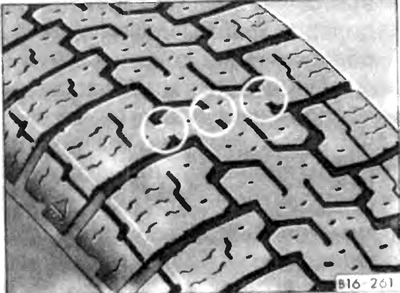
Markings on the sidewalls of the tires (for example, in the form of a triangle or the letters…


When indicators appear in two or more adjacent grooves, the tires must be replaced. However, it is not recommended to allow tires to wear to such an extent. Worn tires do not provide sufficient grip on the road surface, which is even lower on wet roads.


Caution: Do not operate the vehicle with worn, cut or damaged tires to avoid unexpected tire deflation, which may result in loss of control and injury.

Since worn tires do not provide adequate grip on wet road surfaces, the vehicle may be prone to hydroplaning (wheel slip during braking). It is strongly recommended to replace tyres when the remaining tread depth reaches 3 mm.


Tire rotation

If the wear of the front tires is higher than that of the rear tires, it is recommended to swap them as shown in the figure. This will ensure that all tires have approximately the same service life.
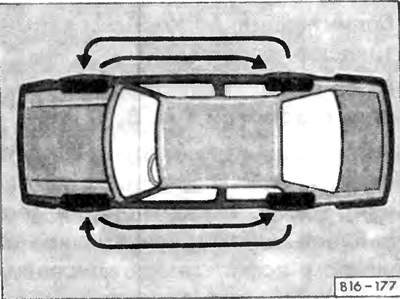
If the wear of the front tires is higher than that of the rear tires, it is recommended to swap…


It is necessary that tire rotation be carried out only on one side of the vehicle.

Diagonal tire rotation is only permitted in the event of abnormal tire wear, such as edge wear. In case of doubt, consult your Volkswagen dealer.

After completing the tire rotation, adjust the pressure in the tubes and tighten the wheel mounting bolts diagonally to the specified torque of 110 Nm.

Wheel and tire replacement


Wheels and tires certified by the manufacturer are specially selected for your vehicle and largely correspond to its traction properties and handling characteristics.

  • Installing and repairing tires requires special knowledge and tools. It is necessary that such work be carried out by a specialist who is provided with special tools and can conduct the necessary examination.

Your Volkswagen dealer has a large selection of spare tires and wheels.
  • For safety reasons, tires should be changed in pairs. Tires with deeper tread should always be installed on the front wheels.
  • Never install previously used tires unless you know the reason for their removal.
  • When replacing a tubeless tire, be sure to install a new valve cover. It is important that tire repairs are performed by a specialist only.
  • In the interests of maximum safety and best driving conditions, it is mandatory to purchase radial tires for replacement that have the same technical characteristics in terms of tire size, design, permissible load, speed, tread pattern, tread depth, etc.

Make sure that the new tires also comply with the specifications marked on the inside of the fuel filler flap or on the driver's side door frame lock trim.

This article is available at russian, bulgarian, belarusian, ukrainian, serbian, croatian, romanian, polish, slovak, hungarian
The text has been checked: Semenova Anna

Share information:

Previous articles
Tire (wheel) care
Replacing windshield wiper blades
Windshield Cleaning Solution Tank
Battery care
Caring for brake fluid in a car
V-profile belt
Next articles
Technical characteristics of the tire
Tires used in winter
Driving a car in difficult operating conditions
Driving in winter
Additional accessories, modifications and replacement of components and assemblies


Similar articles from other manuals for VW cars:
Checking the condition, wear pattern, pressure, and tread depth… Passat B6 (2005-2010)
Brakes/tires/wheels Polo 4 (2001-2009)
Wheels and tires Touareg 1 (2002-2006)
Brake pad wear indicator, instrument cluster, immobilizer… Tiguan 1 (2007-2015)
Brakes, tires, wheel rims Transporter T4 (1990-2003)
Checking the wear status of tires Caddy 3 (2003-2010)
Link to this page in different formats


Visitor comments


No comments yet


How much will 50 + 18 =


Golf 5 
  • General information
  • User manual
  • Maintenance
  • Troubleshooting
  • Power unit
  • Engine repair
  • Cooling and ventilation system
  • Fuel system
  • Ignition system
  • Transmission
  • Clutch
  • Mechanical gearbox
  • Automatic gearbox
  • Chassis
  • Brake system
  • Car suspension
  • Steering
  • Body
  • Interior (internal elements)
  • Exterior (external elements)
  • Doors and covers
  • Electrical equipment
  • Power devices
  • Washers and wipers
  • Lighting and appliances
  • Electrical circuits
Golf 4 
  • General information
  • User manual
  • Weekly checks
  • Maintenance
  • Power unit
  • Petrol engines
  • Diesel engines
  • Cooling system
  • Fuel system (petrol)
  • Control system (petrol)
  • Fuel system (diesel)
  • Exhaust system
  • Transmission
  • Clutch
  • Car gearbox
  • Drive shafts
  • Chassis
  • Car suspension
  • Steering
  • Wheels and tires
  • Brake system
  • Body
  • Exterior (external elements)
  • Interior (internal elements)
  • Ventilation and heating
  • Car doors and sunroof
  • Washers and glass cleaners
  • Electrical equipment
  • Power devices
  • Lighting and appliances
  • Electrical circuits
Golf 3 
  • Petrol engine
  • Engine repair
  • Lubrication system
  • Cooling system
  • Ignition system
  • Diesel engine
  • Engine repair
  • Diesel injection system
  • Pre-glow system
  • Transmission
  • Clutch
  • Gearbox and drive shafts
  • Chassis
  • Steering
  • Wheels and suspension
  • Brake system
  • Electrical equipment
  • Lighting and appliances
  • Electrical circuits
Golf 2 
  • General information
  • Introduction to guide
  • User manual
  • Petrol engines 1.3 l
  • Engine repair
  • Lubrication system
  • Cooling system
  • Carburetors
  • Supply system
  • Ignition system
  • Petrol engines 1.6/1.8 l
  • Engine repair
  • Supply system
  • Ignition system
  • Diesel engines
  • Engine repair
  • Lubrication system
  • Cooling system
  • Power and exhaust system
  • Transmission
  • Clutch
  • 4-speed gearbox 084
  • 5-speed gearbox 085
  • 4-speed gearbox 020/4R
  • 5-speed gearbox 020/4T
  • Automatic gearbox
  • Drive shafts
  • Chassis
  • Steering
  • Car suspension
  • Brake system
  • Body
  • Body elements
  • Doors, locks and windows
  • Electrical equipment
  • Equipment and devices
  • Power devices
Golf 2 (petrol) 
  • General information
  • Characteristics
  • Car care
  • Maintenance
  • Power unit
  • Engine repair
  • Engine 1.05/1.30
  • Engine 1.60/1.80
  • Cooling and lubrication system
  • Power and exhaust system
  • Transmission
  • Clutch
  • Car gearbox
  • Drive shafts
  • Chassis
  • Brake system
  • Steering
  • Suspension
  • Body
  • Body and equipment
  • Electrical equipment
  • Lighting and appliances
  • Electrical circuits
Golf 1 (petrol) 
  • General information
  • Characteristics
  • User manual
  • Maintenance
  • Power unit
  • Engine adjustment
  • Engine 1.1/1.3
  • Engine 1.5/1.6/1.8
  • Engine electrical equipment
  • Cooling system
  • Fuel system
  • Transmission
  • Clutch and manual gearbox
  • Automatic gearbox
  • Chassis
  • Steering
  • Front suspension
  • Rear suspension
  • Brake system
  • Electrical equipment
  • Lighting and appliances
  • Electrical circuits
  • Body
  • Body and equipment
  • Optional equipment
Golf 1 (diesel) 
  • General information
  • Specifications
  • Maintenance
  • Power unit
  • Engine repair
  • Exhaust and turbocharger
  • Cooling system
  • Fuel system
  • Fuel injection system
  • Transmission
  • Clutch and drive shafts
  • Car gearbox
  • Chassis
  • Suspension and wheels
  • Steering
  • Brake system
  • Wheels and tires
  • Body
  • Heating and ventilation
  • Exterior (external elements)
  • Interior (internal elements)
  • Doors and windows
  • Electrical equipment
  • Equipment and devices
  • Lighting system
  • Power devices
  • Electrical circuits
VWmanual.ru © 2016-2026 | Mobile version | News and articles | Sitemap: EN BG BY UA RS HR RO PL SK HU | Write message | Site search
Passat B2 • Passat B3 • Passat B4 • Passat B5 • Passat B6 • Golf 1, diesel • Golf 1, petrol • Golf 2, petrol • Golf 2 • Golf 3 • Golf 4 • Golf 5 • Polo 3 • Polo 4 • Touareg 1 • Tiguan 1 • Sharan 1 • Transporter T3 • Transporter T4 • LT 28 • LT 2D • Beetle • Caddy 3 •
Our website uses cookies to ensure functionality and convenience.