



Caution: Never mix tires of different construction types, such as a steel-cord radial tire with a bradial-cord tire, etc. Using different types of tires at the same time will adversely affect the vehicle's directional stability and may result in loss of control over the vehicle and injury to passengers.
Knowing what each tire designation means will make it easier for you to choose the right tire type. Radial tires have the following designations:
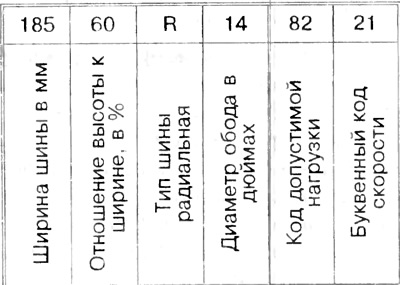
The speed letter code indicates the maximum speed allowed (for summer tires):
- S - up to 180 km/h
- T - up to 190 km/h
- H - up to 210 km/h
- V - up to 240 km/h
- Z - over 240 km/h
On "Z" tires, next to the letter speed code there is a letter designation of the tire type "R".
Caution: Never drive your vehicle at speeds exceeding the maximum speed rating for the tires fitted to it.
Exceeding the maximum permitted speed will result in tire damage, which in turn will result in loss of control of the vehicle and injury to passengers.
Never exceed the speed limit and prepare your vehicle to operate in real road conditions.
The date of manufacture of the tire is also indicated on its wall (or only on the inner surface of the wheel):...121... - means that the tire was manufactured in the 12th week of 1991.
The durability and performance of tires deteriorate over time, even if they have not been used. Direct tire manufacturers warn that tires manufactured more than six years ago are not guaranteed to be reliable under normal operating conditions.
Caution: Old tires may fail while driving, resulting in loss of vehicle control and possible injury.
Replace your tires every six years, regardless of the amount of tread wear. If, under extraordinary circumstances, you are forced to use old tires, drive with extreme caution at low speeds.
Tread wear
The degree of tread wear is a relative indicator based on the intensity of tire wear. For example, a tire marked 150 will be 1.5 times more resistant to wear than a tire marked 100. In any case, the relative performance of tires depends on the actual conditions of their use and can deviate significantly from the norm depending on the driver's driving style, adherence to the maintenance schedule, road and climate conditions.
Tire traction force - A, B, C
Three degrees of adhesion are established: A, B, C (in descending order), which characterize the tire's ability to brake on wet asphalt based on measurements taken at a state testing station with asphalt or concrete pavement.
A tire marked C has the weakest grip on the road surface. The degree of grip is determined by the results of a test when braking a vehicle moving straight ahead.
Temperature levels A, B, C
Temperature levels A (the highest), B and C determine the resistance of the tire to heat generation. Constant heating of the tire to high temperatures reduces its service life and creates conditions for its sudden failure. The temperature level corresponds to the operation of a vehicle that meets the federal safety standard No.109 for mobile vehicles. Levels B and A correspond to higher gradations than the minimum established by law.
Caution: Temperature levels are set for tires that are inflated to the proper pressure and are not subject to overload. Overspeeding, underinflation, or overloading (one wheel or several) tires can cause them to overheat and fail, which in turn will lead to loss of vehicle control and injury to passengers.
If you intend to fit your vehicle with tyres of a different type than those fitted at the factory, please note the following:
- For technical reasons it is not possible to use wheels from other cars in every case - under certain circumstances wheels may not be the same even on cars of the same model.
- Wheel rims and mounting bolts are selected for all types of Volkswagen vehicles.
- When installing different types of wheels (for example, wheels with tires for use in winter) it is necessary to use bolts of the appropriate conical shape and length, since the reliability of the wheel fastening and the performance of the braking system depend on this.
- If you are planning to replace steel wheels with light alloy wheels or winter tyres pre-mounted on rims, first consult your Volkswagen dealer. They have all the technical information on using wheel rims and mounting bolts compatible with those fitted at the factory.
Caution: Using tires, rims and mounting bolts that do not meet the technical requirements of the manufacturer will adversely affect the safety of the vehicle and may lead to an accident and injury to passengers.
If your car is equipped with BBS wheels made of light alloys (unified wheels), then to avoid bleeding air, never loosen the bolts that secure the two wheel components together. This could result in loss of control of the vehicle and injury to passengers!
When installing decorative caps or a front spoiler, make sure that the air flow for cooling the brakes is not obstructed while the vehicle is moving.
Visitor comments